
One of the most essential verbs in Spanish is estar. While it’s often translated as \"to be,\" its use differs significantly from its counterpart ser, and misusing them can lead to confusion or unnatural speech. Unlike ser, which expresses permanent or inherent qualities, estar focuses on temporary states, conditions, locations, and emotions. Mastering estar isn’t just about memorizing conjugations—it’s about understanding context, nuance, and real-life application.
Whether you're describing how you feel today, where an object is located, or your current emotional state, estar plays a central role. This guide breaks down its correct usage with practical examples, common pitfalls, and actionable strategies to help you use estar confidently and accurately.
Understanding the Core Function of Estar
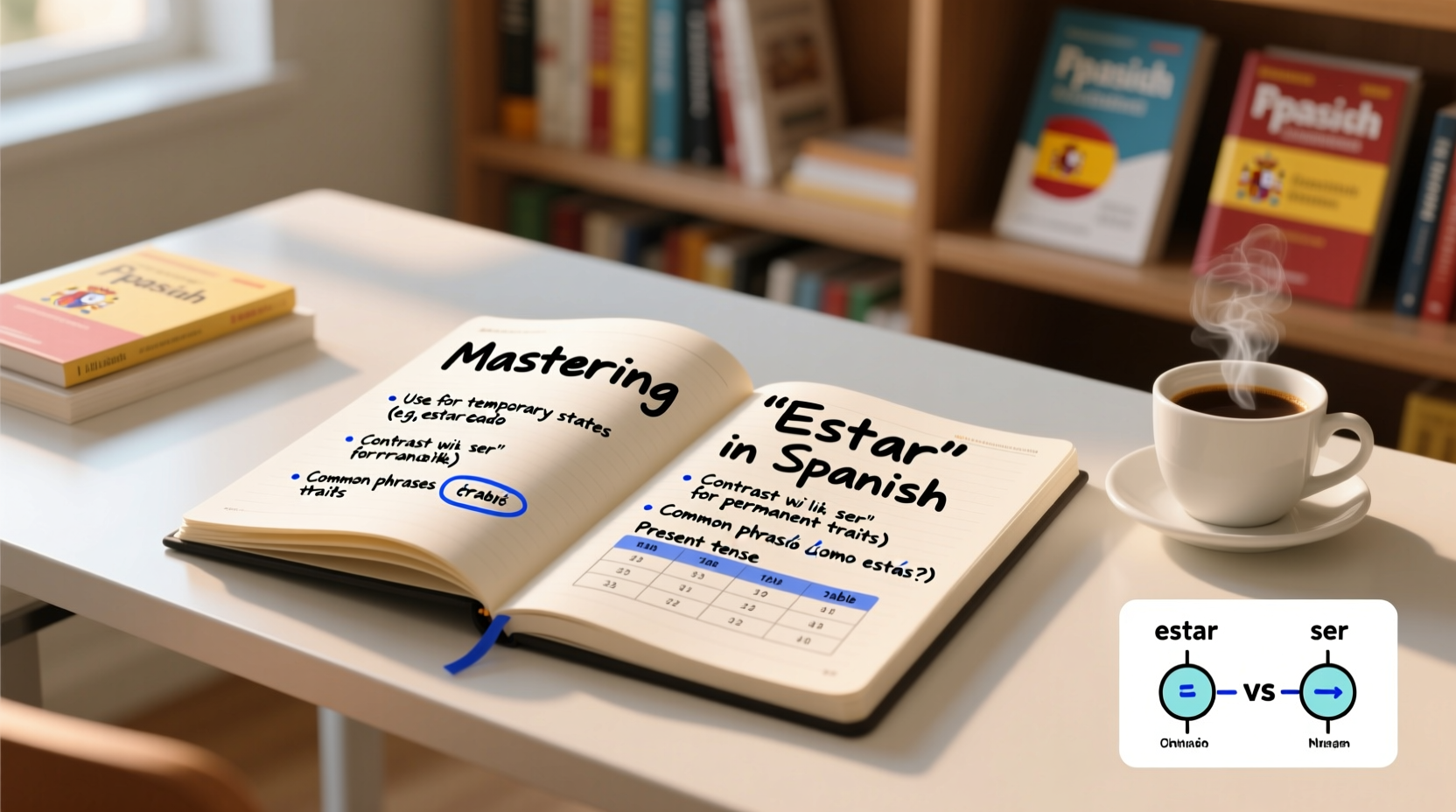
Estar is primarily used to indicate temporary conditions. It answers questions like “Where is it?” “How does someone feel?” or “What is the current situation?” Its conjugation changes based on subject, but the underlying logic remains consistent: describe what is true now, not necessarily forever.
For example:
- Estoy cansado. (I am tired.) — A temporary physical state.
- La llave está en la mesa. (The key is on the table.) — A specific location.
- Estamos felices con el resultado. (We are happy with the result.) — An emotional response.
The key distinction between ser and estar lies in permanence. For instance, saying soy alto (I am tall) uses ser because height is considered a lasting trait. But estoy aburrido (I am bored) uses estar because boredom is fleeting.
“Misusing ser and estar is one of the most common errors among learners, but mastering this difference instantly elevates fluency.” — Dr. Rafael Méndez, Linguistics Professor at Universidad Complutense de Madrid
Common Contexts Where Estar Is Required
To use estar correctly, you must recognize the situations that demand it. Below are the primary categories where estar is the only grammatically correct choice.
1. Location of People and Objects
Anytime you’re talking about where something or someone is physically located, use estar.
- El libro está debajo del sofá. (The book is under the sofa.)
- ¿Dónde está María? Está en la cocina. (Where is María? She’s in the kitchen.)
2. Temporary Emotional or Physical States
Feelings, health, and momentary conditions are expressed with estar.
- Estoy nervioso antes del examen. (I’m nervous before the exam.)
- Mi abuelo está enfermo esta semana. (My grandfather is sick this week.)
3. Progressive Tenses (Ongoing Actions)
Estar forms the backbone of the present progressive (estar + gerund).
- Estoy estudiando para el test. (I am studying for the test.)
- Ellas están bailando en la fiesta. (They are dancing at the party.)
4. Describing Conditions or Situations
When referring to how things are at a given moment—especially if they could change—use estar.
- La puerta está abierta. (The door is open.)
- El clima está horrible hoy. (The weather is terrible today.)
Conjugation Patterns and Usage Tips
Correct conjugation is vital. Here’s the present tense of estar:
| Subject | Conjugation | Example |
|---|---|---|
| Yo | estoy | Estoy listo. (I am ready.) |
| Tú | estás | ¿Estás bien? (Are you okay?) |
| Él/Ella/Usted | está | Él está trabajando. (He is working.) |
| Nosotros/Nosotras | estamos | Estamos aquí. (We are here.) |
| Vosotros/Vosotras | estáis | ¿Dónde estáis? (Where are you all?) |
| Ellos/Ellas/Ustedes | están | Ellas están emocionadas. (They are excited.) |
While the verb itself is regular in most tenses, its placement in sentences and agreement with adjectives matter. Remember: adjectives following estar must match gender and number.
- Estoy cansado. (masc.) vs. Estoy cansada. (fem.)
- Las flores están marchitas. (The flowers are wilted.)
Common Mistakes and How to Avoid Them
Even intermediate learners stumble on estar due to false cognates or overgeneralization. Here are frequent errors and how to fix them.
Mistake: Using ser for emotions
Incorrect: Soy triste hoy. Correct: Estoy triste hoy. (I am sad today.)
Emotions are temporary—use estar.
Mistake: Confusing location with origin
Incorrect: Soy en Madrid. Correct: Estoy en Madrid. (I am in Madrid.)
Use estar for current location, ser for origin: Soy de Madrid.
Mistake: Misusing progressive forms
Incorrect: Estoy como un profesional. Correct: Soy como un profesional. (I am like a professional.)
Progressive forms require action verbs, not stative ones.
“Many students say ‘ soy en casa’ when they mean ‘ estoy en casa’. That small error makes native speakers pause—it’s like saying ‘I exist at home.’” — Lucia Fernández, Spanish Language Coach
Practical Checklist for Using Estar Correctly
Before speaking or writing, run through this checklist to ensure proper usage:
- Is the condition temporary? (Yes → estar)
- Are you describing location? (Yes → estar)
- Is it an emotion or physical state? (Yes → estar)
- Are you using a progressive tense? (Yes → estar + -ando/-iendo)
- Does the adjective agree in gender and number? (Check endings!)
Real-Life Example: Navigating a Conversation Abroad
Carlos, a student visiting Barcelona, meets his host family. He wants to explain that he’s tired from traveling and that his suitcase is in the bedroom. He says:
“Hola, estoy muy cansado porque el vuelo fue largo. Mi maleta está en el dormitorio.”
His use of estar is perfect: tiredness is temporary, and location is involved. Had he said “soy cansado”, it would imply he’s inherently lazy—a misunderstanding. By choosing estar, Carlos communicates clearly and naturally.
This scenario shows how precise verb selection shapes perception. Native speakers notice these subtleties immediately.
Frequently Asked Questions
Can estar ever describe permanent things?
Rarely. While estar is for temporary states, some fixed expressions use it even for long-term conditions. For example, estar muerto (to be dead) or estar casado (to be married). These are idiomatic and learned as phrases, not exceptions to the rule.
Why do we say ¿Cómo estás? and not ¿Cómo eres??
Because ¿Cómo estás? asks about your current state—how you’re feeling today. ¿Cómo eres? would ask about your personality traits (e.g., “Are you outgoing?”). One is temporary, the other enduring.
Can estar be used with time expressions?
No. Time is expressed with ser: Son las tres. (It is three o’clock.) Estar is never used to tell time.
Conclusion: Speak with Confidence and Accuracy
Mastering estar is a milestone in Spanish fluency. It’s not just grammar—it’s a tool for expressing yourself precisely in real-world situations. From stating your feelings to giving directions, estar helps you connect authentically with others. The more you practice distinguishing temporary from permanent states, the more natural your speech will become.




 浙公网安备
33010002000092号
浙公网安备
33010002000092号 浙B2-20120091-4
Comments
No comments yet. Why don't you start the discussion?