
Fractional exponents may seem intimidating at first, but they are simply another way of expressing roots and powers. Understanding how to work with them unlocks a deeper grasp of algebra, calculus, and real-world applications in science and engineering. Whether you're preparing for an exam or brushing up on foundational math skills, mastering fractional exponents is essential. This guide breaks down the concept into manageable steps, offering clear rules, worked examples, and strategies to simplify even complex expressions confidently.
Understanding the Basics: What Are Fractional Exponents?
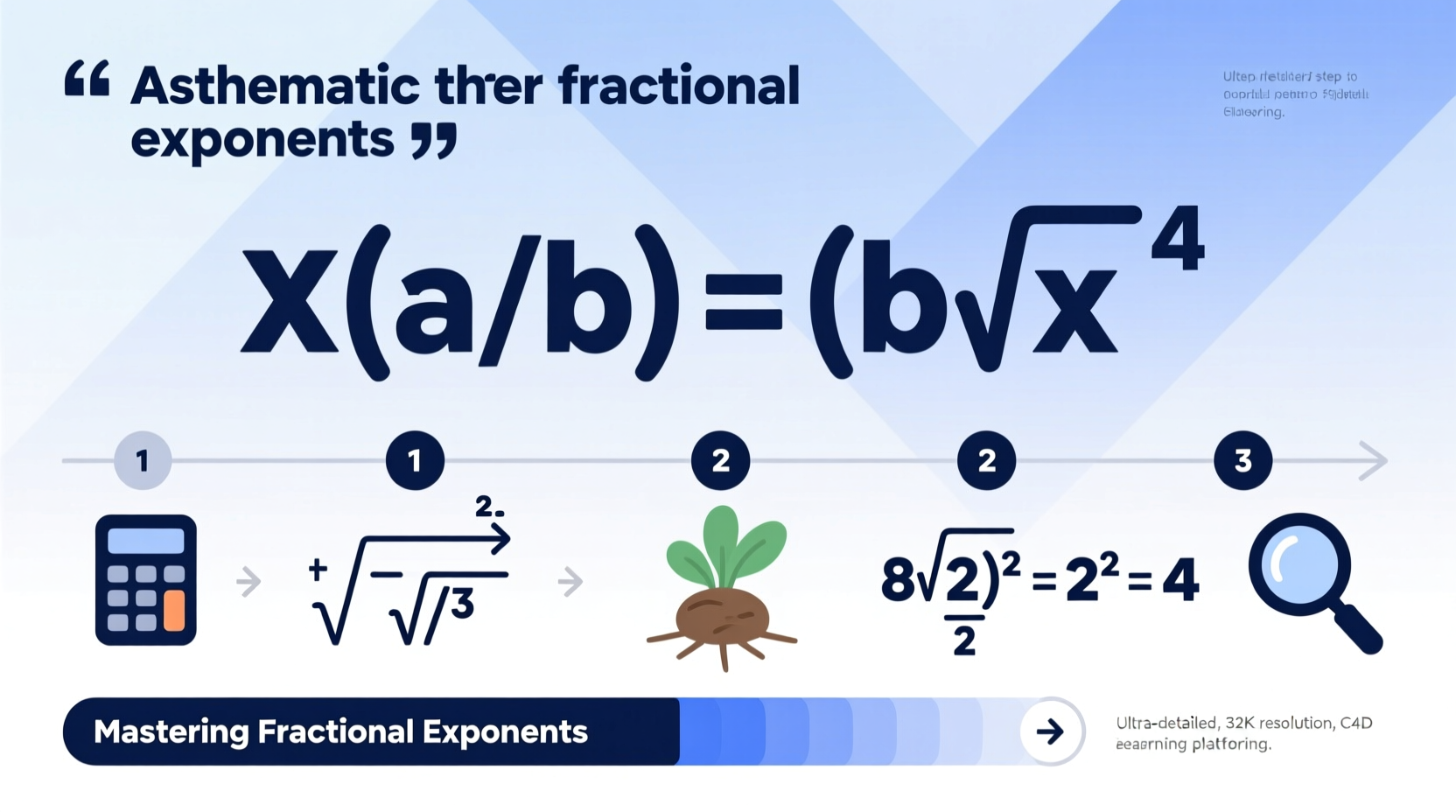
A fractional exponent combines powers and roots. The general form is \\( a^{\\frac{m}{n}} \\), where \\( m \\) is the power and \\( n \\) is the root. This means:
\\[ a^{\\frac{m}{n}} = \\sqrt[n]{a^m} = (\\sqrt[n]{a})^m \\]
For example, \\( 8^{\\frac{2}{3}} \\) can be interpreted as \"the cube root of 8 squared\" or \"the square of the cube root of 8.\" Both interpretations yield the same result:
- \\( \\sqrt[3]{8} = 2 \\), then \\( 2^2 = 4 \\)
- \\( 8^2 = 64 \\), then \\( \\sqrt[3]{64} = 4 \\)
This duality allows flexibility in problem-solving. Recognizing that fractional exponents are rooted in radical notation makes conversion between forms intuitive.
The Core Rules of Fractional Exponents
To manipulate expressions involving fractional exponents, apply the standard laws of exponents, now extended to rational numbers. Below are the key rules:
| Rule | Formula | Example |
|---|---|---|
| Multiplication | \\( a^{\\frac{m}{n}} \\cdot a^{\\frac{p}{q}} = a^{\\frac{m}{n} + \\frac{p}{q}} \\) | \\( 5^{\\frac{1}{2}} \\cdot 5^{\\frac{3}{2}} = 5^{2} = 25 \\) |
| Division | \\( \\frac{a^{\\frac{m}{n}}}{a^{\\frac{p}{q}}} = a^{\\frac{m}{n} - \\frac{p}{q}} \\) | \\( \\frac{7^{\\frac{5}{4}}}{7^{\\frac{1}{4}}} = 7^{1} = 7 \\) |
| Power of a Power | \\( (a^{\\frac{m}{n}})^{\\frac{p}{q}} = a^{\\frac{m}{n} \\cdot \\frac{p}{q}} \\) | \\( (4^{\\frac{1}{2}})^3 = 4^{\\frac{3}{2}} = 8 \\) |
| Negative Fractional Exponent | \\( a^{-\\frac{m}{n}} = \\frac{1}{a^{\\frac{m}{n}}} \\) | \\( 9^{-\\frac{1}{2}} = \\frac{1}{\\sqrt{9}} = \\frac{1}{3} \\) |
These rules mirror those for integer exponents. The critical difference lies in handling fractions during addition, subtraction, and multiplication. Always ensure common denominators when combining exponents through addition or subtraction.
Step-by-Step Guide to Simplifying Expressions with Fractional Exponents
Simplifying expressions requires systematic application of exponent rules. Follow this sequence:
- Convert radicals to exponents: Rewrite any root expressions using fractional exponents. For instance, \\( \\sqrt[4]{x^3} = x^{\\frac{3}{4}} \\).
- Apply exponent rules: Combine like bases using addition/subtraction of exponents for multiplication/division.
- Simplify compound exponents: Use the power-of-a-power rule when exponents are raised to other exponents.
- Reduce fractions in exponents: Simplify \\( \\frac{6}{9} \\) to \\( \\frac{2}{3} \\), so \\( a^{\\frac{6}{9}} = a^{\\frac{2}{3}} \\).
- Rationalize or evaluate if needed: If required, convert back to radical form or compute numerical values.
Consider this example:
Simplify \\( \\left( x^{\\frac{2}{3}} \\cdot x^{-\\frac{1}{6}} \\right)^2 \\)
Step 1: Combine inside parentheses — \\( x^{\\frac{2}{3} - \\frac{1}{6}} = x^{\\frac{4}{6} - \\frac{1}{6}} = x^{\\frac{3}{6}} = x^{\\frac{1}{2}} \\)
Step 2: Apply outer exponent — \\( (x^{\\frac{1}{2}})^2 = x^1 = x \\)
The simplified expression is \\( x \\).
Common Pitfalls and How to Avoid Them
Even experienced students make mistakes with fractional exponents. Awareness of frequent errors helps prevent them:
- Misapplying order of operations: Remember that \\( (a^m)^n = a^{m \\cdot n} \\), not \\( a^{m+n} \\).
- Incorrectly adding fractional exponents: Always find a common denominator before adding or subtracting.
- Ignoring domain restrictions: Expressions like \\( (-8)^{\\frac{1}{2}} \\) are undefined in real numbers because you cannot take the square root of a negative number.
- Confusing numerator and denominator roles: In \\( a^{\\frac{m}{n}} \\), \\( n \\) determines the root, \\( m \\) the power—don’t swap them.
“Fractional exponents bridge arithmetic and algebra—they’re not just symbols, but tools for modeling growth, decay, and geometric relationships.” — Dr. Alan Reyes, Mathematics Educator
Real-World Application: A Mini Case Study
Imagine you're analyzing bacterial growth in a lab. The population after \\( t \\) hours is modeled by \\( P(t) = 1000 \\cdot t^{\\frac{3}{2}} \\). You want to know how many bacteria exist after 4 hours.
Substitute \\( t = 4 \\):
\\( P(4) = 1000 \\cdot 4^{\\frac{3}{2}} \\)
Break it down: \\( 4^{\\frac{1}{2}} = \\sqrt{4} = 2 \\), then raise to the third power: \\( 2^3 = 8 \\)
So, \\( P(4) = 1000 \\cdot 8 = 8000 \\)
This shows how fractional exponents describe non-linear biological processes. Without understanding \\( t^{\\frac{3}{2}} \\), interpreting such models would be impossible.
Essential Checklist for Mastering Fractional Exponents
Use this checklist to build confidence and accuracy:
- ✅ Convert between radical and exponential forms fluently
- ✅ Apply exponent laws correctly to fractional powers
- ✅ Simplify compound exponents step by step
- ✅ Reduce fractions in exponents to lowest terms
- ✅ Check for domain issues (e.g., even roots of negatives)
- ✅ Verify results by substituting simple values
- ✅ Practice regularly with mixed problems
Frequently Asked Questions
Can fractional exponents be negative?
Yes. A negative fractional exponent indicates the reciprocal of the positive version. For example, \\( 16^{-\\frac{1}{4}} = \\frac{1}{16^{\\frac{1}{4}}} = \\frac{1}{2} \\).
What happens if the denominator of the exponent is even and the base is negative?
In the real number system, even roots of negative numbers are undefined. So, \\( (-4)^{\\frac{1}{2}} \\) has no real solution. Be cautious with domains when simplifying.
How do I handle fractional exponents with variables?
Treat variables the same way, but assume variables represent positive real numbers unless otherwise specified. For example, \\( x^{\\frac{2}{3}} = \\sqrt[3]{x^2} \\), valid for all real \\( x \\), though often assumed \\( x > 0 \\) for simplicity.
Conclusion: Build Confidence Through Practice
Mastery of fractional exponents comes not from memorization, but from consistent practice and conceptual understanding. They are more than abstract math—they appear in physics equations, financial models, and data analysis. By internalizing the rules, avoiding common traps, and applying them to real situations, you equip yourself with a powerful mathematical tool. Start with simple conversions, progress to complex simplifications, and challenge yourself with word problems. Each step strengthens your foundation for advanced topics.




 浙公网安备
33010002000092号
浙公网安备
33010002000092号 浙B2-20120091-4
Comments
No comments yet. Why don't you start the discussion?