
Fractions are foundational in mathematics, appearing in everyday calculations, academic curricula, and real-world applications from cooking to engineering. Among the most commonly used fractions is 3/8 — three eighths. While it may seem simple, writing and understanding 3/8 correctly requires clarity, precision, and conceptual awareness. Miswriting or misunderstanding this fraction can lead to errors in measurement, calculation, or communication. This guide breaks down exactly how to write 3/8 properly, interpret its meaning, and apply it accurately across different contexts.
Understanding the Basics of Fractions
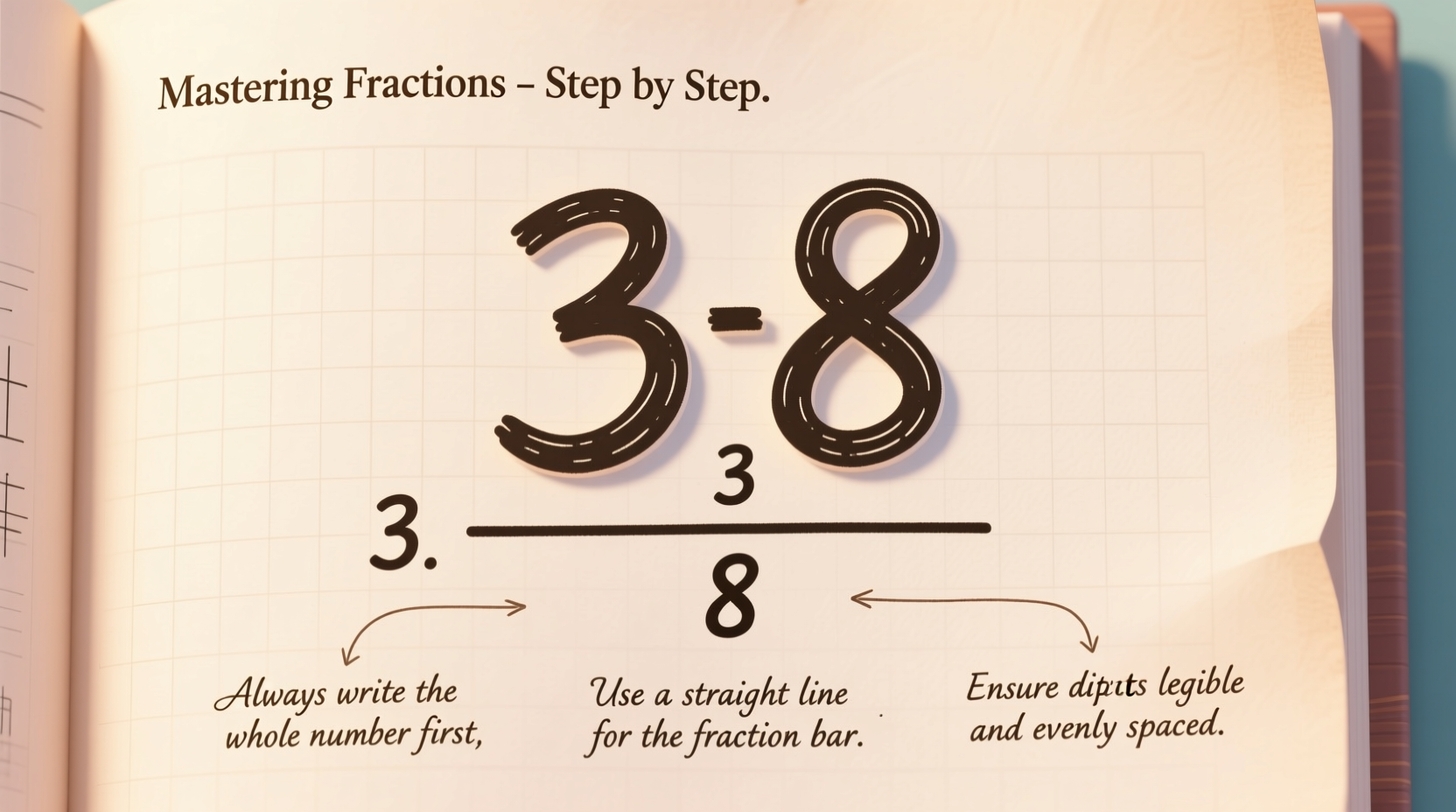
A fraction represents a part of a whole. It consists of two numbers: the numerator (top number) and the denominator (bottom number), separated by a slash or horizontal line. In the fraction 3/8, the numerator is 3 and the denominator is 8. This means you have 3 parts out of a total of 8 equal parts.
The denominator indicates how many equal segments the whole has been divided into. The numerator tells you how many of those segments are being considered. So, 3/8 describes a quantity that is slightly more than one-third but less than one-half — specifically, 37.5% of a whole.
“Understanding what a fraction represents is just as important as knowing how to write it.” — Dr. Alan Reyes, Mathematics Education Specialist
Step-by-Step Guide to Writing 3/8 Correctly
Writing 3/8 may seem straightforward, but doing so clearly and correctly ensures your meaning is unambiguous, especially in academic or technical settings. Follow these steps:
- Identify the components: Confirm that you need to express three out of eight equal parts.
- Use the correct format: Write the numerator (3), followed by a forward slash (/), then the denominator (8): 3/8.
- Avoid common spacing errors: Do not add spaces around the slash unless required by a specific style guide (e.g., “3 / 8” is discouraged in standard math notation).
- Consider context: In formal writing or typeset documents, use a horizontal fraction bar when possible: ¾ (though this is typically reserved for simplified forms like ½ or ¾; 3/8 is usually left in linear form).
- Check alignment: Ensure both numbers are on the same baseline and clearly legible, especially when handwriting.
Common Mistakes When Writing 3/8
Even small errors in formatting can cause confusion. Here are frequent mistakes and how to avoid them:
| Mistake | Why It’s Wrong | Correct Version |
|---|---|---|
| 3\\8 | Backslash is incorrect; it’s not a division symbol in fractions | 3/8 |
| 3 ÷ 8 | This denotes division, not a fractional value | 3/8 |
| three eight | Missing “-th” suffix and hyphen; incomplete term | three-eighths |
| 3 / 8 | Unnecessary spaces reduce readability in mathematical contexts | 3/8 |
| ⅜ | While technically correct, this Unicode character is hard to edit and may render poorly | 3/8 (preferred for accessibility) |
How to Say and Spell 3/8 in Words
In written English, 3/8 should be spelled as three-eighths when used in prose. Note the hyphen and the plural “-s” at the end, since you’re referring to multiple parts.
- ✅ Correct: \"She ate three-eighths of the pizza.\"
- ❌ Incorrect: \"She ate three eight of the pizza.\"
- ❌ Incorrect: \"She ate three eighth of the pizza.\"
When speaking, pronounce it as “three-EIGHTHS,” emphasizing the second word to distinguish it from “eight.” This helps prevent confusion, particularly in instructional or verbal problem-solving scenarios.
Real-World Applications of 3/8
Understanding how to write and use 3/8 correctly isn’t just an academic exercise. It has practical implications across fields:
Construction and Carpentry: Measurements often rely on eighths of an inch. A board cut to 3/8 inch thickness must be labeled precisely to avoid assembly errors.
Cooking: Recipes may call for 3/8 teaspoon of an ingredient. Since measuring spoons rarely include 3/8 marks, cooks must estimate using 1/4 (2/8) plus 1/8, reinforcing the importance of understanding fraction equivalence.
Finance: If someone inherits 3/8 of an estate, accurate documentation ensures fair distribution. Writing it as “3/8” or “three-eighths” in legal text avoids ambiguity.
“In construction, a misread fraction can mean the difference between a perfect fit and a costly rework.” — Maria Thompson, Certified Carpenter and Trade Instructor
Mini Case Study: Teaching Fractions in Middle School
In Ms. Greene’s sixth-grade math class, students were learning to convert improper fractions and compare values. During a lesson on fraction representation, several students wrote “3 over 8” instead of “3/8” in their worksheets. Others used backslashes or added spaces.
To address this, Ms. Greene introduced a “Fraction Format Challenge” where students had to write 3/8 in five different ways — handwritten, typed, spoken, as a decimal, and shaded on a pie chart. By the end of the week, students could confidently write and explain 3/8 in standardized form. The exercise reinforced that clarity in notation supports deeper comprehension.
Best Practices Checklist for Writing 3/8
- Numerator is 3, denominator is 8 — double-check values
- Used a forward slash (/), not a backslash (\\) or division sign (÷)
- No extra spaces: wrote “3/8”, not “3 / 8”
- If spelling out: used “three-eighths” with a hyphen and plural “-s”
- Pronounced correctly as “three-EIGHTHS” in verbal explanations
- Ensured legibility in handwriting — clear numbers, proper alignment
Frequently Asked Questions
Is 3/8 the same as 0.375?
Yes. To convert 3/8 to a decimal, divide 3 by 8. The result is 0.375. This equivalence is useful in contexts requiring decimal precision, such as engineering or computing.
Can 3/8 be simplified further?
No. The greatest common divisor of 3 and 8 is 1, so 3/8 is already in its simplest form. Unlike fractions such as 4/8 (which simplifies to 1/2), 3/8 cannot be reduced.
How do I type 3/8 on a keyboard?
Simply type “3/8” using the number keys and forward slash. On some systems, you can use Alt codes (e.g., Alt+0189 for ½), but there is no standard shortcut for 3/8. Avoid special Unicode characters unless necessary, as they may not be editable or accessible.
Final Thoughts and Call to Action
Mastering how to write 3/8 clearly and correctly is more than a small detail — it’s a reflection of mathematical literacy. Whether you're a student, teacher, DIY enthusiast, or professional, precise fraction usage enhances accuracy, communication, and confidence. Taking care in how you write and interpret 3/8 builds stronger numeracy skills that transfer across subjects and situations.




 浙公网安备
33010002000092号
浙公网安备
33010002000092号 浙B2-20120091-4
Comments
No comments yet. Why don't you start the discussion?