
In mathematics, the concept of a function is foundational. Whether you're studying algebra, calculus, or data science, understanding what makes a relation a function is crucial. A function is more than just an equation — it’s a specific kind of relationship between inputs and outputs. This guide breaks down the core principles, provides practical tools like the vertical line test, and walks through real-world examples to help you confidently determine whether a relation qualifies as a function.
What Is a Function?
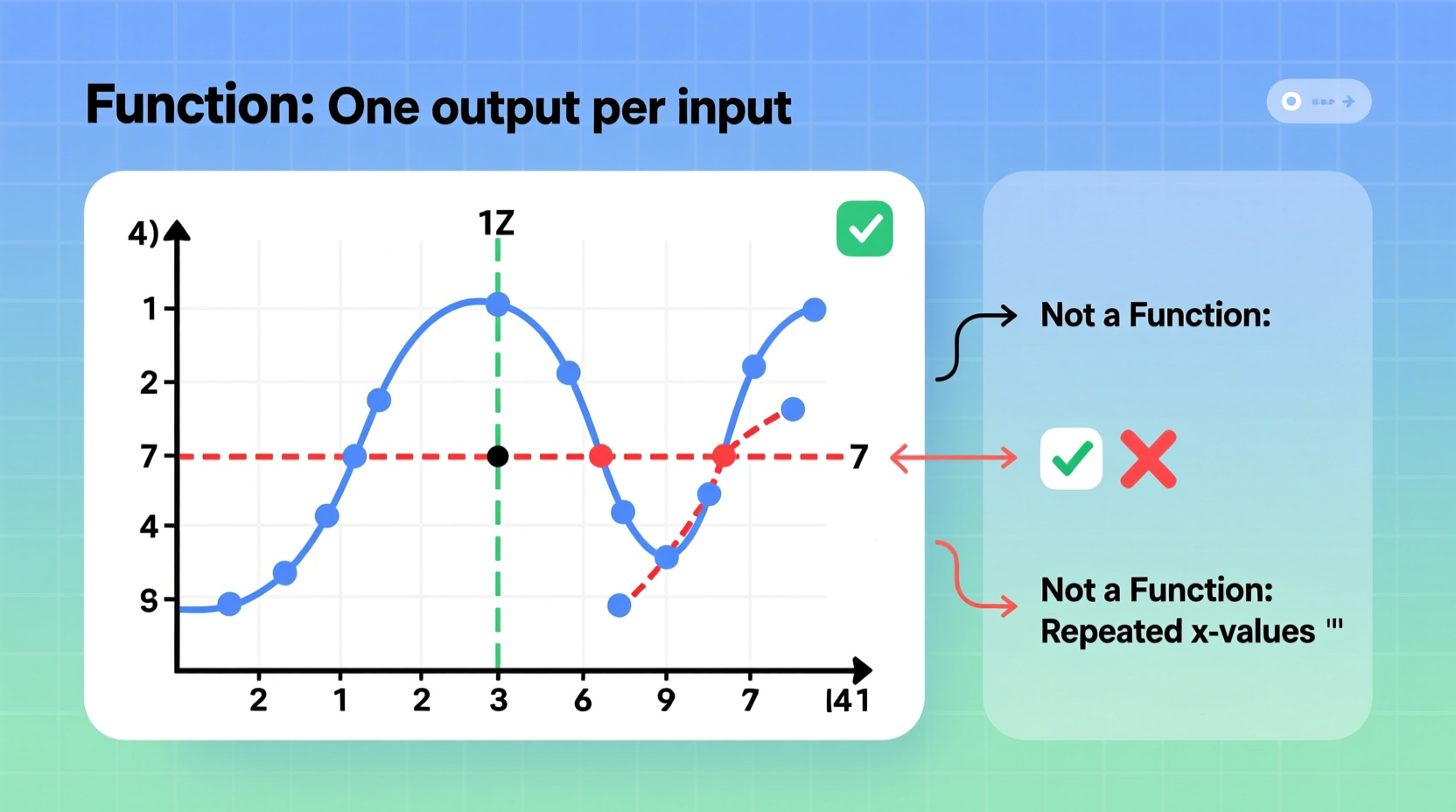
A function is a rule that assigns exactly one output value to each input value. In mathematical terms, if \\( x \\) is an input (from the domain), then there must be only one corresponding output \\( y \\) (in the range). Think of a function as a machine: you feed in a number, and it gives back exactly one result — never two or none.
For example, the equation \\( f(x) = 2x + 3 \\) defines a function because every input \\( x \\) produces one unique output. If \\( x = 4 \\), then \\( f(4) = 11 \\), and no other value.
Contrast this with a relation like \\( x^2 + y^2 = 9 \\), which describes a circle. Here, a single \\( x \\)-value can correspond to two different \\( y \\)-values (e.g., when \\( x = 0 \\), \\( y = 3 \\) or \\( y = -3 \\)). This means it's a relation but not a function.
The Vertical Line Test: A Visual Tool
When dealing with graphs, the quickest way to determine if a relation is a function is the vertical line test. Imagine drawing vertical lines across the graph:
- If any vertical line intersects the graph at more than one point, the relation is not a function.
- If every vertical line touches the graph at most once, it is a function.
This works because a vertical line represents a constant \\( x \\)-value. If it hits multiple \\( y \\)-values, that \\( x \\) maps to more than one output — violating the definition of a function.
Representations of Relations and How to Analyze Them
Relations can appear in several forms: sets of ordered pairs, tables, equations, and graphs. Each requires a slightly different approach to verify functionality.
1. Ordered Pairs
Consider the set: \\( \\{(1, 2), (2, 4), (3, 6), (1, 8)\\} \\).
Here, the input \\( x = 1 \\) appears twice, mapping to both 2 and 8. Since one input has two outputs, this is not a function.
Now consider: \\( \\{(1, 2), (2, 4), (3, 6), (4, 8)\\} \\).
Each input appears only once. This passes the \"one output per input\" rule — it is a function.
2. Tables
Tables organize inputs and outputs clearly. Examine the \\( x \\)-column for duplicates.
| x | y |
|---|---|
| 0 | 5 |
| 1 | 7 |
| 2 | 9 |
| 1 | 10 |
Since \\( x = 1 \\) appears with two different \\( y \\)-values, this table does not represent a function.
3. Equations
Solving for \\( y \\) helps determine functionality. Take \\( y = x^2 \\). For any \\( x \\), squaring yields exactly one \\( y \\) — so it's a function.
But for \\( y^2 = x \\), solving gives \\( y = \\sqrt{x} \\) or \\( y = -\\sqrt{x} \\). So for \\( x = 4 \\), \\( y = 2 \\) or \\( y = -2 \\). Two outputs mean it’s not a function unless restricted.
“Understanding functions starts with recognizing uniqueness in mapping. It’s not about complexity — it’s about consistency.” — Dr. Alan Reyes, Mathematics Educator
Step-by-Step Guide to Determining if a Relation is a Function
Follow this logical sequence regardless of the format:
- Identify the input (domain) and output (range): Determine which variable depends on the other.
- List all input-output pairs: Extract ordered pairs from graphs, tables, or equations.
- Check for repeated inputs: Look for duplicate \\( x \\)-values.
- Verify outputs for duplicates: If any \\( x \\) maps to more than one \\( y \\), it’s not a function.
- Apply the vertical line test (if graphed): Confirm visually that no vertical line crosses the curve more than once.
- State your conclusion clearly: “This relation is a function” or “This relation fails the function criterion because…”
Common Misconceptions About Functions
Several myths persist among learners. Addressing them improves clarity:
- Myth: All equations are functions.
Truth: Only those producing a single output per input qualify. Circles, sideways parabolas, and some rational expressions fail. - Myth: Functions must be written as \\( f(x) \\).
Truth: Any representation — equation, graph, or set — can define a function if it meets the criteria. - Myth: One-to-many mappings are acceptable.
Truth: Functions must be many-to-one or one-to-one, never one-to-many.
Real-World Example: Temperature Conversion
Consider converting degrees Celsius to Fahrenheit using the formula \\( F = \\frac{9}{5}C + 32 \\).
This is a perfect example of a function. Every Celsius temperature corresponds to exactly one Fahrenheit value. Input \\( C = 20 \\), output \\( F = 68 \\). No ambiguity.
Now imagine a faulty sensor that reports two different Fahrenheit readings for the same Celsius input due to calibration errors. That data set would fail as a function — highlighting why functional relationships matter in science and engineering.
Do’s and Don’ts When Evaluating Functions
| Action | Do | Don't |
|---|---|---|
| Analyzing graphs | Use the vertical line test | Assume symmetry implies functionality |
| Working with tables | Sort by input values to spot duplicates | Ignore repeated inputs with different outputs |
| Solving equations | Solve for \\( y \\) and check for ± solutions | Assume all algebraic expressions are functions |
| Interpreting word problems | Define domain and range before deciding | Jump to conclusions without checking mappings |
FAQ
Can a function have the same output for different inputs?
Yes. A function can map multiple inputs to the same output. For example, \\( f(x) = x^2 \\) gives \\( f(2) = 4 \\) and \\( f(-2) = 4 \\). This is allowed — as long as no single input leads to multiple outputs.
Is a straight vertical line a function?
No. A vertical line like \\( x = 3 \\) fails the vertical line test dramatically — every point on the line shares the same \\( x \\)-value but has different \\( y \\)-values. Thus, it’s not a function.
Are all linear equations functions?
Most are, except vertical lines. Equations like \\( y = 3x + 1 \\) are functions, but \\( x = 5 \\) is not, despite being linear.
Conclusion
Mastery of functions begins with a simple yet powerful idea: one input, one output. By applying consistent logic across various representations — ordered pairs, tables, graphs, and equations — you can reliably determine whether a relation qualifies as a function. Use the vertical line test for visuals, scrutinize inputs in datasets, and always question mappings in equations. These skills form the backbone of higher mathematics and analytical thinking.




 浙公网安备
33010002000092号
浙公网安备
33010002000092号 浙B2-20120091-4
Comments
No comments yet. Why don't you start the discussion?