
Drawing realistic hair remains one of the most challenging aspects of figure illustration. Unlike solid forms, hair behaves fluidly, reflects light unpredictably, and varies widely in texture, volume, and movement. Yet mastering it can transform a flat sketch into a dynamic, lifelike portrait. Whether you're working in pencil, ink, or digital media, understanding the structure, flow, and lighting of hair is essential. This guide breaks down the process into actionable steps, offering practical insights that bridge observation and technique.
Understanding Hair as Form, Not Just Strands
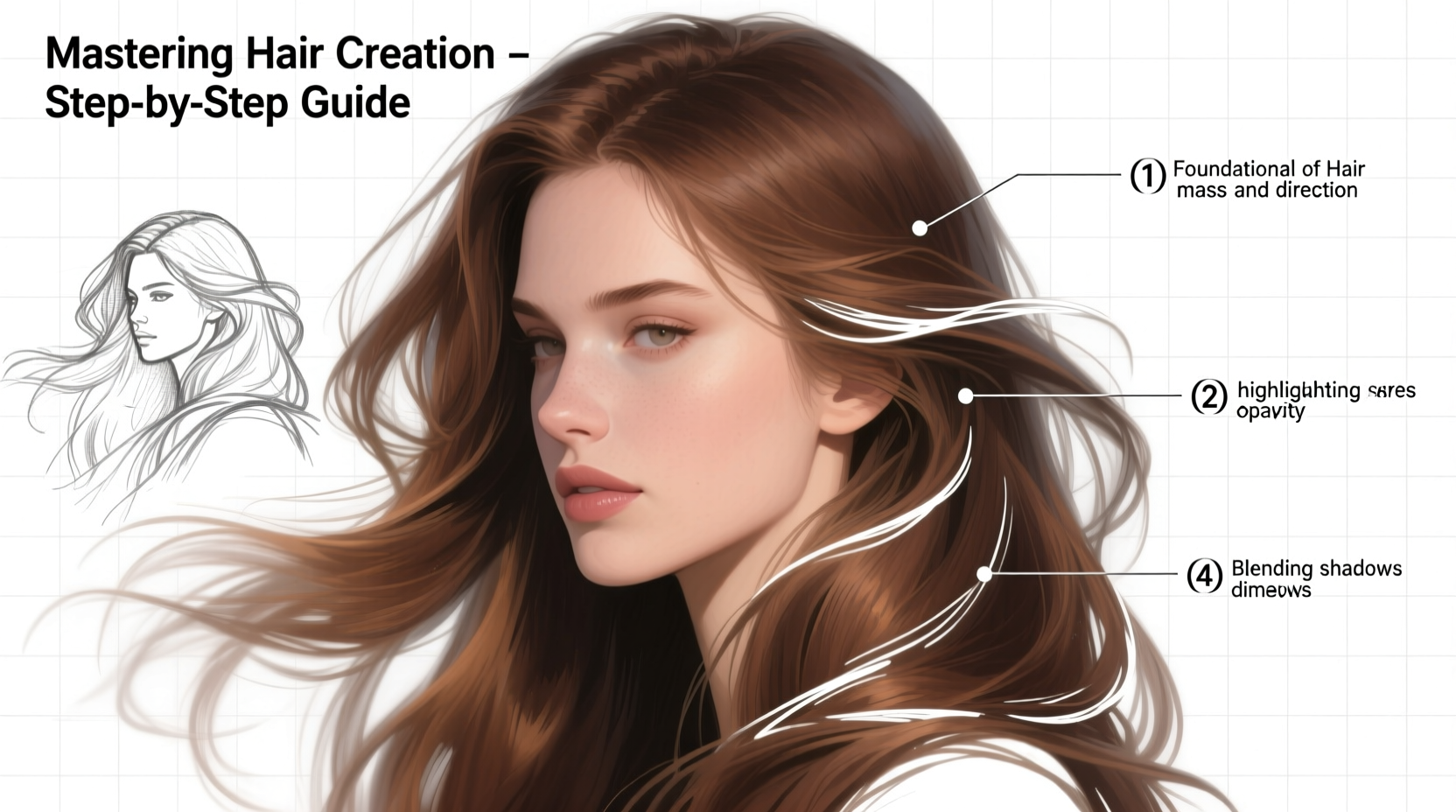
A common mistake among beginners is treating hair as a collection of individual lines. In reality, hair grows in clusters and moves as a cohesive mass. Before detailing strands, think of hair as a three-dimensional form shaped by gravity, wind, and the head’s curvature. Start by blocking in the overall silhouette—this includes volume, parting, and direction of flow.
Consider how different hairstyles behave: a tight bun compresses the form, while loose waves create undulating rhythms. Observe reference photos not just for color or style, but for how light wraps around the shape. The darkest values are often where the hair folds over itself or recedes from the light source.
The Step-by-Step Process: From Structure to Realism
Creating convincing hair requires a methodical approach. Jumping straight into fine details leads to messy, unrealistic results. Follow this sequence to build depth and believability.
- Sketch the Head and Hairline: Begin with the skull and facial features. Accurately place the hairline—it’s rarely a perfect curve and often follows the brow ridge and temples.
- Define the Mass Shape: Lightly outline the total volume of the hairstyle. Ask: Is it pulled back? Voluminous at the crown? Flowing past the shoulders?
- Establish Flow and Direction: Use long, directional lines to indicate how sections move. These aren’t strands but guides showing momentum and wave patterns.
- Add Depth with Value Zones: Identify highlight, midtone, and shadow areas. Hair isn’t uniformly dark; even black hair has subtle shifts in tone.
- Introduce Texture Gradually: Work from broad textures to finer details. Use hatching, stippling, or cross-contour marks depending on the medium and hair type.
- Refine Edges: Soften edges where hair blends into the background or overlaps the face. Keep only select areas sharp, usually near the front plane.
This progression ensures structural accuracy before aesthetic refinement. Rushing step five without completing step four results in flat, “drawn-on” hair that lacks integration with the head.
Avoiding Common Pitfalls: Do’s and Don’ts
Even experienced artists fall into traps when rendering hair. Awareness of these issues helps maintain realism and cohesion.
| Do | Don’t |
|---|---|
| Use varied line weight—thicker lines for shadows, thinner for flyaways | Draw every strand with equal thickness and darkness |
| Let some strands break the outer contour for naturalism | Trace a rigid, closed outline around the entire hairstyle |
| Leave white spaces for highlights instead of erasing later | Rely solely on erasers to create shine after heavy shading |
| Observe how hair clumps due to oil, gravity, or wind | Apply uniform zig-zag patterns across all curly hair |
| Anchor hair to the scalp—show roots emerging naturally | Float hair above the head with no connection point |
Real Example: Drawing Wavy Shoulder-Length Hair
An artist sketches a female portrait with wavy brown hair falling over one shoulder. Initially, they draw stiff, parallel lines radiating from the crown. The result looks artificial, like plastic strips glued to the head. After revising with the step-by-step method, they begin by shaping the hair mass as an oval extending from the left temple. They map S-curves to indicate wave rhythm, then group strands into broad ribbons. Only in the final stage do they add a few loose tendrils near the face and shoulder. The revised version appears soft, dimensional, and integrated with the pose.
“Hair should feel alive—like it responds to movement and environment. That starts with understanding its behavior, not just copying what you see.” — Lena Torres, Portrait Illustrator and Art Instructor
Adapting Techniques by Hair Type
No single method works for all textures. Curly, straight, coarse, and fine hair each demand distinct approaches to value, edge control, and mark-making.
- Straight Hair: Emphasize smooth gradients and strong highlights along central parts. Use long, flowing strokes with minimal interruption.
- Curly Hair: Focus on clumping and negative space. Render curls as interlocking ovals or spirals, leaving gaps between clusters to suggest depth.
- Fine or Thin Hair: Show scalp visibility, especially at the part. Use lighter pressure and spaced-out lines to convey delicacy.
- Thick or Coarse Hair: Build density with layered hatching. Increase contrast between lights and darks to show weight and volume.
- Braids or Updos: Draw the underlying structure first—the twist pattern, tension points, and anchor zones—before refining surface details.
For digital artists, layering is invaluable. Use separate layers for base color, shadows, highlights, and flyaways. This allows non-destructive editing and easier adjustments to lighting consistency.
Essential Checklist for Realistic Hair Rendering
Before finalizing your drawing, run through this checklist to ensure technical and visual accuracy.
- ✅ Is the hair rooted realistically along the hairline and crown?
- ✅ Does the overall shape follow the head’s form and perspective?
- ✅ Are there clear light, midtone, and shadow zones based on a single light source?
- ✅ Do the strands follow a logical flow, influenced by gravity and movement?
- ✅ Have I varied line weight and density to create depth?
- ✅ Are edges selectively softened or sharpened to enhance dimension?
- ✅ Did I leave intentional highlights rather than relying on erasing?
- ✅ Does the texture match the hair type (straight, curly, etc.)?
Frequently Asked Questions
How do I make hair look shiny without overdoing it?
Shininess comes from controlled contrast. Reserve the brightest highlights for the topmost planes where light hits directly—usually along a central part or the outer curve of a braid. Avoid multiple bright spots unless reflecting secondary light sources. Use smooth gradation into midtones; abrupt transitions make shine look artificial.
What if my hair looks flat even after shading?
Flatness often stems from insufficient value range or lack of form definition. Reassess your initial mass shape—did you account for volume beyond the outline? Add deeper shadows where hair overlaps itself or tucks behind the ear. Introduce subtle contour lines within large sections to imply roundness, much like modeling a cylinder.
How can I practice hair drawing effectively?
Start with 15-minute gesture studies focusing only on flow and direction. Use timed sessions from photo references to train quick decision-making. Later, do longer studies (30–60 minutes) emphasizing value and texture. Keep a dedicated sketchbook for hair types—you’ll notice improvement by comparing entries over time.
Mastery Through Observation and Practice
Realistic hair drawing isn’t about replicating a textbook formula—it’s about interpreting how light, structure, and motion interact. The most compelling results come from studying real people: watch how their hair catches light during conversation, how strands lift in a breeze, or how ponytails stretch slightly under their own weight. Carry a small notebook to jot down observations in daily life.
Technical skill grows with consistent, mindful practice. Dedicate time weekly to focused hair studies, applying the principles outlined here. Over time, you’ll develop an intuitive sense of how to render any hairstyle with confidence and authenticity.




 浙公网安备
33010002000092号
浙公网安备
33010002000092号 浙B2-20120091-4
Comments
No comments yet. Why don't you start the discussion?