
Adding decimals is a foundational skill that extends far beyond the classroom. Whether you're balancing a checkbook, calculating a tip, managing inventory, or analyzing data, precision with decimal addition ensures reliability and confidence in your results. While the process may seem straightforward, small errors—like misaligned decimal points or incorrect place values—can lead to significant miscalculations. This guide breaks down the method into clear, actionable steps, offers real-world examples, and provides expert-backed strategies to help you perform decimal addition accurately every time.
Understanding Decimal Numbers
Before diving into addition, it's essential to understand what decimal numbers represent. A decimal number includes a whole number part and a fractional part separated by a decimal point. Each digit to the right of the decimal represents a decreasing power of ten: tenths (1/10), hundredths (1/100), thousandths (1/1000), and so on.
For example, in the number 4.375:
- 4 is the ones place (whole number)
- 3 is in the tenths place (3/10)
- 7 is in the hundredths place (7/100)
- 5 is in the thousandths place (5/1000)
When adding decimals, maintaining the correct place value alignment is critical. Misplacing even one digit can distort the entire result.
Step-by-Step Guide to Adding Decimals
Follow this systematic approach to ensure accuracy when adding decimal numbers:
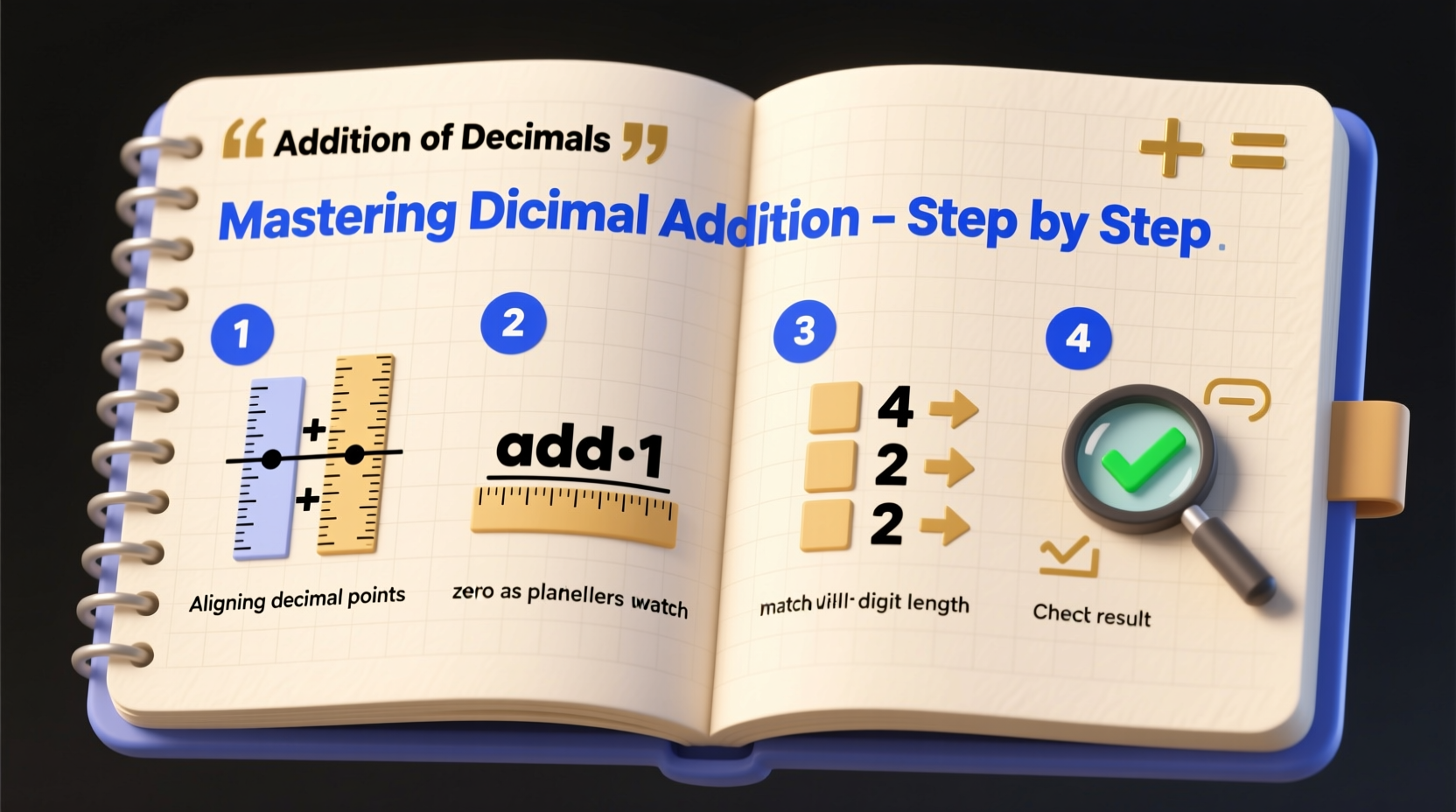
- Align the decimal points vertically. Write each number so that all decimal points are in a straight column. Use zeros as placeholders if necessary to match the number of digits after the decimal.
- Add from right to left, just like with whole numbers, carrying over any excess when a column sums to 10 or more.
- Place the decimal point in the answer directly below the aligned decimal points in the problem.
- Double-check your work by estimating or using inverse operations (e.g., subtracting one addend from the sum to verify).
Example Calculation
Add: 12.45 + 6.7 + 0.308
Step 1: Align decimals
   12.450
    6.700
  + 0.308
  -------
Step 2: Add column by column
     1 1     (carries)
   12.450
    6.700
  + 0.308
  -------
   19.458
The final sum is 19.458. Notice how we added trailing zeros to make all numbers have three decimal places—this simplifies alignment and reduces error risk.
Common Mistakes and How to Avoid Them
Even experienced individuals make avoidable errors when adding decimals. Recognizing these pitfalls improves accuracy:
| Mistake | Why It’s Problematic | Solution |
|---|---|---|
| Ignoring decimal alignment | Leads to incorrect place value addition (e.g., adding tenths to hundredths) | Always line up decimal points before adding |
| Forgetting trailing zeros | Causes misalignment, especially with mixed decimal lengths | Pad shorter decimals with zeros to match the longest decimal |
| Placing the decimal incorrectly in the answer | Results in answers off by powers of ten | Drop the decimal straight down from the column alignment |
| Carrying errors | Overlooked carries distort totals | Mark carries clearly above columns during manual calculation |
Mini Case Study: Grocery Budgeting Gone Wrong
Sophia was tracking her weekly grocery spending using a notebook. She added three receipts: $23.49, $15.60, and $8.7. In her rush, she wrote:
  23.49
  15.60
+  8.7
-------
 107.79  ← Incorrect!
She mistakenly aligned the last number to the right without considering the decimal, effectively treating 8.7 as 87. The correct setup should have been:
  23.49
  15.60
+  8.70
-------
  47.79
This $60 error skewed her budget significantly. With proper alignment and zero padding, she could have avoided the mistake entirely.
“Decimal alignment isn’t just a school rule—it’s a real-world necessity in finance, science, and daily decision-making.” — Dr. Alan Reeves, Mathematics Educator and Curriculum Developer
Practical Tips for Consistent Accuracy
Accuracy in decimal addition comes not only from technique but also from disciplined habits. Incorporate these proven strategies into your routine:
- Estimate first. Round each number to the nearest whole or tenth and add mentally. If your final answer is close to the estimate, it’s likely correct.
- Use consistent formatting. Whether on paper or in spreadsheets, always display the same number of decimal places for clarity.
- Leverage technology wisely. Calculators and apps reduce human error, but don’t become dependent—verify outputs occasionally with manual checks.
- Check subtraction. After adding, subtract one of the original numbers from the sum. You should get the other addend. For example: 12.45 + 6.7 = 19.15 → 19.15 – 6.7 = 12.45.
Checklist: Ensuring Error-Free Decimal Addition
- ☐ Rewrite all numbers with decimals aligned vertically
- ☐ Add trailing zeros to equalize decimal places
- ☐ Add from right to left, carrying as needed
- ☐ Place the decimal point directly below the others
- ☐ Estimate the sum beforehand for reasonableness
- ☐ Verify using subtraction or a calculator
Frequently Asked Questions
Can I add decimals without aligning the points?
No. Without aligning decimal points, you risk adding digits in incorrect place values (e.g., tenths to hundredths). Alignment ensures numerical integrity and is non-negotiable for accuracy.
What do I do if the decimals have different lengths?
Padding with zeros is the standard solution. For instance, convert 4.5 and 3.278 to 4.500 and 3.278. This maintains correct place value and simplifies the addition process.
Is it okay to use a calculator for decimal addition?
Absolutely—but only after understanding the manual process. Relying solely on calculators without comprehension increases the chance of input errors going unnoticed. Use them as a verification tool, not a crutch.
Conclusion: Build Confidence Through Practice
Mastering decimal addition is more than a math requirement—it’s a life skill that empowers better financial decisions, clearer data interpretation, and greater attention to detail. By following a structured method, avoiding common traps, and practicing regularly, anyone can achieve consistent accuracy. Start with simple problems, apply the alignment rule rigorously, and gradually tackle more complex sums. Over time, the process becomes second nature.




 浙公网安备
33010002000092号
浙公网安备
33010002000092号 浙B2-20120091-4
Comments
No comments yet. Why don't you start the discussion?