
Adding an apostrophe and the letter s is one of the most common yet misunderstood aspects of English grammar. Whether you're writing a formal report, crafting an email, or posting on social media, misplacing an apostrophe can undermine your credibility. The confusion often stems from overlapping rules for possession, plurals, and contractions—all involving the use of 's. Understanding when and how to apply these rules correctly ensures clarity and precision in your writing.
Understanding the Three Roles of 's
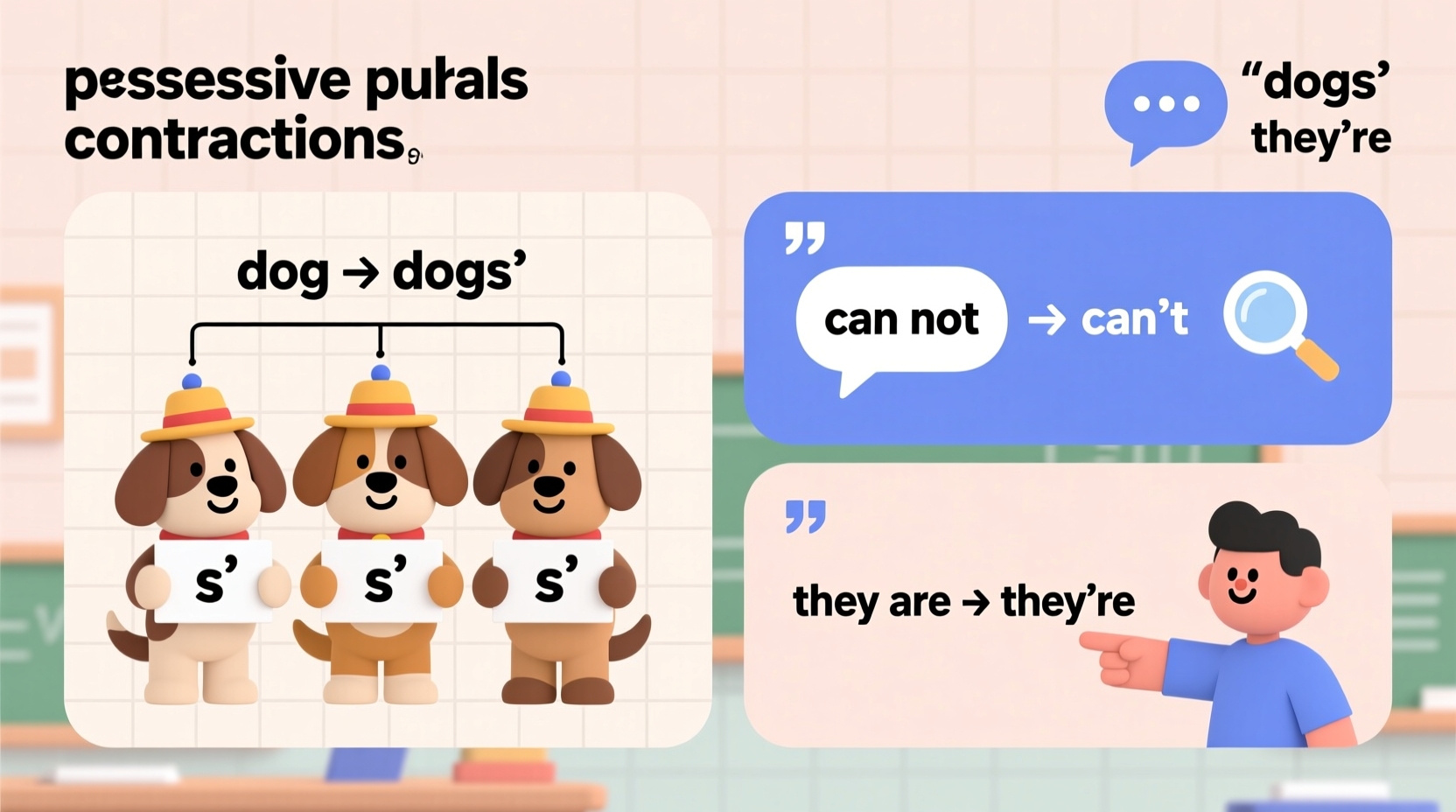
The combination of an apostrophe and s serves three distinct purposes in English: indicating possession, forming contractions, and—less commonly—denoting plural forms in specific cases. Despite their similar appearance, each function follows its own grammatical logic.
- Possession: Shows ownership (e.g., \"Sarah’s book\")
- Contractions: Combines two words by omitting letters (e.g., \"it’s\" for \"it is\")
- Plurals: Rarely used, but applies in special cases like decades or lowercase letters (e.g., \"the 1990s\", \"dot the i’s\")
Mixing up these uses leads to frequent errors, such as writing \"its\" when you mean \"it’s\" or incorrectly pluralizing names with an apostrophe.
Possessive Forms: Singular and Plural Nouns
Possession indicates that something belongs to someone or something. The placement of the apostrophe depends on whether the noun is singular or plural—and whether the plural ends in s.
| Noun Type | Rule | Example |
|---|---|---|
| Singular noun | Add ’s | the dog’s tail |
| Plural noun ending in s | Add ’ after the s | the dogs’ tails |
| Plural noun not ending in s | Add ’s | the children’s toys |
| Singular noun ending in s | Either ’s or ’ — both acceptable | James’s car or James’ car |
While both \"James’s\" and \"James’\" are correct, consistency within a document is key. Many style guides, including the Chicago Manual of Style, recommend using ’s even for singular nouns ending in s, unless it creates awkward pronunciation.
“Clarity trumps rigid adherence to tradition. If 'Charles’s' reads more naturally than 'Charles’', go with the former.” — Dr. Helen Reeves, Linguistics Professor, University of Toronto
Contractions: When 's Replaces Letters
Contractions shorten two words into one by replacing omitted letters with an apostrophe. This feature is essential in informal writing and dialogue, but should be used sparingly in formal contexts.
Common contractions include:
- don’t = do not
- can’t = cannot
- it’s = it is or it has
- she’s = she is or she has
- they’re = they are
A particularly tricky example is it’s vs. its. Because most possessive pronouns (his, hers, theirs) don’t use apostrophes, “its” follows suit. Yet many writers mistakenly use “its” as a contraction or “it’s” as a possessive.
Timeline: How to Proofread for Apostrophe Errors
- Step 1: Identify every instance of 's in your text.
- Step 2: Ask: Is this showing ownership? Then ensure it follows possessive rules.
- Step 3: Could this be a contraction? Try expanding it (e.g., “it’s” → “it is”).
- Step 4: Check if you’re accidentally pluralizing with an apostrophe (e.g., “apple’s for sale” → incorrect).
- Step 5: Verify consistency in names ending in s (e.g., always use “Thomas’s” or always “Thomas’”)
Plural Misconceptions: The Apostrophe Trap
One of the most widespread grammar errors is using an apostrophe to form regular plurals. Signs like “banana’s $1.50” or “happy birthday’s” are rampant in everyday writing but grammatically incorrect.
The only time an apostrophe is used for plurals is in very specific cases:
- To pluralize lowercase letters: “Mind your p’s and q’s.”
- To pluralize single letters: “She got all A’s this semester.”
- To avoid confusion with words that look like verbs: “I’ve interviewed three Ph.D.’s.” (Though “Ph.D.s” is also acceptable.)
- With decades: Both “1990s” and “1990’s” were once common, but modern style favors “1990s” without the apostrophe unless clarity demands it.
Style guides increasingly discourage the use of apostrophes in decade plurals to prevent confusion with contractions. For example, “1990’s” could be misread as “1990 is.”
Real-World Example: A Business Communication Breakdown
In 2021, a small retail chain launched a sidewalk sign reading: “Fresh apple’s and orange’s – $2 each!” Despite accurate pricing, customers mocked the signage on social media. Local news picked up the story, not for the fruit quality, but for the glaring apostrophe misuse.
The owner later admitted: “I thought the apostrophe made it look official.” The incident cost the business goodwill and required a rebranding of all exterior signage. It became a local cautionary tale about how minor grammar errors can damage professional perception.
This case illustrates that while apostrophes may seem minor, their misuse can distract readers, reduce credibility, and even impact brand reputation.
Expert Checklist: Mastering 's Usage
Use this checklist before publishing any written content:
- ☐ No regular plurals use apostrophes (e.g., pens, not pen’s)
- ☐ Singular possessives use ’s (e.g., Maria’s laptop)
- ☐ Plural possessives (ending in s) use only ’ (e.g., students’ exams)
- ☐ Irregular plural possessives use ’s (e.g., women’s rights)
- ☐ Contractions are spelled correctly (e.g., we’re, they’ve, it’s)
- ☐ “Its” is used for possession; “it’s” only when meaning “it is” or “it has”
- ☐ Decades are written without apostrophes (e.g., 1980s, not 1980’s)
- ☐ Letters and numbers use apostrophes only when clarity requires (e.g., dot your i’s)
Frequently Asked Questions
Is it ever correct to write “John’s and Mary’s”?
Yes. Use separate possessives when each person owns something individually: “John’s car and Mary’s bike.” If they share ownership, use “John and Mary’s house” (shared possession).
Why do people keep misusing “its” and “it’s”?
Because nearly all other possessive forms use an apostrophe (dog’s, Sarah’s), people assume “its” should too. But “its” is a pronoun, like “his” or “hers,” which don’t use apostrophes. This exception trips up even experienced writers.
Should I write “boss’s” or “boss’”?
Both are acceptable, but “boss’s” is clearer and aligns with modern usage trends. Pronounce it as “boss-es” to justify the extra syllable. Consistency across your document matters most.
Final Thoughts: Precision Builds Professionalism
Mastering the use of 's isn’t about pedantry—it’s about precision. In a world where first impressions are often formed through written words, clean grammar signals attention to detail and respect for your audience. Whether you're drafting a resume, writing a novel, or posting online, applying these rules consistently elevates your communication.




 浙公网安备
33010002000092号
浙公网安备
33010002000092号 浙B2-20120091-4
Comments
No comments yet. Why don't you start the discussion?