
Chemical equations are the language of chemistry, describing how substances interact during reactions. But an unbalanced equation is like a sentence missing key words—it doesn’t convey the full story. Balancing chemical equations ensures the law of conservation of mass is upheld: atoms are neither created nor destroyed. For students, educators, and lifelong learners, mastering this foundational skill unlocks deeper understanding of reaction stoichiometry, lab preparation, and theoretical chemistry.
While balancing equations may seem intimidating at first, it becomes intuitive with structured practice and the right approach. This guide breaks down the process into actionable steps, highlights common pitfalls, and offers proven strategies to help you succeed confidently.
Understanding the Basics of Chemical Equations
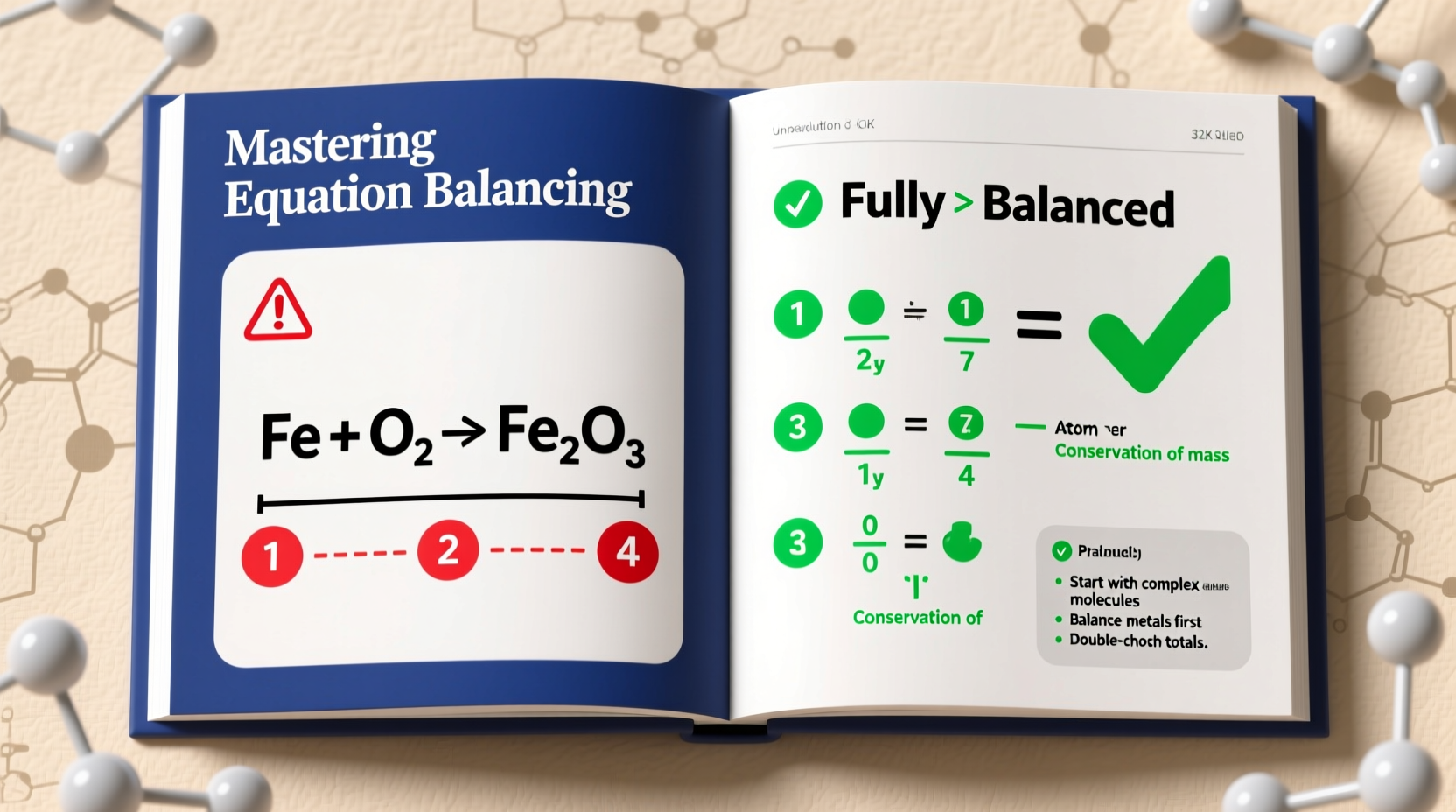
A chemical equation represents a reaction using chemical formulas. Reactants appear on the left, products on the right, separated by an arrow (→). For example:
Fe + O₂ → Fe₂O₃
This shows iron reacting with oxygen to form rust (iron oxide). However, as written, it’s unbalanced. There are two oxygen atoms on the left but three on the right, and one iron atom versus two. The equation must reflect equal numbers of each atom on both sides.
Balancing involves adjusting coefficients—the numbers placed before compounds—not subscripts, which would change the substance itself. Never alter subscripts; only modify coefficients to maintain correct chemical identities.
“Balancing equations isn’t just a mechanical task—it’s a way of visualizing atomic conservation in action.” — Dr. Alan Reyes, Chemistry Educator and Textbook Author
Step-by-Step Guide to Balancing Chemical Equations
Follow this logical sequence to balance any equation systematically. We’ll use the rust formation example to illustrate each step.
- Write the unbalanced equation. Ensure all reactants and products are correctly identified and properly formatted.
- Count atoms of each element on both sides. Create a tally for each element involved.
- Start with the most complex molecule or the element that appears in only one compound on each side. Avoid starting with hydrogen or oxygen if they appear in multiple compounds.
- Add coefficients to balance elements one at a time. Adjust numbers in front of formulas to make atom counts equal.
- Recheck all atoms after each adjustment. Changing one coefficient often affects others.
- Simplify coefficients if possible. Reduce to the smallest whole-number ratio.
Example Walkthrough: Balancing Fe + O₂ → Fe₂O₃
Step 1: Write the unbalanced equation: Fe + O₂ → Fe₂O₃
Step 2: Count atoms:
Left: Fe = 1, O = 2
Right: Fe = 2, O = 3
Step 3: Begin with iron. Two Fe atoms on the right mean we need 2 Fe on the left. Add coefficient 2 to Fe.
2Fe + O₂ → Fe₂O₃
Step 4: Now balance oxygen. Right has 3 O atoms, left has 2. Find least common multiple: 6.
Multiply Fe₂O₃ by 2 → now 6 O and 4 Fe on right.
Adjust left: O₂ needs coefficient 3 (3 × 2 = 6 O), and Fe needs coefficient 4.
4Fe + 3O₂ → 2Fe₂O₃
Step 5: Final check:
Left: Fe = 4, O = 6
Right: Fe = 4, O = 6 ✅
The equation is balanced.
Practical Tips for Success
Even with a solid method, balancing equations can go wrong without attention to detail. These tips refine your technique and prevent common errors.
- Work with pencil and paper. Digital tools help, but writing forces deeper cognitive engagement.
- Balance polyatomic ions as units when they remain unchanged. For example, in reactions involving SO₄²⁻, treat SO₄ as a single entity if it appears on both sides.
- Save hydrogen and oxygen for last. They often appear in multiple compounds and can be adjusted more easily at the end.
- Use fractions temporarily, then multiply to eliminate them. If you get stuck, try fractional coefficients (e.g., ½O₂), then multiply the entire equation by 2 to convert to whole numbers.
- Practice daily with varied reactions. Exposure to combustion, synthesis, decomposition, and displacement reactions builds pattern recognition.
Checklist: Before You Submit Your Balanced Equation
- ✅ All chemical formulas are correct
- ✅ Coefficients are used—not subscripts altered
- ✅ Atom counts match for every element
- ✅ Coefficients are in the lowest whole-number ratio
- ✅ No charges or phases were required but omitted (if applicable)
Common Mistakes and How to Avoid Them
Even experienced students make predictable errors. Recognizing these early prevents frustration and reinforces accuracy.
| Mistake | Why It’s Wrong | How to Fix It |
|---|---|---|
| Changing subscripts instead of coefficients | Alters the chemical identity (e.g., H₂O to H₃O is not water) | Only adjust numbers in front of formulas |
| Forgetting diatomic elements | Elements like O₂, H₂, Cl₂ must be written with subscript 2 when alone | Memorize the seven diatomic elements: H, N, O, F, Cl, Br, I |
| Incorrect atom counting in compounds | Misreading parentheses or subscripts (e.g., Al₂(SO₄)₃ has 3 S and 12 O) | Multiply subscripts outside parentheses: SO₄ × 3 = 3S, 12O |
| Leaving coefficients as fractions | Equations require whole-number coefficients | Multiply entire equation by denominator to clear fractions |
Real Example: A Student’s Journey to Mastery
Jessica, a high school sophomore, struggled with balancing equations despite understanding chemical formulas. Her teacher assigned five equations weekly, but she consistently made small counting errors. After scoring 60% on her first quiz, she decided to change her strategy.
She began using a table to track atoms, wrote out each step clearly, and practiced one equation every morning before class. She focused first on simple synthesis reactions, then progressed to combustion. Within three weeks, she balanced her first redox equation correctly. By mid-term, she scored 94% and even helped classmates during study sessions.
Her breakthrough came not from innate talent, but from consistent, mindful practice and error analysis. “I stopped rushing,” she said. “Now I treat each equation like a puzzle—I enjoy solving it.”
Frequently Asked Questions
Can a chemical equation be balanced in more than one way?
No, a correctly balanced equation has a unique set of coefficients in the simplest whole-number ratio. While you could multiply all coefficients by 2, that wouldn’t be the standard form. The goal is the lowest integers that satisfy atom conservation.
What if I can’t balance oxygen or hydrogen at the end?
This often happens in complex reactions. Try using fractional coefficients temporarily. For example, if you need 5 oxygen atoms on one side but only have O₂, use ⁵⁄₂O₂. Then multiply the entire equation by 2 to eliminate the fraction.
Do physical states affect balancing?
No. States (s), (l), (g), (aq) provide context but don’t impact atom counts. However, including them improves clarity and is often required in formal settings.
Final Thoughts and Call to Action
Balancing chemical equations is a gateway skill—one that opens doors to stoichiometry, reaction prediction, and laboratory precision. It requires patience, attention to detail, and deliberate practice. There’s no shortcut to mastery, but the process itself builds discipline and scientific reasoning.
Every chemist, from student to researcher, once sat where you might be now—staring at an unbalanced equation, unsure where to begin. With the steps, tips, and mindset shared here, you’re equipped to turn confusion into confidence.




 浙公网安备
33010002000092号
浙公网安备
33010002000092号 浙B2-20120091-4
Comments
No comments yet. Why don't you start the discussion?