
Calculating test scores may seem straightforward—add up the points and divide—but accuracy matters more than many realize. A miscalculation can affect student grades, professional evaluations, or certification outcomes. Whether you're a teacher, student, HR professional, or parent helping with homework, understanding the correct methods ensures fairness and consistency. This guide walks through essential techniques, common errors, and practical applications so you can compute test results with confidence.
Understanding the Basics of Test Scoring
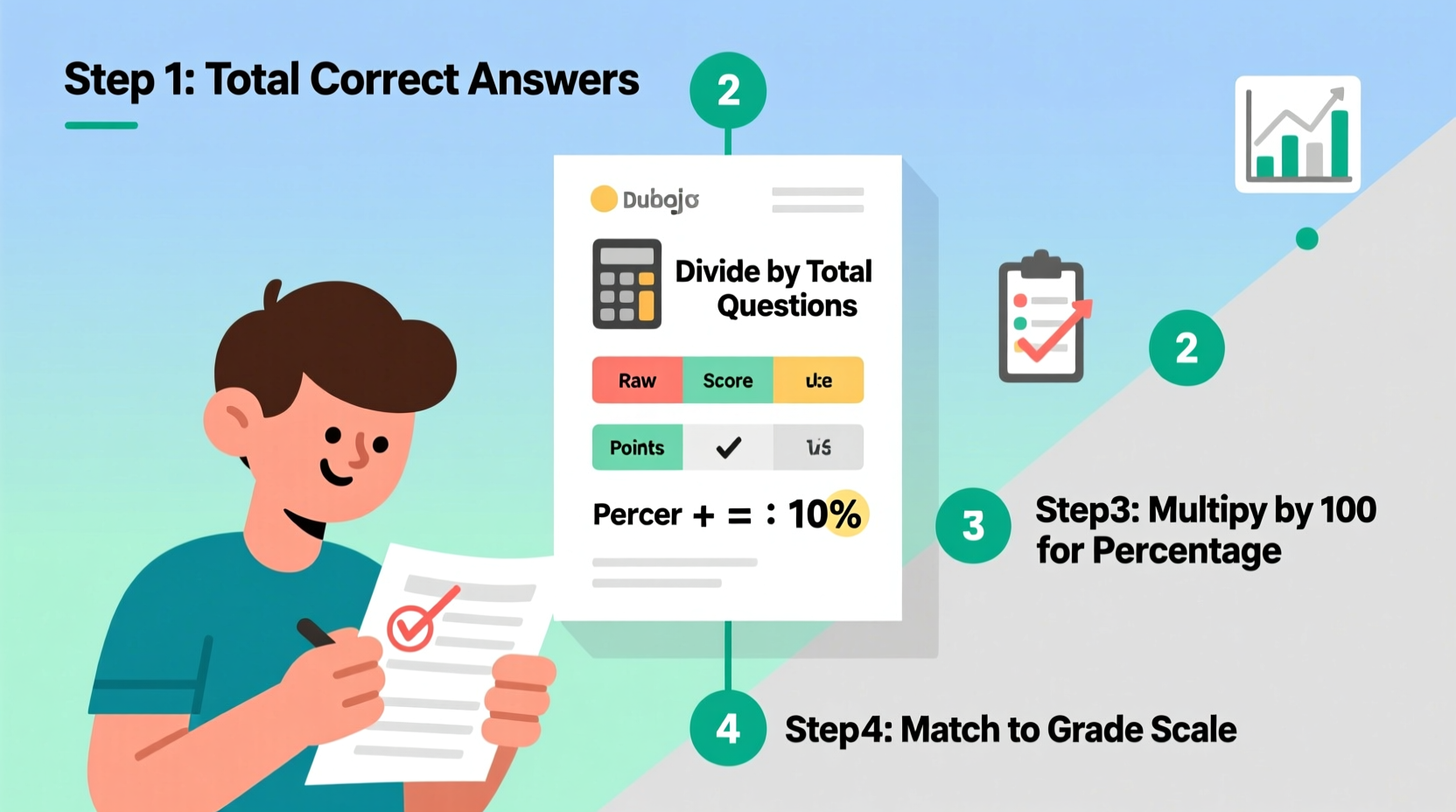
At its core, a test score reflects performance based on correct answers compared to total possible points. The most common form is a percentage: (points earned / total possible points) × 100. But variations exist—weighted sections, partial credit, curved grading, and pass/fail thresholds—all requiring careful attention.
Before diving into calculations, clarify these foundational elements:
- Total Points Available: Sum of all questions or tasks.
- Points Earned: Correct responses or awarded marks.
- Scoring Method: Percentage, letter grade, pass/fail, or scaled score.
- Weighting: Some sections (e.g., essays) may count more than others.
Misunderstanding any of these can lead to inaccurate results. For example, treating a 50-question test with five 10-point essay questions as equally weighted across all items ignores the heavier impact of written responses.
Step-by-Step Guide to Calculating Test Scores
Follow this structured process to ensure precision every time:
- Gather Materials: Test paper, answer key, calculator, and scoring rubric (if applicable).
- Determine Total Possible Points: Add up maximum points for each section. Example: 30 multiple choice (1 pt each), 2 short answers (5 pts each), 1 essay (10 pts) = 50 total points.
- Score Each Section: Mark correct answers and assign points. Use consistent criteria, especially for open-ended responses.
- Sum Points Earned: Tally all awarded points. Suppose a student got 25/30 on MCQs, 7/10 on short answers, and 8/10 on the essay: total = 40 points.
- Calculate Percentage: (40 ÷ 50) × 100 = 80%.
- Apply Grading Scale (if needed): Convert percentage to letter grade using your institution’s scale (e.g., 80% = B).
- Record and Review: Enter the score in your system and verify arithmetic.
This method works for paper-based and digital assessments alike. When grading multiple students, consider using spreadsheets to automate calculations and reduce human error.
Handling Weighted and Composite Scores
Not all tests are scored uniformly. Many modern assessments use weighted components where different sections contribute unequally to the final score.
For instance, a final exam might be composed of:
| Section | Max Points | Weight |
|---|---|---|
| Multiple Choice | 40 | 40% |
| Short Answer | 30 | 30% |
| Essay | 30 | 30% |
To compute a weighted score:
- Convert each section to a percentage: e.g., Student scores 32/40 on MCQ → 80%.
- Multiply each percentage by its weight: 80% × 0.4 = 32.
- Repeat for all sections: Short Answer: 24/30 = 80% → 80 × 0.3 = 24; Essay: 21/30 = 70% → 70 × 0.3 = 21.
- Add weighted values: 32 + 24 + 21 = 77.
The final score is 77%. This approach ensures that no single section disproportionately skews results unless intended.
“Accurate scoring isn’t just about math—it’s about equity. Every student deserves a fair evaluation based on transparent, consistent rules.” — Dr. Linda Reeves, Educational Assessment Specialist
Common Mistakes and How to Avoid Them
Even experienced educators occasionally make scoring errors. Awareness helps prevent them:
- Misreading Point Values: Assuming all questions are worth one point when some are worth more.
- Transcription Errors: Writing down 85 instead of 75 when entering scores.
- Incorrect Weighting: Applying equal importance to high-stakes essays and simple quizzes.
- Ignoring Partial Credit: Failing to award points for partially correct answers in subjective sections.
- Using Outdated Scales: Applying a grading curve no longer relevant to current standards.
Avoid these pitfalls with a standardized checklist.
Test Scoring Checklist
- ☑ Confirm total possible points
- ☑ Verify point distribution per question
- ☑ Apply rubric consistently for open-ended responses
- ☑ Double-check addition and percentages
- ☑ Validate weighting (if applicable)
- ☑ Compare result against grading scale
- ☑ Save raw and final scores for records
Real-World Example: Midterm Exam in a High School Science Class
Ms. Thompson teaches biology to 11th graders. Her midterm has three parts:
- 20 multiple-choice questions (1 point each)
- 5 short-answer questions (4 points each)
- 1 lab analysis essay (20 points)
Total possible: 20 + 20 + 20 = 60 points.
One student, Jordan, earns:
- 17 correct MCQs → 17 points
- 3 full and 2 partial short answers → 3×4 + 2×2 = 12 + 4 = 16 points
- Essay scored 15/20 based on rubric
Total earned: 17 + 16 + 15 = 48 points.
Percentage: (48 ÷ 60) × 100 = 80% → B grade (using standard 90-A, 80-B scale).
Because Ms. Thompson uses a consistent rubric and checks her work in a spreadsheet, she avoids errors and maintains trust with students and parents.
Frequently Asked Questions
How do I calculate a test score when there’s extra credit?
Include extra credit only after calculating the base percentage. For example, if a test is out of 50 points and a student earns 45 + 5 extra credit, their score is 50/50 = 100%, not 110%. Extra credit typically caps at 100% unless policy states otherwise.
What if a student misses a question that was later deemed invalid?
Adjust the total possible points downward. If one 2-point question is invalidated on a 100-point test, recalculate using 98 as the denominator. Award full credit to all students for that item or remove it entirely from scoring.
Can I use software to automate test score calculation?
Yes. Tools like Google Sheets, Excel, or learning management systems (LMS) like Canvas or Moodle can auto-calculate scores using formulas. Just ensure your input data is accurate and formulas are correctly configured.
Final Thoughts and Next Steps
Accurate test scoring supports academic integrity, informs instruction, and builds trust. By mastering the fundamentals—basic percentages, weighted averages, and consistent application—you ensure that every score reflects true performance. Take time to establish a reliable system, whether manual or digital, and document your process for transparency.




 浙公网安备
33010002000092号
浙公网安备
33010002000092号 浙B2-20120091-4
Comments
No comments yet. Why don't you start the discussion?