
Modern devices offer endless customization—from display brightness to privacy permissions—but sometimes changes lead to unexpected issues. Whether you've installed a new app that altered system behavior, adjusted advanced settings during troubleshooting, or simply want to return to a previous state, knowing how to revert settings is essential. This guide walks you through practical methods to reset, roll back, and restore your device’s configuration across major platforms, ensuring stability, performance, and peace of mind.
Why Restoring Settings Matters
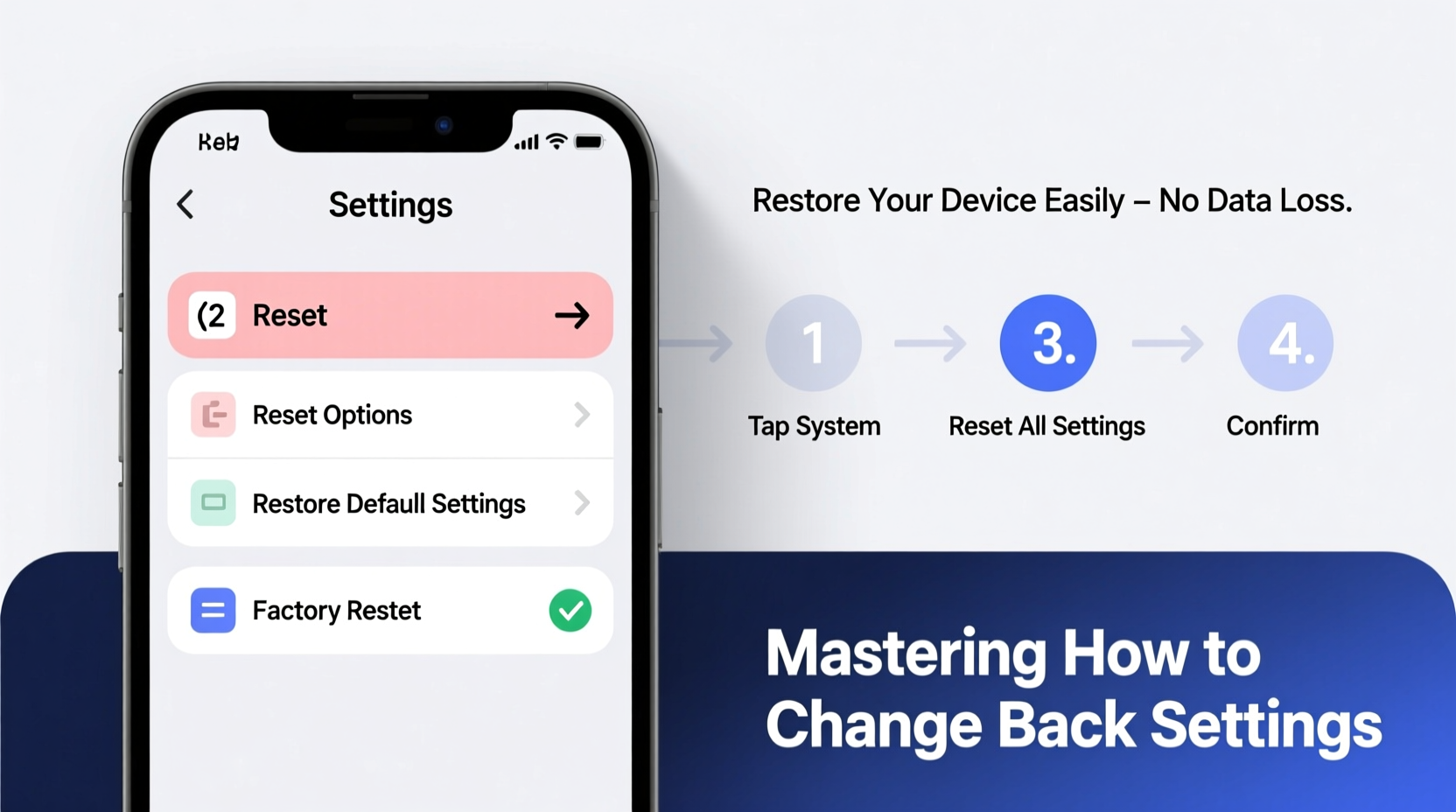
Altering system settings can improve functionality, but incorrect configurations may cause slowdowns, connectivity problems, or security vulnerabilities. A device behaving erratically after a software update or user modification often benefits from reverting to a known good state. Unlike full factory resets, which erase all data, rolling back specific settings preserves personal files while resolving technical issues.
Restoring settings also helps when sharing devices, selling electronics, or troubleshooting for others. It ensures no unintended preferences carry over and provides a clean baseline for diagnostics.
Step-by-Step: How to Revert Common Device Settings
Different devices handle settings rollback differently. Below is a structured approach applicable to smartphones, tablets, and computers.
- Identify the Changed Setting: Determine exactly what was modified—was it Wi-Fi configuration, startup programs, default apps, or system permissions?
- Access the Correct Menu: Navigate to the relevant section in Settings (e.g., Network & Internet, Privacy, Startup).
- Locate Reset or Restore Options: Many menus include “Reset” buttons (e.g., “Reset network settings” on Android or “Renew DHCP Lease” on macOS).
- Use Built-in Recovery Tools: Operating systems often provide tools like System Restore (Windows), Reset Location & Privacy (iOS), or Reset All Settings (Android).
- Confirm and Reboot: After resetting, restart the device to ensure changes take effect.
Reverting on Windows: System Restore in Action
Windows includes a powerful feature called System Restore that creates snapshots of your system state, including registry and system files. If a recent driver update caused instability, System Restore can roll back those changes without affecting documents.
“System Restore is one of the most underused yet effective tools for recovering from faulty updates.” — David Lin, Senior IT Support Specialist at TechGuard Solutions
To use it:
- Press Win + R, type
rstrui, and press Enter. - Select “Choose a different restore point” and click Next.
- Pick a restore point from before the issue began.
- Follow prompts to complete the process. The computer will reboot automatically.
Cross-Platform Comparison: Reset Options Overview
| Platform | Feature Name | What It Resets | Data Loss? |
|---|---|---|---|
| Windows 10/11 | System Restore | Registry, drivers, system files | No (user files preserved) |
| macOS | Recovery Mode + Reinstall | OS-level settings | No (if not erasing disk) |
| iOS | Reset All Settings | Network, wallpaper, privacy, display | No (apps and media safe) |
| Android | Reset App Preferences / Reset Settings | App defaults, permissions, Bluetooth, Wi-Fi | No (unless Factory Reset used) |
| Chrome OS | Powerwash | All user settings and accounts | Yes (local data erased) |
Real Example: Recovering After a Failed Update
Samantha, a freelance graphic designer, updated her Windows laptop to the latest version. After the update, her external monitor stopped detecting properly, and color calibration settings were lost. She tried reinstalling drivers, but the issue persisted. Remembering she had enabled System Protection, she opened System Restore and selected a restore point from two days prior. After rebooting, her display settings returned to normal, and the external monitor functioned again. She resumed work within 20 minutes—without losing any client files.
This case highlights how targeted restoration beats guesswork. Instead of manually adjusting dozens of settings, Samantha relied on a verified system snapshot to return to stability.
Checklist: Preparing for a Smooth Rollback
- ✅ Verify that system protection or automatic backups are enabled.
- ✅ Document current custom settings (e.g., preferred DNS, startup apps).
- ✅ Save open work and close applications before initiating a restore.
- ✅ Connect your device to power to avoid interruption during the process.
- ✅ Confirm the date and time of the last stable configuration.
- ✅ Backup critical data externally if performing broader resets.
Avoiding Common Mistakes When Changing Back Settings
Even with the right tools, users often make preventable errors. These include using Factory Reset when a partial rollback would suffice, ignoring restore point availability, or failing to check internet connectivity post-reset.
Another frequent issue is assuming all settings revert equally. For example, resetting network settings on an iPhone clears saved Wi-Fi passwords but does not affect app data. Similarly, clearing browser settings won’t undo changes made in operating system privacy controls.
“People often confuse ‘reset settings’ with ‘erase everything.’ Understanding the scope of each option prevents unnecessary data loss.” — Lila Chen, UX Researcher at Mobile Insights Group
Frequently Asked Questions
Will resetting my phone’s settings delete my photos and messages?
No. Choosing options like “Reset All Settings” on iOS or “Reset App Preferences” on Android does not erase personal data such as photos, messages, or downloaded apps. However, a full “Factory Reset” will remove all user content. Always confirm which reset option you're selecting.
How far back can I restore my computer’s settings?
The limit depends on when you created restore points and available disk space. Windows typically keeps restore points for several weeks, but manual creation is recommended before major changes. You cannot restore beyond the oldest available point unless third-party backup software was used.
Can I undo a system restore?
Yes. After a System Restore on Windows, you can reverse the action by opening System Restore again and choosing “Undo System Restore.” This reverts to the state immediately following the original restore, provided no new restore points have overwritten the sequence.
Final Tips for Confident Configuration Management
Becoming proficient in restoring settings starts with awareness. Know where your device stores configuration history and how to access recovery features. Regularly create manual restore points before installing unfamiliar software or changing core system options.
On mobile devices, consider enabling cloud backups so that even if a reset occurs, preferences can be reloaded seamlessly. For shared or public devices, use guest modes or profile resets to maintain consistency without affecting primary accounts.
Conclusion: Take Control of Your Device Experience
Mastering how to change back settings empowers you to experiment safely, troubleshoot effectively, and maintain optimal performance. Whether you're a casual user or managing multiple devices, understanding rollback mechanisms turns frustration into resolution. No longer must a misconfigured setting mean hours of searching for fixes—now, restoration is just a few clicks away.




 浙公网安备
33010002000092号
浙公网安备
33010002000092号 浙B2-20120091-4
Comments
No comments yet. Why don't you start the discussion?