
The rate of change is one of the most fundamental concepts in mathematics, especially when studying functions. Whether you're analyzing financial trends, physical motion, or biological growth, understanding how quickly a quantity changes relative to another is essential. The ability to compare rates of change allows you to make informed decisions, predict outcomes, and interpret real-world phenomena with precision. This guide walks through the principles, tools, and strategies needed to confidently assess and contrast how different functions evolve over time or input values.
What Is Rate of Change?
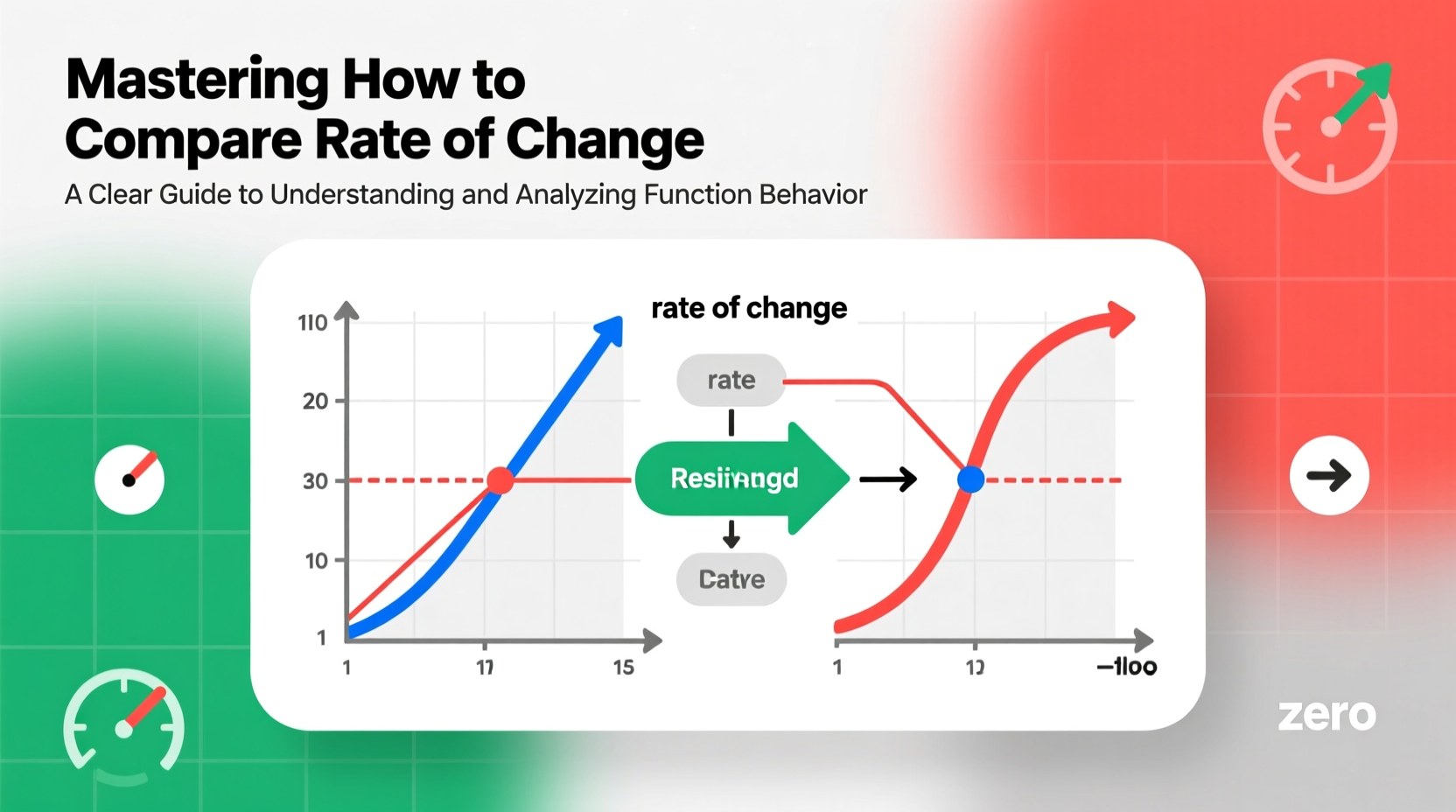
At its core, the rate of change measures how one variable changes in relation to another. In mathematical terms, for a function \\( f(x) \\), the average rate of change between two points \\( x_1 \\) and \\( x_2 \\) is given by:
\\[ \\text{Average Rate of Change} = \\frac{f(x_2) - f(x_1)}{x_2 - x_1} \\]
This formula is essentially the slope of the secant line connecting two points on a graph. When dealing with continuous and differentiable functions, the instantaneous rate of change at a point is found using the derivative \\( f'(x) \\), which represents the slope of the tangent line at that point.
Understanding this distinction—between average and instantaneous rates—is crucial when comparing how functions behave across intervals or at specific moments.
Why Comparing Rates Matters
In real-world contexts, comparing rates of change helps identify which process is accelerating faster, stabilizing, or declining. For example:
- An economist might compare GDP growth rates between countries.
- A biologist could analyze population growth curves of two species.
- An engineer may evaluate the cooling rates of different materials.
These comparisons aren't just about numbers—they reveal patterns, inform predictions, and guide strategic choices. A higher rate of change doesn’t always mean better; context determines significance.
“Rate of change isn’t just a number—it’s a story about momentum, direction, and sustainability.” — Dr. Lena Torres, Applied Mathematician
Step-by-Step Guide to Comparing Rates of Change
To systematically compare the rate of change between two or more functions, follow this structured approach:
- Define the Functions and Variables: Clearly identify the functions involved (e.g., \\( f(x) \\), \\( g(x) \\)) and what each variable represents (time, distance, cost, etc.).
- Determine the Interval or Point of Interest: Decide whether you’re comparing over an interval (average rate) or at a specific point (instantaneous rate).
- Calculate the Rates: Use the difference quotient for average rates or derivatives for instantaneous rates.
- Normalize Units if Necessary: Ensure both rates are expressed in compatible units (e.g., dollars per year vs. euros per month).
- Analyze Trends and Context: Interpret the numerical results within the problem’s domain. Is one function growing faster but unsustainable? Is the other slower but steadier?
- Visualize the Comparison: Plot both functions and their slopes to observe intersections, divergences, or convergence.
Real Example: Business Growth Analysis
Consider two startups, AlphaTech and BetaCorp, whose revenues (in thousands of dollars) are modeled by:
\\[ A(t) = 5t^2 + 10t \\quad \\text{(AlphaTech)} \\]
\\[ B(t) = 40t \\quad \\text{(BetaCorp)} \\]
where \\( t \\) is time in months.
We want to compare their growth rates after 6 months.
For AlphaTech, the instantaneous rate of change is the derivative:
\\( A'(t) = 10t + 10 \\)
At \\( t = 6 \\): \\( A'(6) = 70 \\) → $70,000/month increase.
BetaCorp’s rate is constant: \\( B'(t) = 40 \\) → $40,000/month.
Despite BetaCorp having higher total revenue early on, AlphaTech’s growth rate surpasses it by month 6 due to its quadratic nature. This insight suggests AlphaTech is scaling more aggressively, though long-term sustainability depends on market saturation and costs.
Common Pitfalls and How to Avoid Them
Misinterpreting rates of change can lead to flawed conclusions. Below is a checklist of common mistakes and corrections:
| Pitfall | Why It's Problematic | Solution |
|---|---|---|
| Mixing average and instantaneous rates | Leads to inconsistent comparisons | Clearly define the type of rate used throughout |
| Ignoring units | Invalidates direct comparison | Convert all rates to consistent units |
| Overlooking context | Numbers without meaning can mislead | Always tie results back to real-world implications |
| Assuming linearity | Fails for exponential or polynomial functions | Use calculus tools for non-linear models |
| Not checking domain restrictions | May result in undefined or irrelevant values | Verify input ranges before calculating |
Tools and Techniques for Effective Comparison
Several analytical techniques enhance accuracy when comparing rates:
- Graphical Analysis: Overlay function graphs and their tangent lines to visually assess steepness and trends.
- Derivative Sign Charts: Determine where functions are increasing, decreasing, or leveling off.
- Relative Rate Ratios: Compute ratios like \\( \\frac{f'(x)}{g'(x)} \\) to quantify how much faster one function changes than another.
- Numerical Tables: List values of functions and their differences over equal intervals to detect acceleration patterns.
For instance, if Function X increases by 5 units each step while Function Y increases by 2, then 4, then 8, the doubling pattern indicates exponential growth—its rate is not only higher but accelerating.
Checklist: Preparing to Compare Rates of Change
- ✅ Identify the dependent and independent variables
- ✅ Confirm whether data is discrete or continuous
- ✅ Choose appropriate method (difference quotient or derivative)
- ✅ Normalize scales and units
- ✅ Calculate rates for comparable intervals or points
- ✅ Interpret results in context
- ✅ Validate findings with graphical support
FAQ
Can I compare the rate of change between linear and nonlinear functions?
Yes, absolutely. While linear functions have constant rates, nonlinear ones vary. You can compare them at specific points using derivatives or over intervals using average rates. Just ensure consistent methodology and meaningful context.
What if the functions use different units?
You must convert them to the same unit system before comparison. For example, convert miles per hour to kilometers per minute if necessary. Unit mismatch invalidates any conclusion.
Is a higher rate of change always better?
Not necessarily. A high rate may indicate rapid progress, but also potential instability or unsustainability. For example, a virus spreading quickly has a high infection rate—but that’s undesirable. Always consider goals and constraints.
Conclusion
Mastering how to compare rate of change transforms abstract math into actionable insight. From predicting business trajectories to modeling natural systems, this skill enables deeper understanding of dynamic relationships. By applying structured methods, avoiding common errors, and grounding analysis in real context, you gain a powerful lens for decision-making. Mathematics isn’t just about solving equations—it’s about interpreting change in a changing world.




 浙公网安备
33010002000092号
浙公网安备
33010002000092号 浙B2-20120091-4
Comments
No comments yet. Why don't you start the discussion?