
In academic and professional writing, credibility is built not just through original thought but also through the thoughtful integration of existing knowledge. One of the most effective ways to demonstrate intellectual honesty and scholarly rigor is by citing sources correctly. Proper citation strengthens your arguments, gives credit where it’s due, and allows readers to verify claims. Yet, many writers—students, researchers, and professionals alike—struggle with the nuances of citation styles, source evaluation, and consistency. Mastering this skill is not optional; it's foundational.
Why Accurate Citation Matters
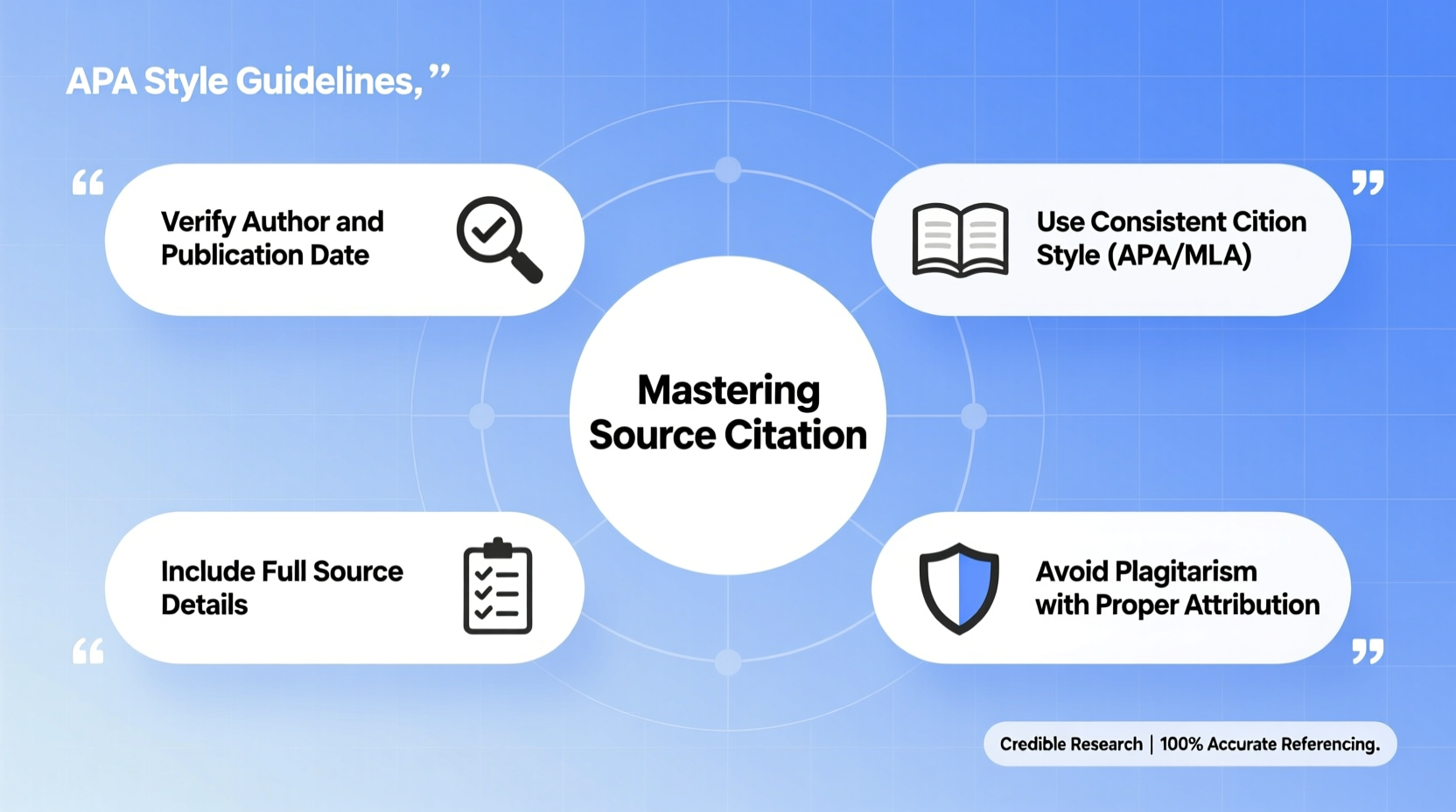
Citing sources isn't merely a formality required by instructors or publishers—it serves multiple critical functions. First, it prevents plagiarism, which can have serious consequences in both academic and professional environments. Second, citations allow readers to trace the origin of ideas, data, and quotations, fostering transparency and trust. Third, they position your work within a broader scholarly conversation, showing that you’ve engaged with relevant literature.
Incorrect or inconsistent citations undermine your credibility. A single missing page number, misattributed author, or incorrect date can cast doubt on the reliability of your entire work. In research-heavy fields like medicine, law, or history, such errors can lead to misinformation or even ethical violations.
“Citation is not about ticking boxes. It’s about participating ethically in the exchange of knowledge.” — Dr. Rebecca Thompson, Associate Professor of Academic Ethics, University of Toronto
Understanding Major Citation Styles
Different disciplines use different citation systems. The three most widely used are APA (American Psychological Association), MLA (Modern Language Association), and Chicago/Turabian. Each has distinct formatting rules for in-text citations and reference lists.
| Style | Commonly Used In | In-Text Example | Reference List Example |
|---|---|---|---|
| APA (7th ed.) | Social sciences, education, psychology | (Smith, 2020, p. 45) | Smith, J. (2020). Research methods in practice. Sage. |
| MLA (9th ed.) | Literature, humanities, arts | (Smith 45) | Smith, John. Research Methods in Practice. Sage, 2020. |
| Chicago (Notes-Bibliography) | History, fine arts, publishing | Footnote: ¹John Smith, Research Methods in Practice (Sage, 2020), 45. | Smith, John. Research Methods in Practice. Chicago: Sage, 2020. |
Choosing the correct style depends on your field, institution, or publication guidelines. Always confirm which format is required before beginning your project. Mixing styles within a single document is a common error that weakens professionalism.
A Step-by-Step Guide to Credible Referencing
Accurate citation begins long before you write your final draft. Follow this timeline to ensure thoroughness and precision at every stage.
- Evaluate Your Sources: Not all sources are equally reliable. Prioritize peer-reviewed journals, academic books, government reports, and reputable news outlets. Avoid uncited blogs, social media posts, or websites without clear authorship.
- Record Full Details Early: As you gather sources, note the author, title, publication date, publisher, URL (if online), and page numbers. Do this immediately—even if you’re unsure you’ll use the source—to avoid retracing steps later.
- Integrate Sources Thoughtfully: When quoting or paraphrasing, clearly distinguish between your voice and others’. Use signal phrases like “According to Jones (2019)” or “As demonstrated in recent studies…”
- Cite as You Write: Insert citations during drafting rather than waiting until the end. This reduces omissions and ensures each claim is properly supported.
- Compile and Format References: Create your bibliography using the required style guide. Double-check punctuation, italics, capitalization, and order of elements.
- Review for Consistency: Scan your document for uniformity in citation style, indentation, and alphabetization. Even small inconsistencies can suggest carelessness.
Common Pitfalls and How to Avoid Them
Even experienced writers make citation mistakes. Below are frequent errors and strategies to prevent them:
- Misquoting or Paraphrasing Too Closely: Changing only a few words from the original text still constitutes plagiarism. True paraphrasing involves rephrasing the idea in your own voice while preserving meaning.
- Omitting Page Numbers in Direct Quotes: In APA and MLA, direct quotes require page numbers. Omitting them makes verification impossible.
- Citing Secondary Sources Incorrectly: If you read Smith’s analysis of Jones’s theory, do not list Jones in your references unless you consulted the original. Instead, write: (Jones, as cited in Smith, 2020).
- Over-Citing Common Knowledge: Widely accepted facts (e.g., “World War II ended in 1945”) don’t need citations. When in doubt, ask: Is this information likely known by a general audience?
- Using Outdated Editions: Citation rules evolve. Using an old version of APA or MLA may result in incorrect formatting. Always consult the latest edition or official style website.
Mini Case Study: The Cost of a Missing Comma
At a major university, a graduate student submitted a thesis on climate policy that included extensive data from government reports. While the content was strong, the committee flagged over 30 citation errors—missing DOIs, incorrect author order, and inconsistent italics in journal titles. Though none were intentional, the lack of attention to detail led to a delayed defense and mandatory revisions. The student later admitted: “I thought the ideas were what mattered most. I didn’t realize how much credibility hinges on the details.”
This case illustrates that technical accuracy is inseparable from scholarly integrity. Precision in citation reflects respect for the reader and the research community.
Essential Checklist for Flawless Citations
Use this checklist before submitting any written work to ensure your referencing meets professional standards:
- ✅ All direct quotes include quotation marks and page/paragraph numbers
- ✅ Paraphrased ideas are properly attributed, even if not quoted
- ✅ Every in-text citation appears in the reference list
- ✅ All entries in the reference list are cited in the text
- ✅ Formatting follows the required style guide (APA, MLA, Chicago, etc.)
- ✅ Author names, titles, dates, and publishers are accurate and complete
- ✅ URLs are functional and, when appropriate, include DOIs
- ✅ Reference list is alphabetized and consistently formatted
- ✅ No reliance on unreliable sources (e.g., Wikipedia as primary reference)
- ✅ Secondary citations are labeled appropriately (“as cited in”)
Frequently Asked Questions
Do I need to cite sources for ideas I’ve summarized in my own words?
Yes. Even when paraphrasing, the original idea belongs to someone else. Failing to cite it constitutes plagiarism. Always credit the source of the concept, not just direct wording.
What should I do if a website has no author or date?
In APA, use the organization as author and “n.d.” for no date. In MLA, use the site name as author if no individual is listed. However, evaluate whether such a source is credible enough to include in academic work.
Can I reuse citations from a previous paper I wrote?
Yes, but only if you’re the original author and the work hasn’t been published elsewhere. However, always ensure citations still align with the current project’s context and requirements. Self-plagiarism occurs when you reuse significant portions of your prior work without acknowledgment.
Final Thoughts: Build Credibility Through Careful Citation
Mastering how to correctly cite sources is more than a technical requirement—it’s a hallmark of intellectual responsibility. Whether you're writing a research paper, blog post, or policy brief, accurate referencing shows that you value truth, transparency, and the contributions of others. It transforms your work from mere opinion into evidence-based argumentation.
The habits you build now—meticulous note-taking, consistent formatting, and critical source evaluation—will serve you throughout your academic and professional life. Excellence in citation isn’t about perfection; it’s about diligence, respect, and a commitment to integrity.




 浙公网安备
33010002000092号
浙公网安备
33010002000092号 浙B2-20120091-4
Comments
No comments yet. Why don't you start the discussion?