
The American bison stands as a symbol of strength, resilience, and wild beauty. Capturing its essence on paper requires more than just copying lines—it demands observation, structure, and emotional understanding. Whether you're a beginner or refining your skills, learning to draw a bison realistically and expressively is a rewarding challenge that deepens your grasp of animal anatomy, texture, and movement.
Drawing wildlife convincingly means going beyond surface details. It’s about understanding form, proportion, and the subtle cues that convey life—how the fur ripples over muscle, how light plays across the hump, and how the eyes suggest quiet power. This guide walks you through a structured approach to drawing the American bison, combining technical precision with artistic expression.
Analyzing Bison Anatomy: The Foundation of Realism
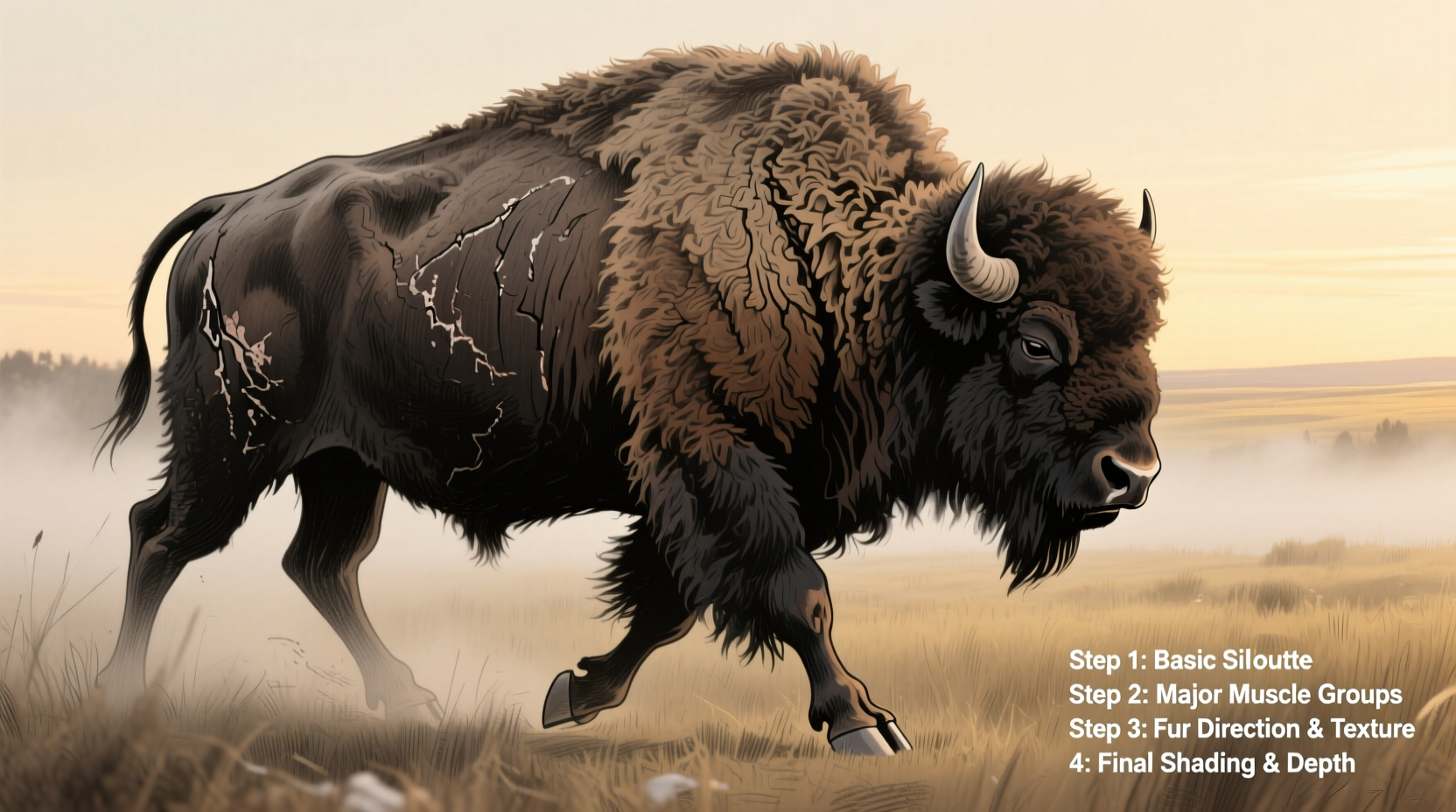
Before putting pencil to paper, study the physical structure of the American bison (*Bison bison*). Unlike domestic cattle, bison have a massive shoulder hump, a broad forehead, short curved horns, and dense fur around the head and shoulders. Their powerful front end tapers to narrower hindquarters, giving them a distinctive silhouette.
Key anatomical features to note:
- Hump and shoulders: Formed by elongated vertebrae and strong muscles, this area dominates the front half.
- Head and neck: Thick, woolly fur creates a shaggy mane; the skull is broad with small ears and upward-curving horns.
- Legs and hooves: Short but sturdy, built for endurance in rugged terrain.
- Tail: Short, with a tuft at the end, unlike longer-tailed bovines.
Observing reference photos from multiple angles helps internalize these proportions. Pay attention to how weight shifts affect posture—whether the bison is grazing, standing alert, or walking slowly across the prairie.
Step-by-Step Guide to Drawing a Bison
Follow this structured process to build your drawing from basic shapes to refined details. Use light pencil strokes at first so corrections are easy.
- Start with simple geometric forms: Draw an oval for the body, a smaller circle for the head, and cylinders for the legs. Position the hump higher than the hips to reflect natural posture.
- Connect the major masses: Link the head to the body with a thick neck shape. Add guidelines for facial features—center line, eye level, and horn placement.
- Refine the outline: Begin shaping the woolly head, defining the brow ridge, muzzle, and ear positions. Curve the back downward from the hump to the tail.
- Add facial details: Place the small, dark eyes slightly forward. Draw short, curved horns emerging above the ears. Define the broad nostrils and heavy jawline.
- Develop fur texture: Use layered, directional strokes to suggest clumps of fur, especially around the beard, chest, and shoulders. Avoid uniform lines—bison fur is coarse and irregular.
- Shade for volume: Identify a consistent light source. Deep shadows under the chin, beneath the hump, and between the legs enhance three-dimensionality.
- Finalize and refine: Darken key outlines, add fine hair strands, and use blending tools for soft transitions in shaded areas.
This method ensures accuracy while allowing room for creative interpretation. The goal isn’t robotic replication but a lifelike representation infused with character.
Techniques for Expressive and Realistic Fur Rendering
One of the most challenging aspects of drawing a bison is rendering its thick, shaggy coat without making it look flat or scribbled. Success lies in observing how light interacts with texture and layering marks strategically.
| Technique | How to Apply | Best For |
|---|---|---|
| Directional Hatching | Use short, curved lines following muscle contours | Shoulders and neck fur |
| Layered Tonal Gradation | Build up darks gradually with multiple passes | Deep shadows under the belly and jaw |
| Eraser Lifting | Use a kneaded eraser to lift graphite for highlights | Fur catching light on the hump or cheek |
| Crosshatching with Variation | Overlap lines at different angles sparingly | Textured areas like the beard and legs |
Resist the urge to cover every inch with texture. Strategic negative space and contrast between smooth and rough areas make the fur appear more natural. Focus intensity on focal points—the face, front shoulders, and eyes—while simplifying distant or shadowed regions.
“Wildlife drawing isn’t about perfection—it’s about presence. A single well-placed highlight in the eye can make the animal feel alive.” — Lena Reyes, Wildlife Illustrator & Educator
Avoiding Common Mistakes: Do’s and Don’ts
Even experienced artists fall into traps when drawing complex animals. Awareness of frequent errors helps you stay on track.
| Do | Don’t |
|---|---|
| Use reference images from reputable wildlife sources | Rely solely on memory or cartoonish depictions |
| Sketch loosely at first, then refine gradually | Commit to dark outlines too early |
| Vary pencil pressure for natural tonal transitions | Apply even, mechanical shading across large areas |
| Study real bison behavior and posture | Draw stiff, unnatural poses lacking weight distribution |
Mistakes are part of the process. If your first attempt feels off, analyze what’s not working—is it the angle of the head? The flow of the fur? Each iteration builds skill.
Mini Case Study: From Sketch to Finished Piece
Jamie, an intermediate artist, wanted to draw a bison in a winter setting. Her initial sketch had correct proportions but looked flat. After studying museum photos and videos of bison moving through snow, she noticed how their breath fogged in cold air and how sunlight highlighted the frost on their fur.
She revised her approach: starting with a light grid to align facial features, using a 2B pencil for mid-tones and a 6B for deep shadows under the jaw and legs. She lifted highlights on the top of the hump with a vinyl eraser and added subtle texture with a fine-tip tortillon. The final piece conveyed not just anatomy, but atmosphere—cold, quiet, and majestic.
Her breakthrough came from focusing on environment and mood, not just the animal itself. This holistic view transformed a technically accurate sketch into an expressive artwork.
Essential Checklist for Drawing a Realistic Bison
Keep this checklist handy during your drawing session to ensure you cover all critical aspects:
- ✅ Gather high-quality reference images from multiple angles
- ✅ Lightly sketch basic shapes (ovals, circles, cylinders) for proportion
- ✅ Mark the horizon line and eye level if including background
- ✅ Define the hump and shoulder mass before detailing the head
- ✅ Place eyes, nose, and horns using alignment guides
- ✅ Use directional strokes to mimic fur growth patterns
- ✅ Establish a single light source and shade consistently
- ✅ Add texture selectively—focus on high-impact areas
- ✅ Step back regularly to evaluate overall balance
- ✅ Finalize with strong contrasts and clean edges where needed
FAQ
What pencils should I use for drawing a bison?
A range from HB to 6B allows full control over tones. Use HB for initial sketching, 2B–4B for mid-tones, and 6B for deep shadows. A kneaded eraser helps lift highlights in fur.
How do I make the bison look powerful and not stiff?
Capture slight asymmetry in stance—one leg slightly forward, head tilted. Avoid perfect symmetry, which can look artificial. Suggest movement through directional fur lines and dynamic weight distribution.
Can I draw a bison from imagination after practicing?
Yes, but only after extensive study from references. Understanding anatomy enables confident interpretation. Even master artists rely on research before working from imagination.
Conclusion: Bring the Spirit of the Wild to Life
Drawing an American bison is more than a technical exercise—it’s an act of connection with one of North America’s most iconic creatures. With careful observation, structured technique, and attention to expressive detail, your artwork can reflect not just appearance, but presence.
Every stroke you make deepens your ability to see form, interpret light, and communicate emotion through art. Whether your goal is portfolio development, personal fulfillment, or sharing nature’s grandeur with others, mastering the bison is a milestone worth pursuing.




 浙公网安备
33010002000092号
浙公网安备
33010002000092号 浙B2-20120091-4
Comments
No comments yet. Why don't you start the discussion?