
Drawing snakes offers a unique challenge and opportunity for artistic expression. Their elongated forms, intricate scales, and fluid movement demand attention to anatomy, proportion, and motion. Whether you're aiming for scientific realism or imaginative fantasy designs, mastering snake illustration requires a blend of observation, technique, and creativity. This guide breaks down the process into actionable steps, offering insights that help both beginners and experienced artists refine their approach.
Understanding Snake Anatomy: The Foundation of Realism
To draw a convincing snake, begin with an understanding of its biological structure. Unlike mammals, snakes have highly specialized bodies adapted for flexibility and stealth. They lack limbs, but possess hundreds of vertebrae—up to 400 in some species—that allow them to move in undulating patterns across surfaces.
Their heads vary significantly depending on species: venomous snakes like vipers often have triangular heads housing venom glands, while non-venomous constrictors may have more streamlined profiles. Eyes, nostrils, and heat-sensing pits (in pit vipers) are key details that add authenticity.
When sketching, think of the snake’s body as a long cylinder that tapers toward the tail. It doesn’t simply bend—it coils, lifts, and twists in three-dimensional space. Start with light gesture lines to map out the spine’s path before adding volume.
Step-by-Step Guide to Drawing a Realistic Snake
- Sketch the central axis line: Draw a flowing curve representing the snake’s spine. This defines posture—whether it's coiled, crawling, or striking.
- Add basic body width: Mark consistent cross-sections along the axis and connect them to form a tapered tube. Keep proportions accurate; most snakes are thickest behind the head and gradually narrow.
- Define the head shape: Based on species, draw a distinct head. Include jawline, eye placement, and snout detail. Remember, many snakes can dislocate their jaws—so show slight separation if depicting feeding behavior.
- Refine the outline: Smooth the body contours, adjusting for perspective. If part of the snake is elevated, foreshorten the visible segments.
- Begin texturing with scales: Start near the head and work backward. Scales overlap like roof shingles. On the back, they’re usually hexagonal; on the belly, large rectangular scutes aid in locomotion.
- Apply shading and depth: Identify your light source. Shade the underside and inner curves. Use hatching or stippling to simulate scale texture without overworking the surface.
- Finalize details: Enhance eyes with reflective dots, darken pits or nostrils, and vary scale edges to suggest wear or moisture.
Common Pitfalls to Avoid
| Do | Avoid |
|---|---|
| Use overlapping curves to show 3D form | Draw flat, ribbon-like bodies with no volume |
| Vary scale size and direction based on anatomy | Repeat identical scale patterns uniformly across the body |
| Show muscle tension in bends and coils | Make sharp, angular kinks inconsistent with biology |
| Study real species for color and pattern accuracy | Guess markings without references (e.g., misplacing rattlesnake bands) |
Creative Approaches: From Mythical Serpents to Stylized Art
Beyond realism lies a rich world of artistic interpretation. Snakes appear in mythology, symbolism, and fantasy art—from Norse Jörmungandr encircling the Earth to Mesoamerican feathered serpents. These designs invite exaggeration, abstraction, and fusion with other elements.
To create stylized snakes, consider altering proportions: elongate the body dramatically, enlarge the eyes for emotive effect, or incorporate geometric scale patterns. Some artists use snakes as frames for typography or integrate floral motifs within the coil.
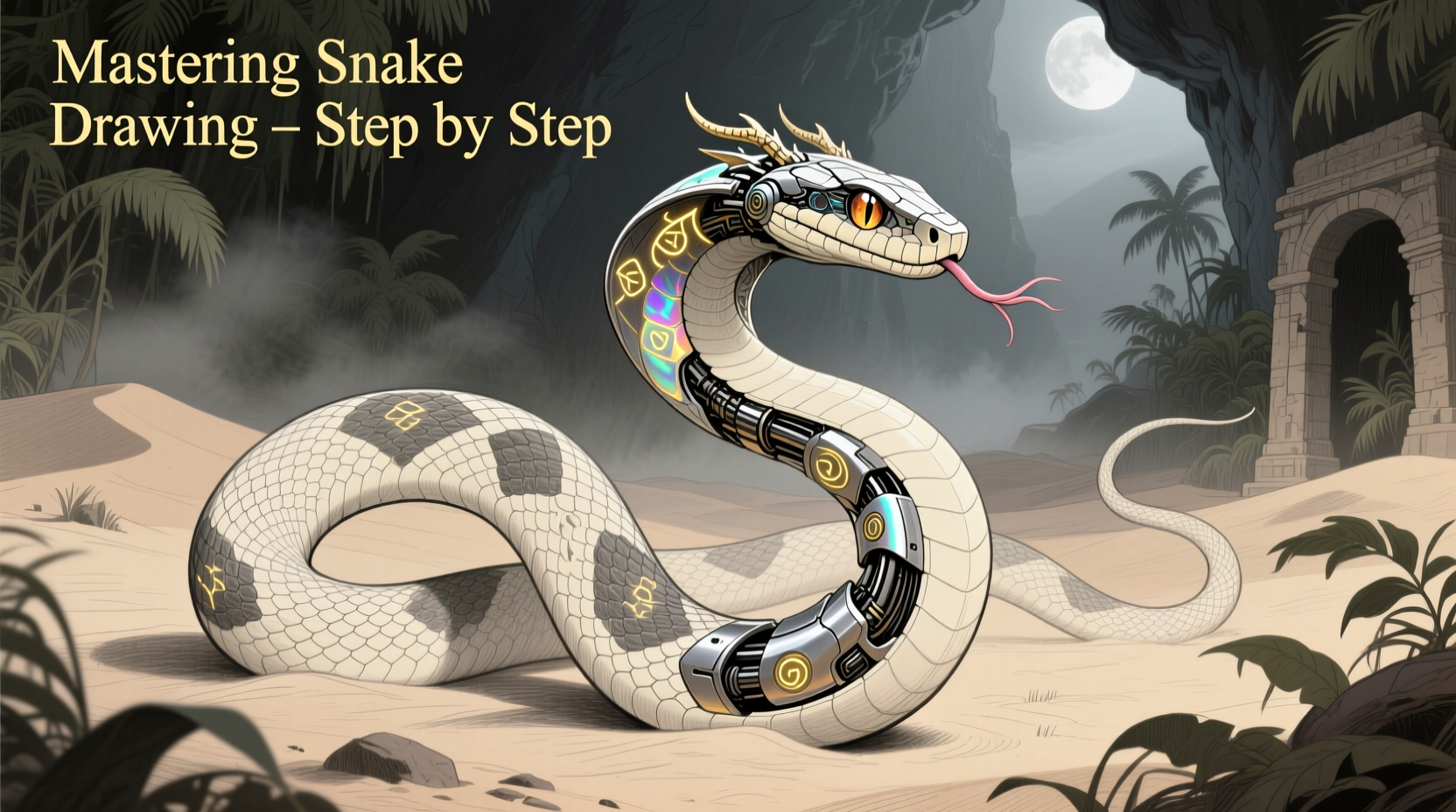
In digital illustration, layering gradients and metallic textures can transform a simple sketch into a mystical creature. For example, a cybernetic snake might feature glowing circuit-like patterns beneath translucent scales, blending organic and mechanical aesthetics.
“Snakes are not just animals—they’re symbols of transformation, danger, and wisdom. Capturing that essence elevates a drawing beyond mere representation.” — Lena Torres, Wildlife Illustrator & Educator
Mini Case Study: Designing a Fantasy Forest Guardian
An artist commissioned to illustrate a forest guardian chose a serpent motif rooted in Celtic design. Starting with a copperhead reference, they exaggerated the body length to wrap around an ancient tree. Instead of natural skin, the snake’s scales were reimagined as interlocking leaves and bark fragments, colored in deep moss greens and earthy browns.
The eyes glowed faintly amber, suggesting magic. By combining anatomical accuracy with symbolic elements, the final piece felt both believable and mythical. Viewers recognized the snake’s true form while perceiving its role as a protector of nature.
Essential Tools and Techniques for Texture and Detail
The illusion of realism hinges on texture. Snakes’ skin varies widely: pythons have smooth, glossy scales; desert vipers exhibit keeled (ridged) scales that scatter light; sea snakes may appear almost metallic.
- Pencil grading: Use HB for outlines, 2B–4B for midtones, and 6B for deep shadows. Blend with stumps or tissue for seamless gradients.
- Ink detailing: Fine liners (0.1–0.3 mm) excel at rendering individual scales. Work from top to bottom to avoid smudging.
- Digital methods: Use textured brushes set to low opacity to build up scale layers gradually. Layer masks help adjust lighting independently.
Checklist: Preparing for Your Next Snake Illustration
- ✅ Choose a specific species or concept (realistic vs. stylized)
- ✅ Gather high-quality reference images from multiple angles
- ✅ Sketch the spine curve and establish body thickness
- ✅ Block in head structure and facial features
- ✅ Map major pattern elements (stripes, spots, bands)
- ✅ Begin scale texturing from the front, working backward
- ✅ Apply consistent lighting and shading
- ✅ Refine details: eyes, mouth, environmental interaction (e.g., grass contact)
Frequently Asked Questions
How do I make my snake drawing look 3D and not flat?
Create dimension by emphasizing the cylindrical form. Shade one side consistently based on a single light source. Add subtle highlights along the ridge of the back and soften transitions between light and shadow. Overlapping coils also enhance depth perception.
What’s the best way to draw coiled snakes?
Begin with a spiral guideline for the base coil, then draw the upper loops rising from the center. Each loop should slightly overlap the one below. Pay attention to perspective—coils closer to the viewer appear wider and more compressed.
Can I use symmetry when drawing snake patterns?
Limited symmetry works well—especially along the dorsal line—but avoid perfect mirroring. Natural patterns have slight variations. For instance, a stripe may widen on one side or break near the tail. Imperfections increase believability.
Mastery Through Practice and Observation
Drawing snakes well isn’t about replicating a formula—it’s about learning to observe, interpret, and innovate. Spend time studying live snakes at zoos or through documentaries. Notice how they rest, strike, or glide over terrain. Capture these movements in quick gesture sketches to internalize their rhythm.
Over time, you’ll develop an intuitive sense of how their bodies compress and stretch. Combine this knowledge with creative experimentation, and your drawings will evolve from technical exercises to compelling artworks.




 浙公网安备
33010002000092号
浙公网安备
33010002000092号 浙B2-20120091-4
Comments
No comments yet. Why don't you start the discussion?