
Improper fractions are a fundamental concept in mathematics, often appearing in arithmetic, algebra, and real-life applications like cooking, construction, and finance. An improper fraction is simply a fraction where the numerator (top number) is greater than or equal to the denominator (bottom number). While the term “improper” might suggest something incorrect, these fractions are perfectly valid—and essential—for deeper mathematical understanding. Knowing how to work with them confidently empowers students and adults alike to handle more complex problems with ease.
Understanding Improper Fractions: The Basics
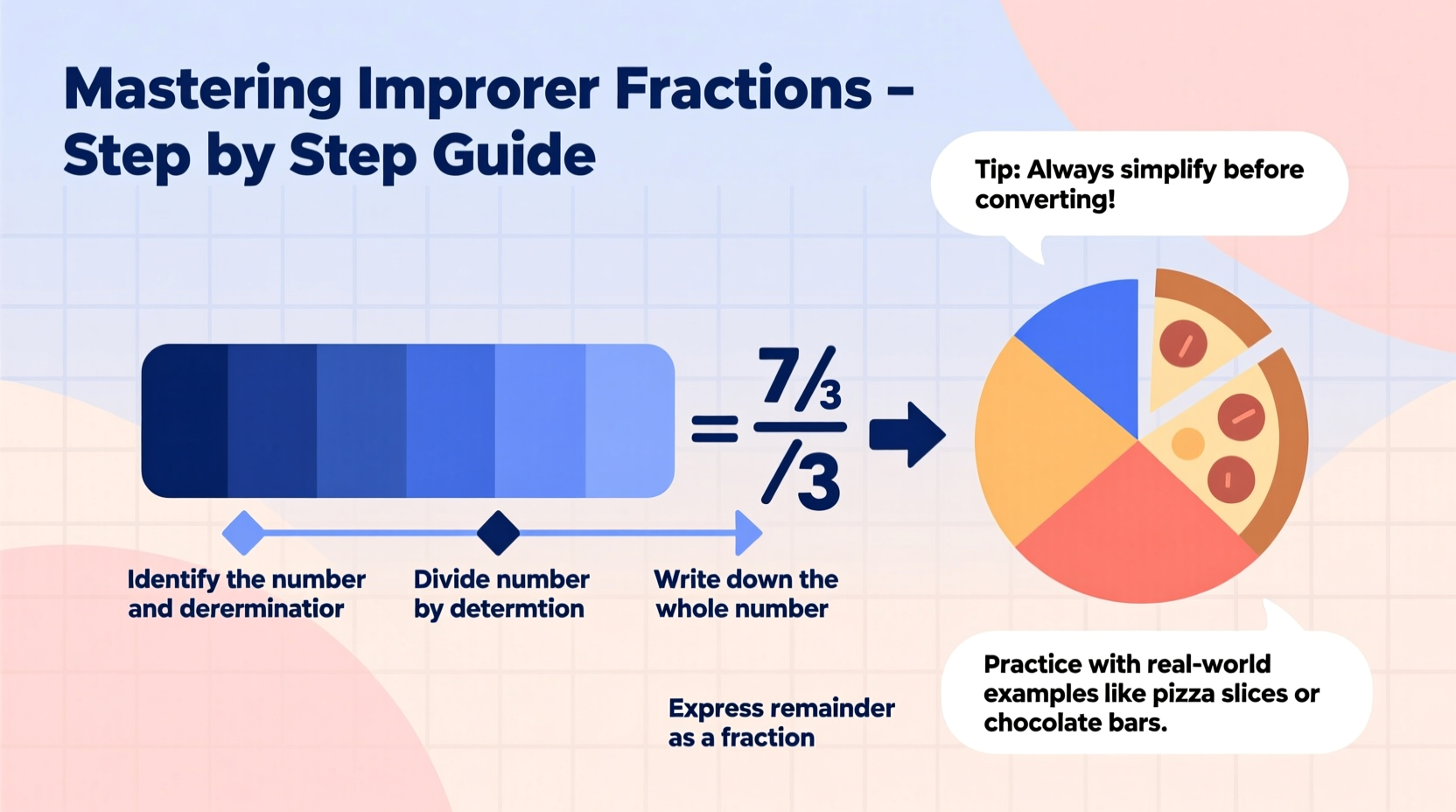
A fraction represents a part of a whole. In proper fractions, the numerator is smaller than the denominator (e.g., 3/4). But when you have more than one whole unit—such as five quarters—you end up with an improper fraction: 5/4. This doesn’t mean it’s wrong; it just means it's greater than 1.
For example, if you eat 5 slices of a pizza cut into 4 equal pieces, you’ve eaten 5/4 of a pizza—one whole pizza and one extra slice. Expressing quantities this way is both accurate and useful.
Step-by-Step Guide to Expressing Improper Fractions
Converting between mixed numbers and improper fractions is a core skill. Below is a clear, repeatable process for both directions.
Step 1: Convert Mixed Numbers to Improper Fractions
- Multiply the whole number by the denominator.
- Add the result to the numerator.
- Write the sum over the original denominator.
Example: Convert 3 2/5 to an improper fraction.
- Multiply: 3 × 5 = 15
- Add: 15 + 2 = 17
- Result: 17/5
Step 2: Convert Improper Fractions to Mixed Numbers
- Divide the numerator by the denominator.
- The quotient becomes the whole number.
- The remainder becomes the new numerator.
- The denominator stays the same.
Example: Convert 19/6 to a mixed number.
- Divide: 19 ÷ 6 = 3 with a remainder of 1
- Whole number: 3
- Remainder: 1 → new numerator
- Denominator: 6
- Result: 3 1/6
Step 3: Simplify When Necessary
After conversion, always check if the fraction can be simplified. Reduce by dividing both numerator and denominator by their greatest common divisor (GCD).
Example: 10/4 simplifies to 5/2 (divide both by 2), which can then be written as 2 1/2.
Practical Applications and Real-World Examples
Improper fractions aren’t just textbook exercises—they appear in everyday situations.
Mini Case Study: Baking with Fractional Measurements
Sophia is baking cookies and needs to double a recipe that calls for 3/4 cup of sugar. Doubling gives her 6/4 cups. Instead of measuring six quarter-cups manually, she converts 6/4 to a mixed number: 1 1/2 cups. This makes measurement easier and reduces errors. Recognizing that 6/4 is equivalent to 1 1/2 saves time and improves accuracy.
This simple conversion shows how fluency with improper fractions supports practical decision-making in daily tasks.
Common Mistakes and How to Avoid Them
Even capable learners make avoidable errors when working with improper fractions. Awareness prevents repetition.
| Mistake | Why It Happens | How to Fix It |
|---|---|---|
| Forgetting to multiply the whole number when converting to improper fractions | Rushing through steps or misunderstanding the process | Always follow: (whole × denominator) + numerator |
| Placing the remainder in the denominator instead of the numerator | Confusion during division step | Remember: remainder goes on top, original denominator stays |
| Not simplifying final answers | Overlooking reduction opportunities | Check GCD after every conversion |
“Students who master improper fractions early develop stronger foundations for algebra and problem-solving.” — Dr. Linda Park, Mathematics Education Researcher
Essential Tips for Mastery
Building lasting proficiency requires consistent practice and smart strategies. Here are key techniques to internalize the skill.
- Use visual models like fraction bars or circles to see how 7/3 equals two full units plus 1/3.
- Relate conversions to money: $5.75 is like 5 + 3/4, which connects to mixed numbers.
- Label your work clearly: write “=?” and show each step to avoid skipping logic.
- Double-check using reverse conversion: turn 11/4 into 2 3/4, then convert back to confirm.
Checklist: Mastering Improper Fractions
- Convert 3 mixed numbers to improper fractions
- Convert 3 improper fractions to mixed numbers
- Simplify at least 2 fractions after conversion
- Verify one answer by reversing the process
- Apply fractions to a real task (e.g., doubling a recipe)
Frequently Asked Questions
Can an improper fraction be negative?
Yes. A fraction like -7/3 is still improper because the absolute value of the numerator (7) is greater than the denominator (3). The negative sign applies to the entire value.
Is it necessary to convert improper fractions to mixed numbers?
It depends on context. In mathematical calculations, improper fractions are often preferred because they’re easier to multiply or divide. However, in communication—especially in real-world settings like cooking or carpentry—mixed numbers are clearer and more intuitive.
What if the numerator and denominator are equal?
If the numerator equals the denominator (e.g., 8/8), the fraction equals 1. This is still considered improper because the rule is “numerator ≥ denominator,” but it simplifies directly to a whole number.
Conclusion: Build Confidence Through Practice
Mastering how to express improper fractions is not about memorizing rules—it’s about developing number sense and flexibility. Whether you're helping a child with homework, studying for a test, or adjusting measurements in a kitchen, this skill enhances clarity and precision. With structured practice, awareness of common pitfalls, and real-world application, anyone can become fluent.




 浙公网安备
33010002000092号
浙公网安备
33010002000092号 浙B2-20120091-4
Comments
No comments yet. Why don't you start the discussion?