
Understanding the long-term behavior of functions is essential in calculus, mathematical modeling, and real-world applications like population growth or economic forecasting. One of the most revealing features of a function’s end behavior is the horizontal asymptote—a horizontal line that the graph approaches as x tends toward positive or negative infinity. Unlike vertical asymptotes, which indicate where a function grows without bound, horizontal asymptotes describe stability and limits at extreme values.
Despite their importance, many students struggle with identifying horizontal asymptotes due to inconsistent rules across function types. This guide demystifies the process, offering a structured approach applicable to rational, exponential, and other common functions.
What Is a Horizontal Asymptote?
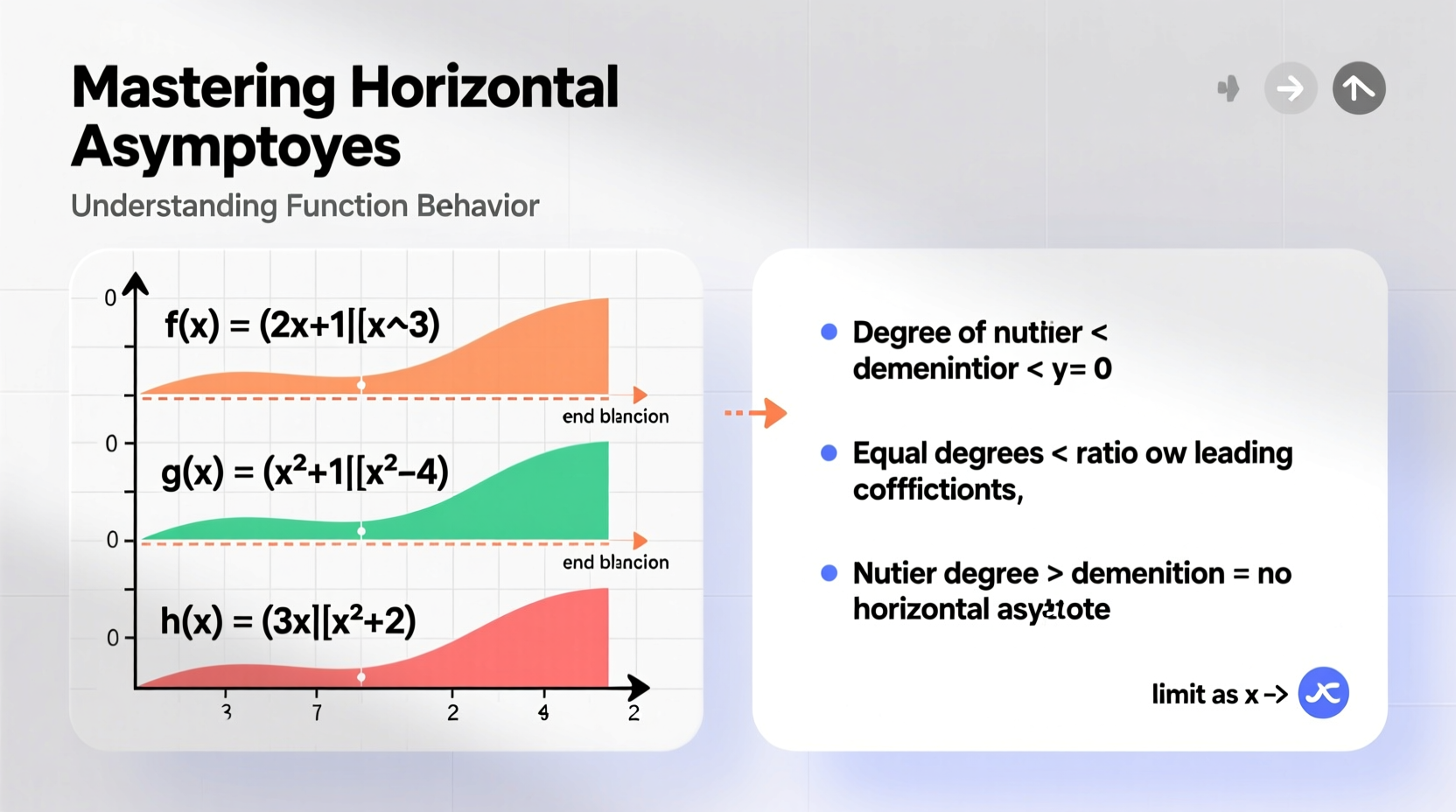
A horizontal asymptote is a y-value that a function approaches as x → ∞ or x → –∞. It does not require the function to ever reach this value—only that it gets arbitrarily close over time. For example, the function f(x) = 1/x has a horizontal asymptote at y = 0, because as x grows larger (in either direction), the output shrinks toward zero.
Unlike slant or vertical asymptotes, horizontal asymptotes are always parallel to the x-axis. They provide insight into equilibrium states in dynamic systems. In pharmacokinetics, for instance, drug concentration in the bloodstream may approach a steady-state level—an idea modeled by a horizontal asymptote.
“Horizontal asymptotes reflect the ultimate fate of a system described by a function—they tell us where things settle after the chaos subsides.” — Dr. Alan Reyes, Applied Mathematician
Finding Horizontal Asymptotes in Rational Functions
Rational functions—ratios of two polynomials—are the most common context for learning about horizontal asymptotes. The key lies in comparing the degrees of the numerator and denominator.
Let f(x) = P(x)/Q(x), where P(x) and Q(x) are polynomials. Let n be the degree of the numerator and d the degree of the denominator. Three cases determine the horizontal asymptote:
| Degree Comparison | Asymptote Rule | Example |
|---|---|---|
| n < d | y = 0 | f(x) = (2x + 1)/(x² – 3) → y = 0 |
| n = d | y = a/b, where a and b are leading coefficients | f(x) = (4x² + 3)/(2x² – 5) → y = 4/2 = 2 |
| n > d | No horizontal asymptote (may have slant asymptote instead) | f(x) = (x³ + 2)/(x² + 1) → No HA; check for oblique |
This framework applies regardless of coefficient complexity. What matters is the highest-degree term’s influence as x becomes very large.
Step-by-Step Guide: Analyzing a Rational Function
- Simplify the function by factoring and canceling common terms.
- Determine the degree of the numerator (n) and denominator (d).
- Compare n and d using the three-case rule above.
- If n = d, divide the leading coefficients to find y = a/b.
- Verify behavior numerically by plugging in large values of x (e.g., 1000, –1000).
Exponential and Other Non-Rational Functions
Not all functions with horizontal asymptotes are rational. Exponential decay and logistic models frequently exhibit them.
Consider f(x) = 2 + e⁻ˣ. As x → ∞, e⁻ˣ → 0, so f(x) → 2. Thus, y = 2 is a horizontal asymptote. As x → –∞, e⁻ˣ → ∞, so no asymptote exists on the left side.
Similarly, logistic functions such as f(x) = L / (1 + e⁻ᵏˣ) have two horizontal asymptotes: y = 0 as x → –∞ and y = L as x → ∞. These model phenomena like market saturation or disease spread leveling off.
In general, look for terms that vanish at infinity. If a function can be written as f(x) = C + g(x), where g(x) → 0 as x → ±∞, then y = C is a horizontal asymptote.
Common Misconceptions and Errors
- Mistake: Assuming all functions have horizontal asymptotes.
Reality: Polynomials of degree ≥1 grow without bound and lack horizontal asymptotes. - Mistake: Confusing horizontal and vertical asymptotes.
Reality: Vertical asymptotes come from undefined points (like division by zero); horizontal ones describe end behavior. - Mistake: Believing the function cannot cross its horizontal asymptote.
Reality: It can—and often does. For example, f(x) = sin(x)/x crosses y = 0 infinitely many times while still approaching it.
Mini Case Study: Modeling Internet Adoption Rates
A technology analyst uses the logistic function f(t) = 90 / (1 + 5e⁻⁰·²ᵗ) to model internet adoption in a developing region, where t is years since 2000 and f(t) is percentage of households online.
To forecast long-term penetration, she identifies horizontal asymptotes. As t → ∞, e⁻⁰·²ᵗ → 0, so the denominator approaches 1. Therefore, f(t) → 90 / 1 = 90. The horizontal asymptote is y = 90.
This means, under current trends, internet adoption will approach but not exceed 90%. The company adjusts infrastructure plans accordingly, focusing on reaching near-total coverage rather than assuming 100% uptake.
Checklist: How to Find Horizontal Asymptotes
Use this checklist whenever analyzing a function’s end behavior:
- ✅ Determine if the function is rational, exponential, logarithmic, or another type.
- ✅ For rational functions, compare degrees of numerator and denominator.
- ✅ Simplify algebraic expressions before analysis.
- ✅ Evaluate limits as x → ∞ and x → –∞ separately if needed.
- ✅ Look for decaying terms (like e⁻ˣ) that vanish at infinity.
- ✅ Verify results by testing large input values numerically.
- ✅ Remember: crossing the asymptote is allowed. Only the trend matters.
FAQ
Can a function have more than one horizontal asymptote?
Yes, but only two—one as x → ∞ and another as x → –∞. For example, f(x) = arctan(x) has y = π/2 as x → ∞ and y = –π/2 as x → –∞. Most standard functions have the same limit in both directions.
Do square root functions have horizontal asymptotes?
No. Functions like f(x) = √x grow without bound as x → ∞, albeit slowly. Since they don’t approach a finite y-value, there is no horizontal asymptote.
Is a horizontal asymptote the same as a limit at infinity?
Essentially, yes. The horizontal asymptote y = L exists if and only if limₓ→∞ f(x) = L or limₓ→–∞ f(x) = L. The asymptote is the graphical representation of that limit.
Conclusion
Mastering how to find horizontal asymptotes unlocks deeper understanding of how functions behave over time. Whether you're simplifying rational expressions, modeling real-world trends, or preparing for advanced calculus, recognizing these invisible boundaries helps predict outcomes and interpret graphs with confidence. The rules are consistent once you know how to classify the function and apply the right analytical tools.




 浙公网安备
33010002000092号
浙公网安备
33010002000092号 浙B2-20120091-4
Comments
No comments yet. Why don't you start the discussion?