
Acid-base chemistry is foundational in both general and organic chemistry, influencing everything from biological systems to industrial processes. At the heart of this field lies the concept of equilibrium constants—specifically, Ka (acid dissociation constant) and Kb (base dissociation constant). These values quantify the strength of acids and bases in aqueous solutions, allowing chemists to predict reaction outcomes, pH levels, and buffer effectiveness. Yet many students struggle with deriving and applying these constants effectively. This guide demystifies the process, offering a structured approach to mastering Ka and Kb calculations while deepening your understanding of acid-base equilibria.
Understanding Acid and Base Strength Through Equilibrium
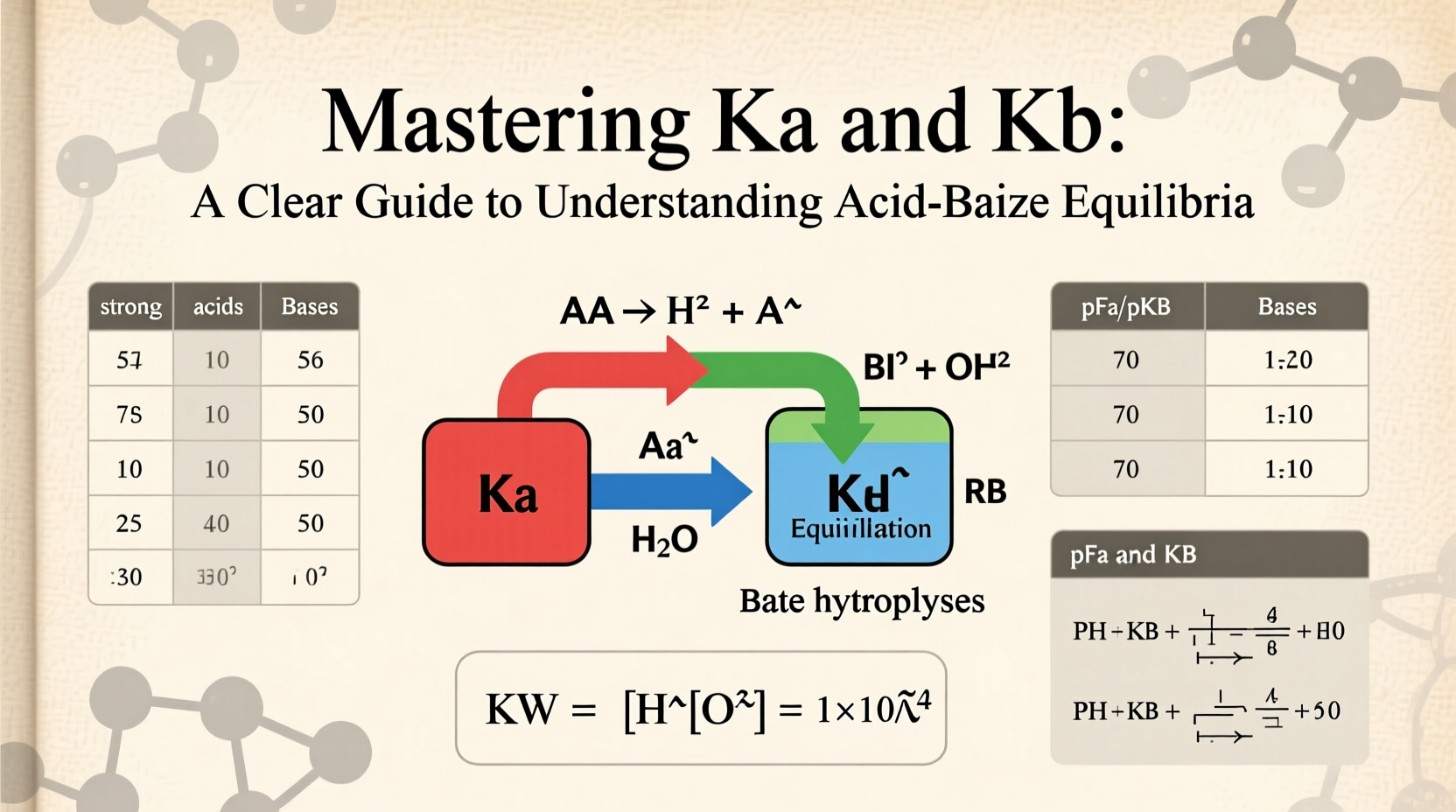
In aqueous solutions, weak acids and bases do not fully dissociate. Instead, they establish a dynamic equilibrium between the undissociated molecules and their ions. For a generic weak acid HA:
HA(aq) + H₂O(l) ⇌ H₃O⁺(aq) + A⁻(aq)
The equilibrium expression for this reaction defines Ka:
Ka = [H₃O⁺][A⁻] / [HA]
Likewise, for a weak base B:
B(aq) + H₂O(l) ⇌ BH⁺(aq) + OH⁻(aq)
The corresponding Kb is:
Kb = [BH⁺][OH⁻] / [B]
The magnitude of Ka or Kb directly reflects the strength of the acid or base. A higher Ka means a stronger acid; a higher Kb indicates a stronger base. Importantly, water’s autoionization links these two constants through the ion product constant Kw:
Kw = Ka × Kb = 1.0 × 10⁻¹⁴ at 25°C
This relationship allows you to find Kb if you know Ka (or vice versa), provided the conjugate pair is involved.
Step-by-Step Guide to Finding Ka and Kb
Calculating Ka or Kb follows a logical sequence based on experimental data or known concentrations. Below is a universal method applicable to most textbook and lab scenarios.
- Write the balanced chemical equation for the dissociation of the acid or base in water.
- Set up an ICE table (Initial, Change, Equilibrium) to track concentration changes.
- Substitute equilibrium concentrations into the Ka or Kb expression.
- Solve for the unknown, often using approximations when justified (e.g., x << initial concentration).
- Verify assumptions using the 5% rule: if x is less than 5% of the initial concentration, the approximation holds.
For example, consider acetic acid (CH₃COOH) with an initial concentration of 0.10 M and a measured pH of 2.87.
pH = 2.87 → [H₃O⁺] = 10⁻²·⁸⁷ ≈ 1.35 × 10⁻³ M
Using the ICE table:
| CH₃COOH | H₃O⁺ | CH₃COO⁻ | |
|---|---|---|---|
| Initial (M) | 0.10 | 0 | 0 |
| Change (M) | -x | +x | +x |
| Equilibrium (M) | 0.10 - x | x | x |
Since x = 1.35 × 10⁻³,
Ka = (x)(x) / (0.10 - x) ≈ (1.35 × 10⁻³)² / 0.10 = 1.82 × 10⁻⁵
This result aligns closely with the accepted Ka value for acetic acid (1.8 × 10⁻⁵), validating the method.
Practical Applications and Real-World Context
Understanding Ka and Kb isn’t limited to passing exams—it has tangible applications. Consider pharmaceutical formulation, where the pKa of a drug influences its solubility and ability to cross cell membranes. A compound with a pKa near physiological pH (7.4) may exist in both protonated and deprotonated forms, affecting absorption rates.
“Knowing the Ka of active ingredients allows us to optimize delivery and stability in liquid medications.” — Dr. Lena Torres, Pharmaceutical Chemist
Another example involves environmental science. Rainwater acidity is influenced by dissolved CO₂ forming carbonic acid (H₂CO₃), which has two Ka values due to stepwise dissociation:
- H₂CO₃ ⇌ H⁺ + HCO₃⁻ (Ka₁ ≈ 4.3 × 10⁻⁷)
- HCO₃⁻ ⇌ H⁺ + CO₃²⁻ (Ka₂ ≈ 5.6 × 10⁻¹¹)
These values help model ocean acidification and buffer capacity in natural waters.
Common Pitfalls and How to Avoid Them
Even experienced students make errors when calculating Ka and Kb. The following checklist helps prevent frequent mistakes:
- Confirm the substance is a weak acid/base before applying equilibrium expressions.
- Use molarity (mol/L), not mass or percentage, in calculations.
- Account for stoichiometry: some bases produce more than one OH⁻ per molecule.
- Double-check ICE table setup—signs matter (e.g., reactants decrease, products increase).
- Always state units and significant figures appropriately.
A common misconception is treating polyprotic acids as monoprotic. For instance, sulfuric acid (H₂SO₄) is strong in its first proton donation but weak in the second (Ka₂ = 1.2 × 10⁻²). Failing to recognize this leads to inaccurate pH predictions.
Do’s and Don’ts When Working With Ka and Kb
| Action | Do | Don't |
|---|---|---|
| Setting up equilibrium expressions | Exclude pure liquids (like H₂O) from Ka/Kb expressions | Include water concentration in the expression |
| Using approximations | Apply x ≈ 0 when initial concentration is much greater than Ka | Assume approximation without checking the 5% rule |
| Relating Ka and Kb | Use Ka × Kb = Kw only for conjugate pairs | Apply the relationship to unrelated acids and bases |
| Interpreting magnitude | Recognize that pKa = –log(Ka); lower pKa = stronger acid | Assume a larger number always means stronger acid |
Frequently Asked Questions
Can I find Ka from pH alone?
Yes, if you know the initial concentration of a weak acid and measure the pH, you can calculate [H⁺], then use an ICE table to determine Ka. This is one of the most common lab-based methods.
What if I’m given Kb but need Ka?
If you’re dealing with a conjugate acid-base pair, use the relationship Ka × Kb = 1.0 × 10⁻¹⁴. For example, if ammonia (NH₃) has a Kb of 1.8 × 10⁻⁵, then the Ka of its conjugate acid NH₄⁺ is 10⁻¹⁴ / 1.8 × 10⁻⁵ = 5.56 × 10⁻¹⁰.
Why are some Ka values listed as “very large”?
Strong acids like HCl or HNO₃ are considered to have “infinite” or very large Ka values because they dissociate completely in water. Their equilibria lie entirely to the right, making Ka impractical to measure directly.
Putting It All Together: A Mini Case Study
Sarah, a biochemistry student, was tasked with preparing a buffer solution using formic acid (HCOOH) and sodium formate. She needed to confirm the Ka of formic acid experimentally. She prepared a 0.20 M solution of HCOOH and measured its pH as 2.23.
From pH: [H⁺] = 10⁻²·²³ ≈ 5.89 × 10⁻³ M
ICE Table:
- Initial [HCOOH] = 0.20 M
- Change: –x → x = 5.89 × 10⁻³
- Equilibrium: [HCOOH] = 0.20 – 0.00589 ≈ 0.194 M
Ka = (5.89 × 10⁻³)² / 0.194 ≈ 1.79 × 10⁻⁴
The literature value is 1.8 × 10⁻⁴—her result was accurate within rounding error. This exercise reinforced her confidence in handling equilibrium problems and highlighted the importance of precise pH measurement.
Conclusion: Take Control of Acid-Base Chemistry
Mastery of Ka and Kb is not about memorizing formulas—it's about understanding behavior at the molecular level. By practicing systematic problem-solving, recognizing patterns in conjugate pairs, and learning from real-world contexts, you transform abstract constants into powerful tools. Whether you're preparing for exams, conducting lab work, or advancing in a science-related career, fluency in acid-base equilibria opens doors.




 浙公网安备
33010002000092号
浙公网安备
33010002000092号 浙B2-20120091-4
Comments
No comments yet. Why don't you start the discussion?