
The letter m represents the slope of a line—a fundamental concept in algebra and calculus that quantifies how steep or shallow a line is. Whether you're analyzing data trends, designing engineering models, or solving geometric problems, knowing how to accurately find m is essential. The slope determines direction and rate of change, making it one of the most practical tools in mathematics. This guide breaks down every method for calculating slope, from basic formulas to advanced interpretations, so you can apply them confidently across different types of equations.
Understanding What “m” Represents
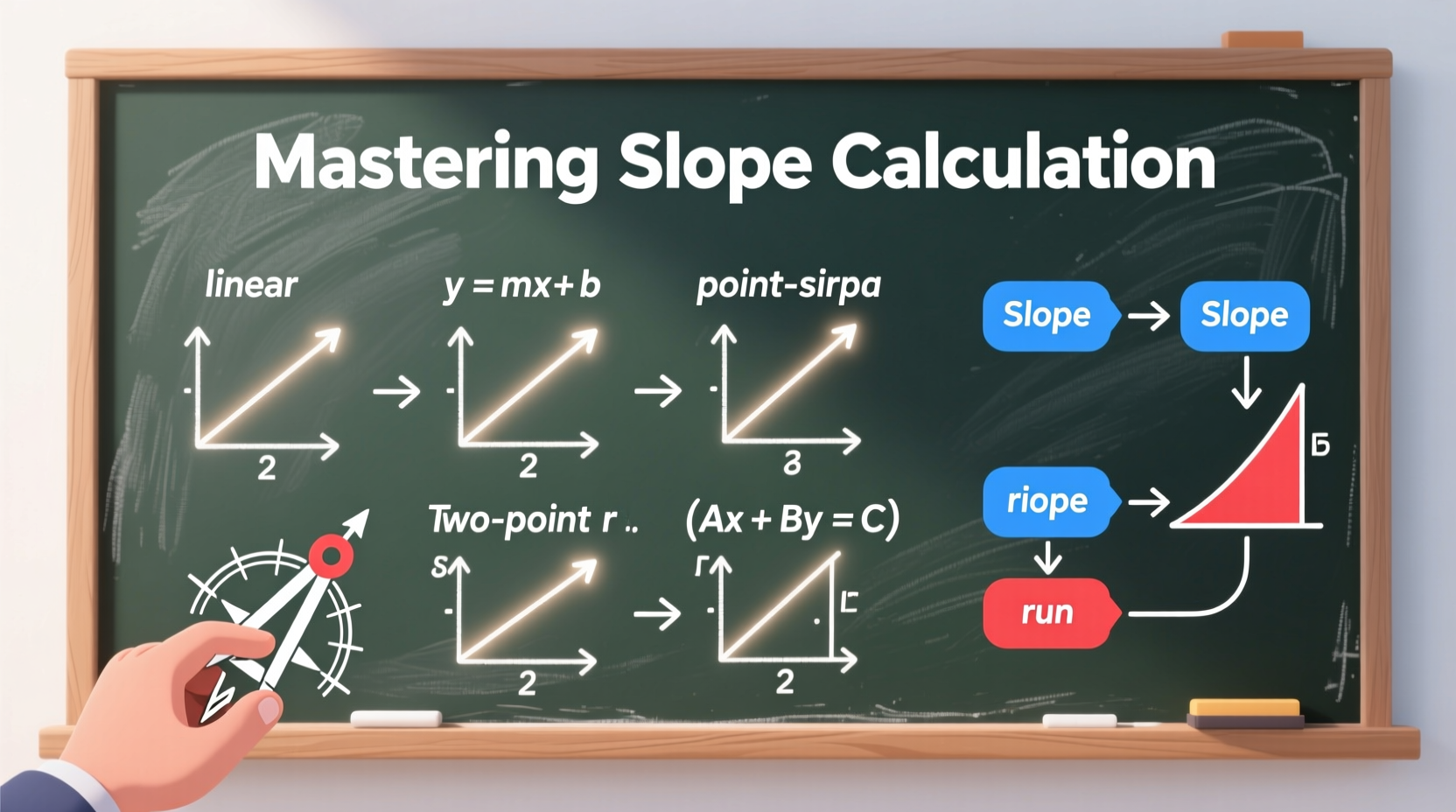
In the linear equation y = mx + b, m stands for the slope—the ratio of vertical change (rise) to horizontal change (run) between any two points on a line. A positive m indicates an upward trend, while a negative value means the line descends. A zero slope corresponds to a flat, horizontal line; an undefined slope occurs when the line is perfectly vertical.
Slope isn’t just theoretical—it has real implications. In economics, it can represent marginal cost; in physics, velocity; in machine learning, the weight of a feature. Understanding what m measures allows you to interpret results meaningfully beyond mere calculation.
“Slope is more than a number—it’s a story of change. Learning to read it correctly transforms abstract math into actionable insight.” — Dr. Alan Reyes, Applied Mathematician
Step-by-Step Guide to Calculating Slope from Two Points
The most common way to find m is by using two known points on a line: (x₁, y₁) and (x₂, y₂). The formula is straightforward:
m = (y₂ – y₁) / (x₂ – x₁)
Follow this five-step process to ensure accuracy:
- Identify two distinct points on the line.
- Label the coordinates as x₁, y₁ and x₂, y₂.
- Subtract the y-values: y₂ – y₁ (this is the rise).
- Subtract the x-values: x₂ – x₁ (this is the run).
- Divide the rise by the run to get m.
For example, given points (3, 5) and (7, 9):
- Rise = 9 – 5 = 4
- Run = 7 – 3 = 4
- m = 4/4 = 1
This tells us the line rises 1 unit for every 1 unit moved right—indicating a 45-degree incline.
Finding Slope from Different Equation Forms
Not all equations appear in the familiar y = mx + b format. Being able to extract m from various forms is crucial for mastering slope calculation.
| Equation Type | Form | How to Find m |
|---|---|---|
| Slope-Intercept | y = mx + b | m is already visible (coefficient of x) |
| Point-Slope | y – y₁ = m(x – x₁) | m is explicitly stated |
| Standard Form | Ax + By = C | Rearrange to solve for y, then identify m |
| General Polynomial | f(x) = ax² + bx + c | Use derivative: f’(x) = 2ax + b → slope varies per x |
Take the standard form equation: 4x + 2y = 8. To find m, isolate y:
- 2y = -4x + 8
- y = -2x + 4
Now, m = -2. This means the line falls 2 units vertically for every 1 unit moved horizontally.
Advanced Method: Using Derivatives for Nonlinear Equations
While straight lines have constant slopes, curves require a different approach. Here, m becomes the instantaneous rate of change at a specific point—calculated using derivatives.
For instance, consider the quadratic function f(x) = x² + 3x. Its derivative is:
f’(x) = 2x + 3
This new function gives the slope of the tangent line at any point x. At x = 1:
m = 2(1) + 3 = 5
This technique is indispensable in calculus, engineering, and data science, where understanding how variables change relative to each other is critical.
Mini Case Study: Applying Slope in Real Life
Jamal is a civil engineer designing a wheelchair-accessible ramp for a public library. Safety regulations require a maximum slope of 1:12 (rise over run), meaning no more than 1 inch of elevation per 12 inches of horizontal length.
The entrance is 30 inches above ground level. Jamal must determine the minimum required ramp length:
- Slope limit: m = 1/12
- Total rise: 30 inches
- Required run = rise / m = 30 / (1/12) = 360 inches (30 feet)
Using the slope formula, he confirms the design complies with ADA standards. Without accurate slope calculation, the ramp could pose a safety hazard. This example illustrates how mastering m translates directly into real-world impact.
Checklist: How to Accurately Find m in Any Situation
Use this checklist whenever you need to calculate slope:
- ✅ Determine if the relationship is linear or nonlinear.
- ✅ Identify available information: two points, equation, graph, or context?
- ✅ Choose the correct method: two-point formula, rearranging equations, or differentiation.
- ✅ Perform calculations carefully, watching signs and order of operations.
- ✅ Interpret the result: Is the slope positive, negative, zero, or undefined?
- ✅ Verify with a second method if possible (e.g., check calculated m against a graph).
Common Pitfalls and How to Avoid Them
Even experienced students make mistakes when calculating slope. Watch out for these common errors:
- Mixing up x and y coordinates: Ensure you subtract y-values for the numerator and x-values for the denominator.
- Ignoring undefined slopes: If x₂ – x₁ = 0, the slope is undefined (vertical line)—don’t call it zero.
- Assuming all equations are linear: Parabolas and exponentials don’t have a single slope; use derivatives instead.
- Forgetting units: In applied contexts, slope often includes units (e.g., miles per hour, dollars per unit).
Double-check your work by plotting points or estimating visually. A quick sketch can reveal obvious inconsistencies.
FAQ
Why is slope represented by the letter \"m\"?
The origin of using m for slope is uncertain. Some historians suggest it comes from the French word *monter* (to climb), while others believe it was arbitrarily chosen in 18th-century textbooks. Regardless of its roots, m is now universally accepted in mathematics.
Can a line have more than one slope?
No—if a line is straight, its slope is constant everywhere. However, curves have varying slopes at different points, which is why we use derivatives to find the slope of the tangent line at a particular location.
What does a slope of zero mean?
A slope of zero means there is no vertical change as you move horizontally. Graphically, this appears as a flat, horizontal line. In practical terms, it suggests no change in output despite changes in input—like a fixed cost that doesn't vary with production levels.
Conclusion: Take Control of Change Through Slope Mastery
Understanding how to find m empowers you to decode relationships between variables, predict outcomes, and solve complex problems across disciplines. From simple two-point calculations to interpreting derivatives in dynamic systems, the ability to compute and interpret slope separates casual learners from true problem solvers.
Whether you're preparing for exams, advancing in your career, or simply deepening your mathematical fluency, practice these methods regularly. Revisit the checklist, apply the tips, and test yourself with diverse equation types. The clearer your grasp of slope, the better equipped you’ll be to navigate both academic challenges and real-world decisions.




 浙公网安备
33010002000092号
浙公网安备
33010002000092号 浙B2-20120091-4
Comments
No comments yet. Why don't you start the discussion?