
Understanding how to calculate the perimeter and area of geometric figures is essential in everyday life—from planning a garden layout to estimating paint for a room or designing a floor plan. While these concepts may seem basic, their applications extend far beyond the classroom. With the right approach, anyone can master these calculations efficiently and accurately.
This guide breaks down the process into clear, logical steps. You’ll learn standard formulas, recognize patterns across shapes, and develop problem-solving confidence regardless of complexity.
Understanding Perimeter and Area: The Core Concepts
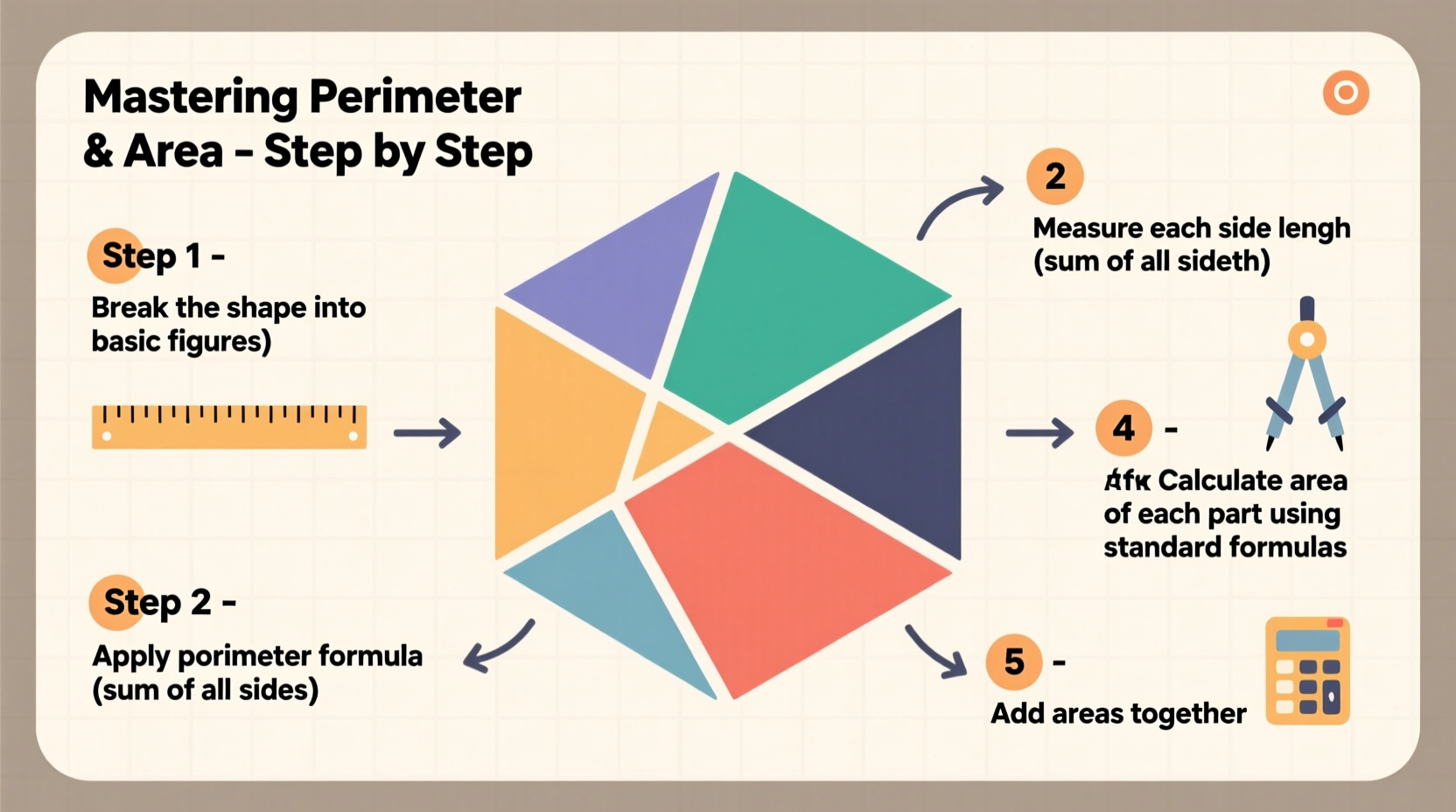
The perimeter refers to the total distance around the edge of a two-dimensional shape. Think of it as the length of a fence needed to enclose a yard. In contrast, area measures the amount of space inside a shape—how much carpet you’d need to cover a floor, for example.
These measurements depend on the type of figure. Regular polygons have predictable side lengths and angles, making calculations straightforward. Irregular shapes require decomposition or approximation techniques.
“Geometry isn’t just about numbers—it’s about spatial reasoning. Once students grasp the meaning behind perimeter and area, they stop memorizing and start understanding.” — Dr. Linda Park, Mathematics Education Researcher
Key Differences at a Glance
| Metric | Definition | Units Used | Real-World Use Case |
|---|---|---|---|
| Perimeter | Total length of the boundary | Centimeters, meters, feet | Fencing a backyard |
| Area | Measure of surface enclosed | Square cm, square m, sq ft | Tiling a bathroom floor |
Step-by-Step Guide to Calculating Perimeter
Finding the perimeter follows a simple principle: add up all the side lengths. The method varies slightly depending on the figure.
- Identify the Shape: Determine whether it's regular (all sides equal) or irregular.
- List All Side Lengths: Write down each measured side. For missing values, use known properties (e.g., opposite sides of rectangles are equal).
- Sum the Sides: Add all side lengths together.
- Include Units: Always express the answer in linear units (e.g., cm, m).
Examples Across Common Shapes
- Square: Perimeter = 4 × side length
- Rectangle: Perimeter = 2 × (length + width)
- Triangle: Perimeter = sum of three sides
- Regular Pentagon: Perimeter = 5 × side length
- Irregular Polygon: Add every individual side measurement
Calculating Area: From Simple to Complex Figures
Area calculation depends more heavily on shape-specific formulas. Unlike perimeter, there’s no universal addition rule—each category requires its own logic.
Standard Formulas for Common Shapes
| Shape | Area Formula | Description |
|---|---|---|
| Rectangle | Length × Width | Basic multiplication of adjacent sides |
| Square | Side² | All sides equal; multiply one side by itself |
| Triangle | (Base × Height) ÷ 2 | Height must be perpendicular to base |
| Parallelogram | Base × Height | Same as rectangle but slanted top/bottom |
| Trapezoid | (Sum of parallel bases) × Height ÷ 2 | Average of two bases times height |
| Circle | π × radius² | Use π ≈ 3.14 unless higher precision is required |
Breaking Down Composite Shapes
Many real-world figures aren’t pure geometric shapes—they’re combinations. To find the area:
- Divide the figure into standard components (rectangles, triangles, circles).
- Calculate the area of each part using the correct formula.
- Add the areas together.
- If parts are cut out (like windows in a wall), subtract those areas.
Real-World Application: A Home Renovation Example
Consider Sarah, who wants to install new flooring in her oddly shaped living room. The space combines a large rectangle (5m × 6m) with a semi-circular alcove (radius 2m). She needs to know the total area to order materials.
She breaks it down:
- Area of rectangle: 5 × 6 = 30 m²
- Area of full circle: π × (2)² ≈ 12.56 m²
- Since it’s a semi-circle: 12.56 ÷ 2 ≈ 6.28 m²
- Total area: 30 + 6.28 = 36.28 m²
To account for waste, she adds 10% extra: 36.28 × 1.10 ≈ 39.9 m². She orders 40 square meters of flooring—enough to complete the job without running short.
This practical example shows how combining geometry with estimation leads to smart decisions.
Essential Checklist for Accurate Calculations
Before finalizing any perimeter or area result, verify the following:
- ✅ Confirm the shape type and choose the correct formula
- ✅ Ensure all measurements are in the same unit (convert if necessary)
- ✅ Double-check that height is perpendicular when required (especially in triangles and trapezoids)
- ✅ Label answers with appropriate units (e.g., “cm” for perimeter, “cm²” for area)
- ✅ Re-add side lengths or recompute area if result seems too high or low
- ✅ For composite shapes, clearly mark subdivisions on paper
Common Mistakes and How to Avoid Them
Even experienced learners make preventable errors. Here are frequent pitfalls:
- Using diameter instead of radius in circle formulas: Remember, radius is half the diameter. A = πr² uses radius only.
- Confusing perimeter with area: One measures outside length; the other, internal coverage. Always ask: “Am I fencing or tiling?”
- Forgetting to halve the base-times-height in triangles: The triangle formula includes division by 2 because it occupies half the space of a corresponding rectangle.
- Adding non-linear dimensions: Never add meters and centimeters without converting first.
“Students who slow down and annotate their diagrams tend to score significantly higher than those rushing through calculations.” — Prof. Alan Torres, STEM Curriculum Developer
FAQ: Frequently Asked Questions
Can I find the area of an irregular shape without breaking it down?
Yes, though less precisely. You can use grid paper to count squares inside the shape, or apply advanced methods like the shoelace formula for coordinate-based polygons. However, decomposition remains the most accessible and accurate technique for beginners.
What if I don’t know the height of a triangle?
If you know all three sides, use Heron’s formula: First compute the semi-perimeter s = (a+b+c)/2, then Area = √[s(s-a)(s-b)(s-c)]. Alternatively, trigonometry (Area = ½ab·sin(C)) works if you know two sides and the included angle.
Do perimeter and area increase proportionally when scaling a shape?
No. When you double the side lengths of a shape, the perimeter doubles (linear relationship), but the area quadruples (quadratic relationship). This is crucial in design and manufacturing where scaling affects material costs disproportionately.
Final Thoughts and Next Steps
Mastering perimeter and area is not about rote memorization—it’s about recognizing patterns, applying logic, and solving real challenges. Whether you're measuring fabric for curtains, calculating sod for landscaping, or helping a child with homework, these skills empower informed decisions.
The key is consistent practice. Start with simple shapes, progress to composites, and always validate your work. Over time, you’ll develop an intuitive sense of size and scale that goes beyond formulas.




 浙公网安备
33010002000092号
浙公网安备
33010002000092号 浙B2-20120091-4
Comments
No comments yet. Why don't you start the discussion?