
Quadratic functions are foundational in algebra and appear frequently in real-world applications—from physics to economics. One of the most important characteristics of a quadratic function is its range: the set of all possible output values (y-values) it can produce. Understanding how to determine the range not only strengthens your mathematical reasoning but also enhances problem-solving abilities across disciplines. This guide breaks down the process into simple, actionable steps, supported by examples, tips, and expert insights.
Understanding Quadratic Functions and Their Graphs
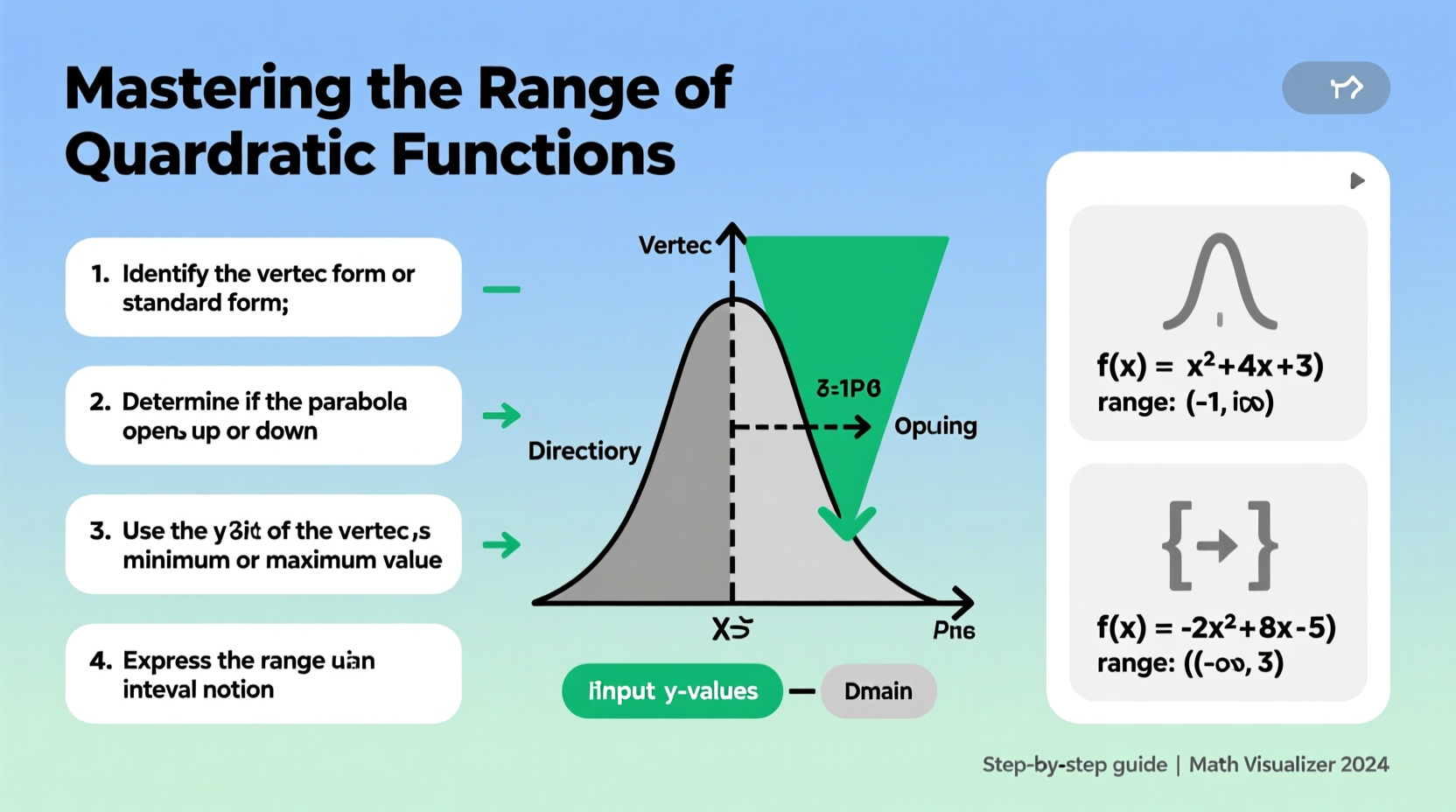
A quadratic function is typically written in the form:
f(x) = ax² + bx + c
where a, b, and c are constants, and a ≠ 0. The graph of a quadratic function is a parabola—a U-shaped curve that opens either upward or downward depending on the sign of a.
The direction of the parabola determines whether the vertex represents a minimum or maximum point:
- If a > 0, the parabola opens upward, and the vertex is the lowest point (minimum).
- If a < 0, the parabola opens downward, and the vertex is the highest point (maximum).
This turning point—the vertex—is crucial for determining the range because it sets the boundary value for the function's outputs.
“Knowing the vertex gives you immediate insight into the behavior of the entire function. It’s the anchor for finding domain and range.” — Dr. Alan Reyes, Mathematics Educator
Step-by-Step Guide to Finding the Range
Finding the range of a quadratic function follows a logical sequence. Follow these steps carefully to ensure accuracy every time.
- Identify the coefficients: Extract a, b, and c from the equation f(x) = ax² + bx + c.
- Determine the direction of the parabola: Check the sign of a. If positive, the parabola opens up; if negative, it opens down.
- Find the x-coordinate of the vertex: Use the formula x = –b/(2a).
- Calculate the y-coordinate of the vertex: Plug the x-value from Step 3 back into the original function to get f(–b/(2a)).
- Determine the range based on direction:
- If a > 0, the range is [k, ∞), where k is the y-coordinate of the vertex.
- If a < 0, the range is (–∞, k].
Worked Example: Applying the Steps
Let’s walk through an example to solidify the method.
Function: f(x) = 2x² – 8x + 5
- Coefficients: a = 2, b = –8, c = 5
- Direction: Since a = 2 > 0, the parabola opens upward → minimum at the vertex.
- Vertex x-coordinate: x = –(–8)/(2×2) = 8/4 = 2
- y-coordinate: f(2) = 2(2)² – 8(2) + 5 = 8 – 16 + 5 = –3
- Range: Because the parabola has a minimum value of –3, the range is all y-values greater than or equal to –3 → [–3, ∞)
This result means no matter what x-value you input, the output will never be less than –3.
Common Mistakes and How to Avoid Them
Even experienced students make errors when calculating ranges. Here are frequent pitfalls and how to prevent them.
| Mistake | Why It Happens | How to Fix It |
|---|---|---|
| Incorrect vertex calculation | Misapplying the formula x = –b/(2a), especially with negative signs | Double-check signs and use parentheses when substituting values. |
| Confusing domain and range | Assuming range is all real numbers like domain | Remember: domain is always (–∞, ∞) for quadratics; range depends on vertex and direction. |
| Wrong inequality direction | Using [k, ∞) when a < 0 or (–∞, k] when a > 0 | Always link the inequality to the opening direction: up → minimum, down → maximum. |
Alternative Methods: Completing the Square
Another powerful way to find the range—especially useful when working without a calculator—is completing the square to convert the quadratic into vertex form:
f(x) = a(x – h)² + k
In this form, (h, k) is the vertex, making it easy to read off the range directly.
Example: Convert f(x) = –x² + 6x – 7 to vertex form.
Step 1: Factor out the coefficient of x² (here, –1):
f(x) = –(x² – 6x) – 7
Step 2: Complete the square inside the parentheses:
Take half of –6 → –3, square it → 9
f(x) = –(x² – 6x + 9 – 9) – 7 = –[(x – 3)² – 9] – 7
Step 3: Simplify:
f(x) = –(x – 3)² + 9 – 7 = –(x – 3)² + 2
Now in vertex form: vertex is (3, 2), and since a = –1 < 0, the parabola opens downward.
→ Range is (–∞, 2]
Real-World Application: Maximizing Profit
Consider a small business modeling its profit using a quadratic function:
P(x) = –2x² + 40x – 150
where x is the number of units sold, and P(x) is profit in dollars.
To find the maximum possible profit, we calculate the range. Since a = –2 < 0, the parabola opens downward, meaning there’s a maximum profit at the vertex.
Vertex x = –40/(2×–2) = 10
P(10) = –2(10)² + 40(10) – 150 = –200 + 400 – 150 = 50
The maximum profit is $50, and the range of possible profits is (–∞, 50]. This tells the owner that while losses are possible at extreme production levels, the best-case scenario is $50.
Quick Checklist: Verify Your Range Calculation
Use this checklist whenever you're determining the range of a quadratic function:
- ✅ Identified coefficients a, b, and c correctly
- ✅ Determined if a > 0 (opens up) or a < 0 (opens down)
- ✅ Calculated vertex x-coordinate using x = –b/(2a)
- ✅ Found y-coordinate by plugging x back into f(x)
- ✅ Expressed range using correct interval notation:
- [k, ∞) for upward-opening parabolas
- (–∞, k] for downward-opening ones
- ✅ Checked work by plugging in another x-value to confirm outputs align with the range
Frequently Asked Questions
Can the range of a quadratic function ever be all real numbers?
No. Unlike the domain—which is always all real numbers for standard quadratics—the range is restricted due to the vertex acting as a minimum or maximum. Therefore, the range is always bounded on one side.
What if the quadratic is written in factored form?
If given in factored form (e.g., f(x) = (x – p)(x – q)), expand it first to standard form to identify a, b, and c. Alternatively, find the roots and average them to get the x-coordinate of the vertex (since it lies midway between the zeros), then compute f(x) at that point.
Do horizontal shifts affect the range?
No. Horizontal translations (left/right) change the x-position of the vertex but not the y-value. Only vertical shifts or changes in the leading coefficient affect the range.
Final Thoughts and Action Steps
Finding the range of a quadratic function is a skill that combines algebraic manipulation with conceptual understanding. Mastery comes not just from memorizing formulas, but from recognizing patterns, avoiding common traps, and practicing consistently. Whether you're preparing for exams, teaching others, or applying math to real-life models, this ability provides clarity and precision.
Start by working through five additional problems using both standard and vertex forms. Focus on accuracy first, then speed. Over time, identifying the range will become second nature.




 浙公网安备
33010002000092号
浙公网安备
33010002000092号 浙B2-20120091-4
Comments
No comments yet. Why don't you start the discussion?