
Squaring numbers is a fundamental mathematical skill that appears in everything from basic arithmetic to advanced algebra, engineering, and computer science. While it may seem straightforward—multiply a number by itself—the challenge lies in doing so quickly and accurately, especially without a calculator. Mastering this ability not only improves mental math but also builds confidence in handling more complex numerical problems. Whether you're a student preparing for exams or an adult brushing up on forgotten skills, understanding efficient techniques to find square numbers can save time and reduce errors.
Understanding Square Numbers: The Foundation
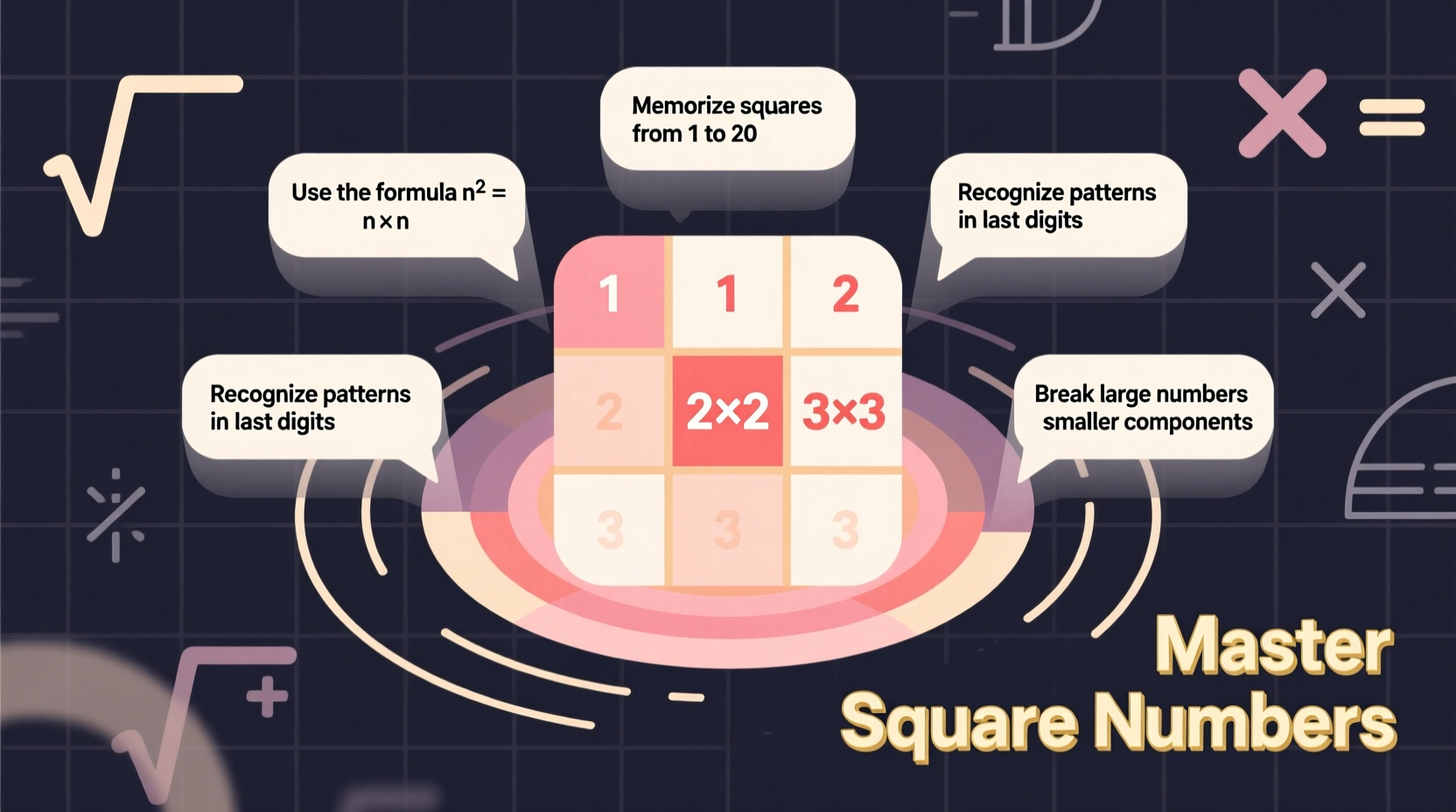
A square number is the product of an integer multiplied by itself. For example, 5² = 25, so 25 is a perfect square. These numbers form a sequence: 1, 4, 9, 16, 25, 36, 49, 64, 81, 100, and so on. Recognizing patterns within this sequence allows for faster recall and estimation.
One key insight is symmetry in squaring. Positive and negative integers yield the same square: (−7)² = 49 and 7² = 49. However, since we typically refer to principal (positive) squares, focus remains on non-negative integers.
Step-by-Step Guide to Squaring Any Two-Digit Number
For many, squaring numbers beyond 10 becomes mentally taxing. But with a structured approach, even larger two-digit numbers can be squared efficiently. Here's a reliable method using algebraic expansion:
- Express the number as (a + b), where a is a multiple of 10 and b is the units digit.
- Use the identity: (a + b)² = a² + 2ab + b².
- Calculate each term separately and sum them.
Example: Find 37².
Break down: 37 = 30 + 7
Then:
(30 + 7)² = 30² + 2×30×7 + 7² = 900 + 420 + 49 = 1,369
This method works universally and reduces cognitive load by breaking the problem into manageable parts.
Special Cases and Shortcut Techniques
Certain categories of numbers allow for lightning-fast squaring using pattern-based shortcuts.
Squaring Numbers Ending in 5
Any number ending in 5 follows a predictable rule:
- Multiply the tens digit by one more than itself.
- Append \"25\" to the result.
Example: 65²
Tens digit = 6 → 6 × (6+1) = 6 × 7 = 42
Append 25 → 4,225
Squaring Numbers Close to 100
Use deviation from 100:
- If the number is less than 100, subtract the difference from the original number and append the square of the difference.
- If greater than 100, add the excess and append its square (adjusting for double digits).
Example: 97²
Difference from 100: 3
97 − 3 = 94
3² = 09
Result: 9,409
Using Difference of Squares for Mental Math
Another powerful trick uses the identity: a² = (a − b)(a + b) + b². Choose b such that (a − b) and (a + b) are easier to multiply.
Example: 48²
Let b = 2 → (48 − 2)(48 + 2) + 2² = 46 × 50 + 4 = 2,300 + 4 = 2,304
This leverages round numbers (like multiples of 10 or 50) for simpler multiplication.
Practical Tips for Accurate Calculation
Avoiding mistakes is just as important as speed. Here are proven strategies to ensure precision:
- Double-check endings: Perfect squares end only in 0, 1, 4, 5, 6, or 9. If your result ends in 2, 3, 7, or 8, recheck your work.
- Estimate first: Before calculating, approximate. For 43², think 40² = 1,600 and 50² = 2,500; expect a value around 1,800–1,900.
- Digit sum verification: Use digital root checks. The digital root of a perfect square must be 1, 4, 7, or 9.
| Last Digit of Number | Possible Last Digits of Square |
|---|---|
| 0 | 0 |
| 1 or 9 | 1 |
| 2 or 8 | 4 |
| 3 or 7 | 9 |
| 4 or 6 | 6 |
| 5 | 5 |
“Mental math isn’t about raw intelligence—it’s about recognizing patterns and applying consistent strategies.” — Dr. Alan Reyes, Cognitive Mathematics Researcher
Mini Case Study: From Struggle to Speed
Jamal, a high school junior, struggled with timed math tests. He spent too long calculating squares manually, often making errors under pressure. After learning the (a + b)² expansion method and memorizing squares up to 25, he began practicing daily with flashcards and real-world problems.
Within three weeks, Jamal could compute any two-digit square in under 15 seconds. On his next algebra test, he finished 12 minutes early and scored 25% higher than his previous average. His success wasn’t due to innate talent but consistent application of structured techniques.
Checklist: Mastering Square Number Calculation
Follow this actionable checklist to build proficiency:
- ☐ Memorize squares from 1² to 20²
- ☐ Practice the (a + b)² formula daily with random numbers
- ☐ Apply shortcut rules for numbers ending in 5 or near 100
- ☐ Verify results using last-digit and estimation checks
- ☐ Use the difference of squares method when convenient
- ☐ Time yourself weekly to track improvement
- ☐ Teach someone else—explaining reinforces mastery
Frequently Asked Questions
Can I square decimals using these methods?
Yes, but adjust for decimal placement. For example, to find 2.5², calculate 25² = 625, then divide by 100 (since 2.5 = 25/10). Result: 6.25. The same algebraic principles apply.
Is there a quick way to tell if a large number is a perfect square?
Yes. First, check the last digit (must be 0, 1, 4, 5, 6, or 9). Then compute its digital root. If it’s not 1, 4, 7, or 9, it’s not a perfect square. Finally, estimate the square root and test nearby integers.
Why do I need to learn this without a calculator?
Mental calculation strengthens number sense, improves problem-solving agility, and is essential in standardized tests where calculators aren’t allowed. It also builds confidence in everyday situations—from estimating areas to budgeting.
Conclusion: Build Confidence Through Practice
Finding square numbers doesn’t have to be slow or error-prone. With the right tools—memorization, algebraic identities, and pattern recognition—you can perform accurate calculations swiftly and confidently. The techniques outlined here are not shortcuts to bypass understanding, but pathways to deeper numerical fluency. Start small, practice consistently, and integrate these methods into daily math routines.




 浙公网安备
33010002000092号
浙公网安备
33010002000092号 浙B2-20120091-4
Comments
No comments yet. Why don't you start the discussion?