
The y-intercept is one of the most fundamental concepts in algebra and graphing. It represents the point where a line crosses the y-axis—where the value of x is zero. Whether you're analyzing financial trends, designing models, or preparing for standardized tests, knowing how to accurately determine the y-intercept can simplify problem-solving and deepen your understanding of linear relationships. This guide breaks down the process into clear, actionable steps, supported by real-world applications and common pitfalls to avoid.
Understanding the Y-Intercept: Definition and Significance
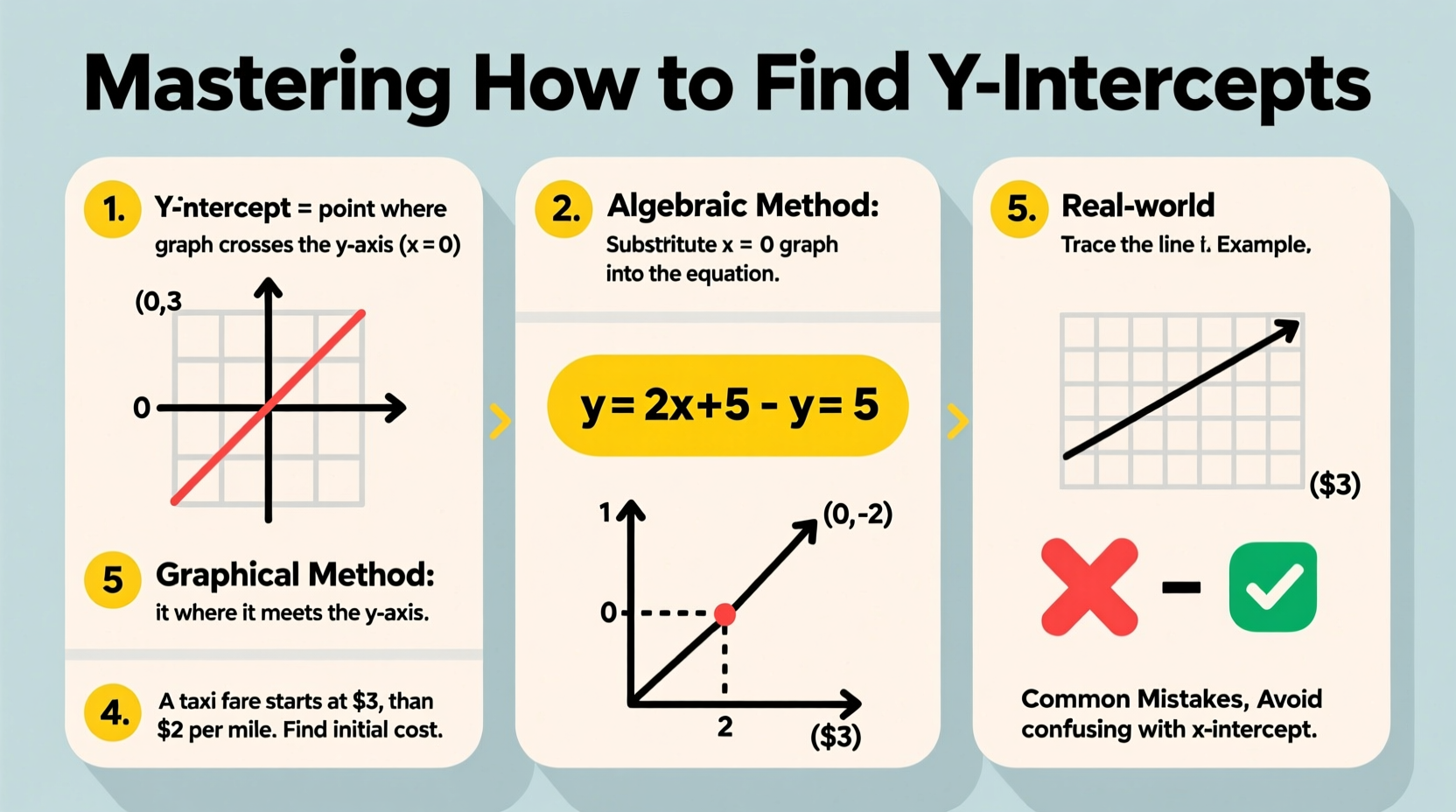
In any linear equation expressed in slope-intercept form—y = mx + b—the constant b represents the y-intercept. This means that when x = 0, y = b. The coordinate point is written as (0, b). For example, in the equation y = 2x + 5, the y-intercept is 5, so the line passes through (0, 5).
This concept extends beyond equations on paper. In practical scenarios, the y-intercept often reflects an initial value or starting condition. Imagine tracking monthly subscription costs including a setup fee: if you pay $30 per month plus a $50 sign-up charge, the total cost after x months is modeled by C = 30x + 50. Here, the y-intercept (50) represents the upfront cost before any monthly payments begin.
Step-by-Step Guide to Finding the Y-Intercept
Finding the y-intercept follows a consistent logic regardless of the format of the equation. Below is a structured approach applicable to various representations of linear functions.
- Identify the Equation Type: Determine whether the equation is in slope-intercept form (y = mx + b), standard form (Ax + By = C), or given as two points.
- Substitute x = 0: Plug 0 in place of x and solve for y. This works universally because the y-axis occurs where x = 0.
- Solve for y: Simplify the equation to isolate y. The resulting value is the y-intercept.
- Write the Coordinate Point: Express the result as (0, y) to reflect its position on the Cartesian plane.
- Verify Graphically (Optional): If using graphing tools, confirm that the line crosses the y-axis at your calculated point.
Example 1: Slope-Intercept Form
Given: y = -4x + 7
Substitute x = 0:
y = -4(0) + 7 → y = 7
Y-intercept: (0, 7)
Example 2: Standard Form
Given: 3x + 2y = 6
Substitute x = 0:
3(0) + 2y = 6 → 2y = 6 → y = 3
Y-intercept: (0, 3)
Example 3: Two Points Given
Suppose a line passes through (2, 8) and (4, 12). First, calculate the slope:
m = (12 - 8) / (4 - 2) = 4 / 2 = 2
Now use point-slope form: y - y₁ = m(x - x₁)
Using (2, 8): y - 8 = 2(x - 2)
Simplify: y - 8 = 2x - 4 → y = 2x + 4
Y-intercept: (0, 4)
Common Scenarios and Practical Applications
Understanding the y-intercept isn't limited to math class—it appears across disciplines. Consider these real-life uses:
- Economics: A business model predicting profit might include fixed startup costs represented by the y-intercept.
- Physics: In motion graphs, the y-intercept could represent initial velocity or position at time zero.
- Data Science: Regression lines in trend analysis often interpret the y-intercept as baseline expectations when all variables are neutral.
“Knowing where a relationship begins—its origin point—is just as important as knowing its rate of change.” — Dr. Alan Reyes, Mathematics Educator and Curriculum Developer
Mini Case Study: Predicting Sales Growth
A small coffee shop owner tracks daily sales over two weeks and finds a near-linear increase. Using collected data, they derive the equation S = 15d + 120, where S is total sales in dollars and d is days since opening. The y-intercept here is 120, meaning even on day zero (before opening), there was $120 in pre-orders or launch-day reservations. This insight helps justify marketing investments made prior to opening.
Do’s and Don’ts When Finding Y-Intercepts
| Action | Do | Don’t |
|---|---|---|
| Equation Handling | Rearrange to y = mx + b when possible | Assume the constant is always the y-intercept without isolating y |
| Substitution | Always plug in x = 0 systematically | Guess based on appearance without calculation |
| Graph Interpretation | Confirm visually only after algebraic verification | Estimate from a rough sketch alone |
| Units & Context | Label intercepts with correct units in applied problems | Ignore context; treat it purely as a number |
Expert Tips for Avoiding Common Mistakes
Even experienced students occasionally misidentify y-intercepts due to formatting confusion. Here are proven strategies to stay accurate:
One frequent error arises in standard form equations like 5x - y = 10. Students may incorrectly assume “10” is the y-intercept. However, substituting x = 0 gives -y = 10 → y = -10. So the actual y-intercept is (0, -10).
Frequently Asked Questions
Can a line have no y-intercept?
Only vertical lines (e.g., x = 4) lack a y-intercept because they never cross the y-axis. All non-vertical lines—including horizontal ones—will intersect the y-axis at exactly one point.
Is the y-intercept always positive?
No. The y-intercept can be positive, negative, or zero. For instance, y = 3x - 2 has a y-intercept at (0, -2), while y = 4x passes through (0, 0).
How do I find the y-intercept from a graph?
Locate where the line crosses the vertical axis. Read the y-value at that point. Ensure the scale is consistent; sometimes tick marks represent increments other than 1.
Final Checklist: Mastering Y-Intercept Identification
- ✅ Confirm the equation type (slope-intercept, standard, etc.)
- ✅ Substitute x = 0 into the equation
- ✅ Solve algebraically for y
- ✅ Write the answer as a coordinate: (0, b)
- ✅ Double-check by converting to y = mx + b form if needed
- ✅ Apply context when interpreting real-world models
Conclusion: Build Confidence Through Practice
Finding the y-intercept is more than a mechanical skill—it's a gateway to interpreting relationships, forecasting outcomes, and building stronger analytical foundations. With deliberate practice and attention to detail, anyone can master this essential component of algebra. Start by solving simple equations, then progress to word problems and graphical interpretations. Each exercise strengthens your ability to extract meaningful information from mathematical models.




 浙公网安备
33010002000092号
浙公网安备
33010002000092号 浙B2-20120091-4
Comments
No comments yet. Why don't you start the discussion?