
Incorrect or poorly formatted addresses are among the top reasons for delayed, returned, or lost mail. Whether you're sending a personal letter, an important document, or a business package, accuracy in addressing is non-negotiable. A small typo—a missing apartment number, a misspelled street name, or incorrect ZIP code—can derail delivery entirely. Mastering how to put an address correctly isn’t just about following rules; it’s about ensuring clarity, professionalism, and reliability in every piece of mail you send.
The Standard Address Format: What You Need to Know
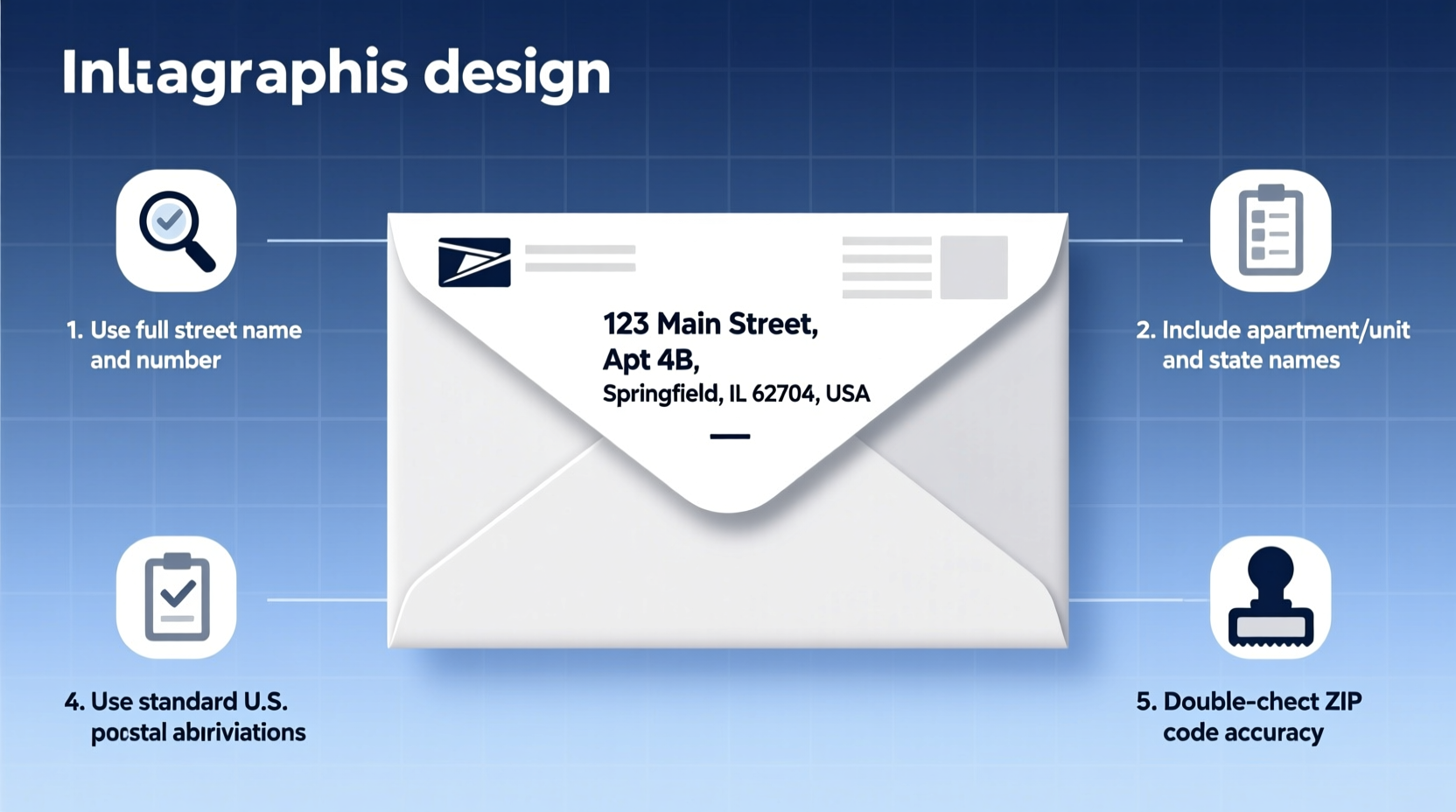
In most countries, especially under the United States Postal Service (USPS) guidelines, there’s a standardized format that ensures optimal readability by both humans and automated sorting systems. Following this structure increases the chances your mail will reach its destination quickly and without issue.
The correct order for a domestic U.S. mailing address is:
- Recipient’s full name
- Street address (including apartment, suite, or unit number)
- City, followed by state abbreviation
- ZIP code
For example:
John A. Reynolds
1234 Oakwood Drive, Apt 5B
Portland, OR 97201
This sequence allows postal machines to scan and route mail efficiently. Deviating from it—such as placing the ZIP code on the first line—confuses automated systems and can result in misdirection.
Common Addressing Mistakes and How to Avoid Them
Even experienced shippers make small but costly mistakes. These errors often stem from assumptions, haste, or lack of awareness about best practices.
- Using informal abbreviations: “St.” for Street is acceptable, but “Rd” instead of “Rd.” (with period) or “Ave” instead of “Ave.” may confuse scanners.
- Omitting apartment or suite numbers: This is one of the most frequent causes of undeliverable mail. Always include secondary unit identifiers clearly.
- Misspelling city names: For instance, “Phoeniz” instead of “Phoenix” renders the ZIP code irrelevant because the system cross-references city and code.
- Incorrect ZIP codes: A wrong digit can redirect your mail across town—or across the country.
- Overcrowding or messy handwriting: If the address is crammed into a corner or written in cursive script, optical character recognition (OCR) systems may fail to read it.
| Mistake | Correct Version | Why It Matters |
|---|---|---|
| 123 Main St #5 | 123 Main St, Unit 5 | # symbol not universally recognized; “Unit” is clearer |
| San Fransico, CA | San Francisco, CA | Misspelled city invalidates routing logic |
| 902100 | 90210 | Extra digit breaks ZIP validation |
| JOHN DOE / 456 ELM ST / CHICAGO IL | John Doe 456 Elm Street Chicago, IL 60611 |
Line breaks and formatting aid scanning accuracy |
Step-by-Step Guide to Writing a Perfect Mailing Address
To consistently get it right, follow this proven process every time you prepare an envelope or label:
- Verify the recipient’s full name: Confirm spelling and include middle initials if known. Avoid nicknames unless explicitly requested.
- Capture the complete street address: Include directional indicators (N, S, NE), proper suffixes (Drive, Lane, Boulevard), and secondary unit designators like “Suite,” “Apt,” or “Floor.”
- Use official USPS city and state abbreviations: For example, “CA” for California, “TX” for Texas. Never shorten city names (“Chi” for Chicago).
- Double-check the ZIP code: Use the USPS ZIP Code Lookup tool online to confirm accuracy. Consider using the full ZIP+4 code for faster processing.
- Format cleanly on the envelope: Center the text, leave margins, use block letters or printed labels, and avoid punctuation beyond necessary commas and periods.
- Review before sealing: Read the entire address aloud to catch omissions or typos.
International Mailing: Special Considerations
Sending mail abroad adds complexity. Address formats vary significantly by country, and failure to adapt can lead to indefinite delays.
General international addressing guidelines include:
- Write the country name in all capital letters on the last line.
- Follow the destination country’s address sequence—some list the postal code before the city.
- Include any required regional identifiers (e.g., province, prefecture).
- Avoid using abbreviations not recognized internationally.
For example, a Canadian address should be formatted as:
Sophie Tremblay
567 Rue des Érables, Appartement 12
Québec, QC G1R 4L2
CANADA
“Over 30% of international mail experiences delays due to incorrect formatting. Taking five extra minutes to verify the structure saves days in transit.” — Daniel Ruiz, International Logistics Coordinator at GlobalPost Solutions
Real-World Example: The Cost of a Missing Comma
A small nonprofit in Denver once mailed 200 fundraising letters to donors. The address was written as:
Sarah Mitchell
102 Pine Street Apt 3C
Denver CO 80206
Notice the missing comma between city and state. While seemingly minor, dozens of these letters were misrouted to Cokedale, Colorado (ZIP code 81027), because the automated system interpreted “Denver CO” as a single malformed city name. By the time the error was caught, the campaign’s response window had passed. After switching to properly formatted addresses with commas and using printed labels, their delivery success rate jumped to 99.8%.
Checklist: Ensuring Every Address Is Correct
Before dropping any mailpiece in the box, run through this checklist:
- ✅ Full recipient name spelled correctly
- ✅ Street number and name complete and accurate
- ✅ Secondary unit (Apt, Suite, etc.) included and properly labeled
- ✅ City spelled correctly and matched to the state
- ✅ State abbreviated using two-letter USPS standard
- ✅ ZIP code verified using official lookup tools
- ✅ Address centered on the envelope with clear spacing
- ✅ Country name in ALL CAPS for international mail
- ✅ No stray marks, smudges, or overlapping text
Frequently Asked Questions
Should I include “United States” on domestic mail?
No. Adding “United States” or “USA” to domestic mail is unnecessary and can interfere with automated sorting systems designed for domestic routes only.
What’s the difference between ZIP code and ZIP+4?
The standard ZIP code identifies a general delivery area. ZIP+4 adds four additional digits to pinpoint a specific block, building, or high-volume receiver. Using ZIP+4 improves delivery speed and accuracy, especially for bulk mailers.
Can I use punctuation like periods or hyphens in the address?
Minimal punctuation is acceptable—periods in abbreviations (e.g., “St.” or “Ave.”) are fine. However, avoid excessive punctuation, symbols, or emojis. Hyphens in house numbers (e.g., 123-5A) are acceptable if officially assigned.
Final Thoughts: Precision Pays Off
Mastering how to put an address correctly is a simple skill with far-reaching impact. It reflects attention to detail, respect for the recipient, and professionalism in communication. In business, accurate addressing protects your reputation and ensures timely deliveries. In personal correspondence, it shows care and consideration.
With the rise of automation in mail processing, human error stands out more than ever. A well-formatted address isn’t just polite—it’s practical. Take the extra moment to verify, format, and present each address with precision. The time invested now prevents frustration, delays, and missed opportunities later.




 浙公网安备
33010002000092号
浙公网安备
33010002000092号 浙B2-20120091-4
Comments
No comments yet. Why don't you start the discussion?