
Reading is more than decoding words on a page. True reading mastery lies in comprehension—grasping not just what the text says, but what it means, implies, and why it matters. In an age of information overload, the ability to extract insight from dense material is a competitive advantage in academics, careers, and personal growth. Yet many readers skim surface-level, missing nuance, context, and deeper connections. The difference between passive reading and active understanding comes down to strategy. With deliberate techniques, anyone can transform their reading into a dynamic process of engagement, analysis, and retention.
The Gap Between Reading and Understanding
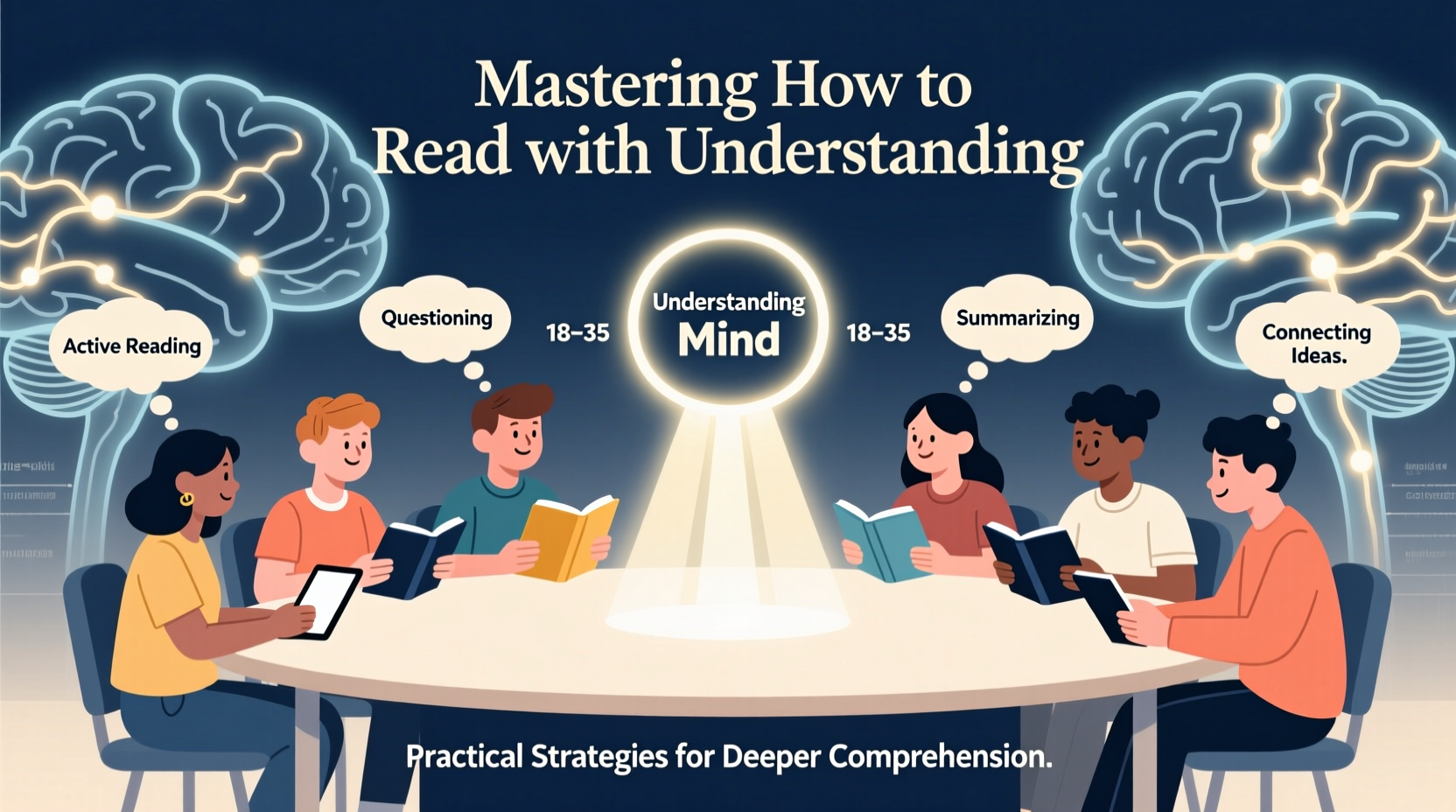
Most people assume that if they can read fluently, they understand what they’re reading. But fluency—the speed and accuracy of word recognition—is only one component. Comprehension requires cognitive effort: making inferences, connecting ideas, evaluating arguments, and visualizing concepts. Without these skills, even fast readers may retain little or misinterpret key points.
Consider research from the National Assessment of Educational Progress (NAEP), which shows that only about 37% of high school seniors perform at or above the proficient level in reading. This isn’t due to lack of vocabulary alone—it reflects a deficit in higher-order thinking when engaging with texts. The good news? These skills are learnable.
“Reading is not a passive act of recognition; it’s an active construction of meaning.” — Dr. Nell K. Duke, Professor of Literacy, Language, and Culture
Core Strategies for Deeper Comprehension
Improving comprehension isn’t about reading slower or harder—it’s about reading smarter. The following evidence-based strategies shift reading from passive consumption to active inquiry.
1. Preview Before You Read
Before diving into a chapter or article, take two minutes to preview. Skim headings, subheadings, introductions, summaries, and visuals. Ask: What is this about? What might the author argue? This primes your brain by activating prior knowledge and setting expectations.
2. Annotate Actively
Engage directly with the text by underlining key claims, writing margin notes, or highlighting contradictions. Use symbols: ? for confusion, ! for surprise, → for connections. Annotation forces attention and creates a dialogue between reader and writer.
3. Summarize in Your Own Words
After each section, pause and summarize the main idea aloud or in writing. If you can’t explain it simply, you don’t understand it fully. This technique leverages the “self-explanation effect,” where articulating reasoning strengthens memory and clarity.
4. Ask Questions Continuously
Treat reading like an interview. Who is the audience? What evidence supports the claim? Is there bias? Could the argument be challenged? Questioning builds critical thinking and prevents passive acceptance of information.
5. Visualize Concepts
For complex ideas—scientific processes, historical timelines, abstract theories—create mental images or simple diagrams. Visualization converts abstract language into concrete representations, improving recall and integration.
Step-by-Step Guide: The SQR3 Method for Deep Reading
One of the most effective frameworks for academic and professional reading is the SQR3 method—Survey, Question, Read, Recite, Review. Developed in the 1940s by Francis P. Robinson, it remains a gold standard for structured comprehension.
- Survey: Scan the entire piece—titles, headings, bold terms, graphics, conclusion. Form a mental outline.
- Question: Turn each heading into a question. This sets purpose and focus.
- Read: Read actively to answer your questions. Highlight sparingly; focus on ideas, not phrases.
- Recite: After each section, close the book and recite the answer to your question in your own words.
- Review: Once finished, revisit all questions and answers. Summarize the whole text in one paragraph.
This cycle reinforces learning through retrieval practice—a proven method for long-term retention. Students using SQR3 consistently outperform peers in exams requiring conceptual understanding.
Common Pitfalls That Block Comprehension
Even motivated readers fall into traps that undermine understanding. Recognizing these habits is the first step to correcting them.
| Pitfall | Why It Hurts Comprehension | Better Alternative |
|---|---|---|
| Reading without purpose | No clear goal leads to aimless skimming and poor retention | Define your objective: Am I learning facts, analyzing arguments, or gathering examples? |
| Multitasking while reading | Distracted attention fragments focus and impairs memory encoding | Read in focused 25-minute blocks with zero distractions |
| Ignoring unfamiliar terms | Gaps in vocabulary create blind spots in meaning | Pause to define key terms using context or a quick search |
| Never reviewing | Without reinforcement, most information is forgotten within 24 hours | Review summaries within one day and again after one week |
Real Example: From Confusion to Clarity
Sophia, a graduate student in public policy, struggled with dense legislative analyses. She’d spend hours reading but couldn’t articulate the core arguments afterward. Frustrated, she applied the SQR3 method to a 20-page journal article on healthcare reform.
She began by surveying the abstract, headings, and conclusion. Her first question: “What problem does this policy aim to solve?” As she read each section, she paused to recite answers aloud. When she hit technical terms like “actuarial value,” she looked them up immediately. After finishing, she wrote a 150-word summary.
The next morning, she reviewed her notes and was surprised at how clearly the structure and logic came back. For the first time, she could discuss the article confidently in class. Within three weeks, her reading efficiency improved by 40%, and her paper grades rose from B to A-range.
Checklist: Build Your Comprehension Routine
- ☑ Set a clear purpose before starting to read
- ☑ Survey the text to build a mental framework
- ☑ Turn headings into guiding questions
- ☑ Read in distraction-free intervals (25–45 minutes)
- ☑ Annotate key points and questions in margins
- ☑ Pause every few paragraphs to summarize in your own words
- ☑ Look up unfamiliar terms immediately
- ☑ Recite answers to your initial questions after each section
- ☑ Write a brief summary after finishing
- ☑ Review your notes within 24 hours and again in a week
Frequently Asked Questions
Can these strategies work for fiction as well as nonfiction?
Absolutely. While fiction doesn’t always present arguments, deep comprehension still matters. Ask: What motivates this character? How does the setting shape the mood? What themes emerge? Annotating symbolism or turning plot points into questions enhances literary analysis and enjoyment.
I read slowly when I try to understand deeply. Is that normal?
Yes. Speed comes after mastery. Initially, deep reading takes longer because you’re processing, not just scanning. Over time, as your comprehension skills strengthen, you’ll absorb complex material faster. Prioritize understanding first—speed follows naturally.
How do I stay focused when the material is dry or boring?
Make it interactive. Set mini-challenges: “Can I predict the next point?” or “What would I ask the author?” Use a pen to track lines, stand while reading, or read aloud. Connecting the content to your goals—e.g., “This report helps me improve my team’s strategy”—also boosts motivation.
Conclusion: Reading as a Skill Worth Mastering
Understanding what you read isn’t a talent reserved for scholars or gifted students—it’s a skill built through consistent, intelligent practice. By shifting from passive consumption to active engagement, you unlock the full value of every article, book, or report you encounter. Whether you're studying for an exam, analyzing a business proposal, or exploring new ideas, deeper comprehension gives you clarity, confidence, and a lasting edge.




 浙公网安备
33010002000092号
浙公网安备
33010002000092号 浙B2-20120091-4
Comments
No comments yet. Why don't you start the discussion?