
Writing dates seems simple—until you send an invoice marked \"03/04/2025\" and realize your client in Germany thinks it’s April 3rd, not March 4th. A small oversight in date formatting can lead to missed deadlines, scheduling conflicts, or even legal misunderstandings. Despite its simplicity, the way we write dates varies widely across cultures, industries, and technologies. Getting it right isn’t just about correctness—it’s about clarity, professionalism, and effective communication.
This guide breaks down everything you need to know about writing dates properly: standard formats, regional differences, digital considerations, and practical rules for business, academic, and personal use.
Understanding Date Format Standards
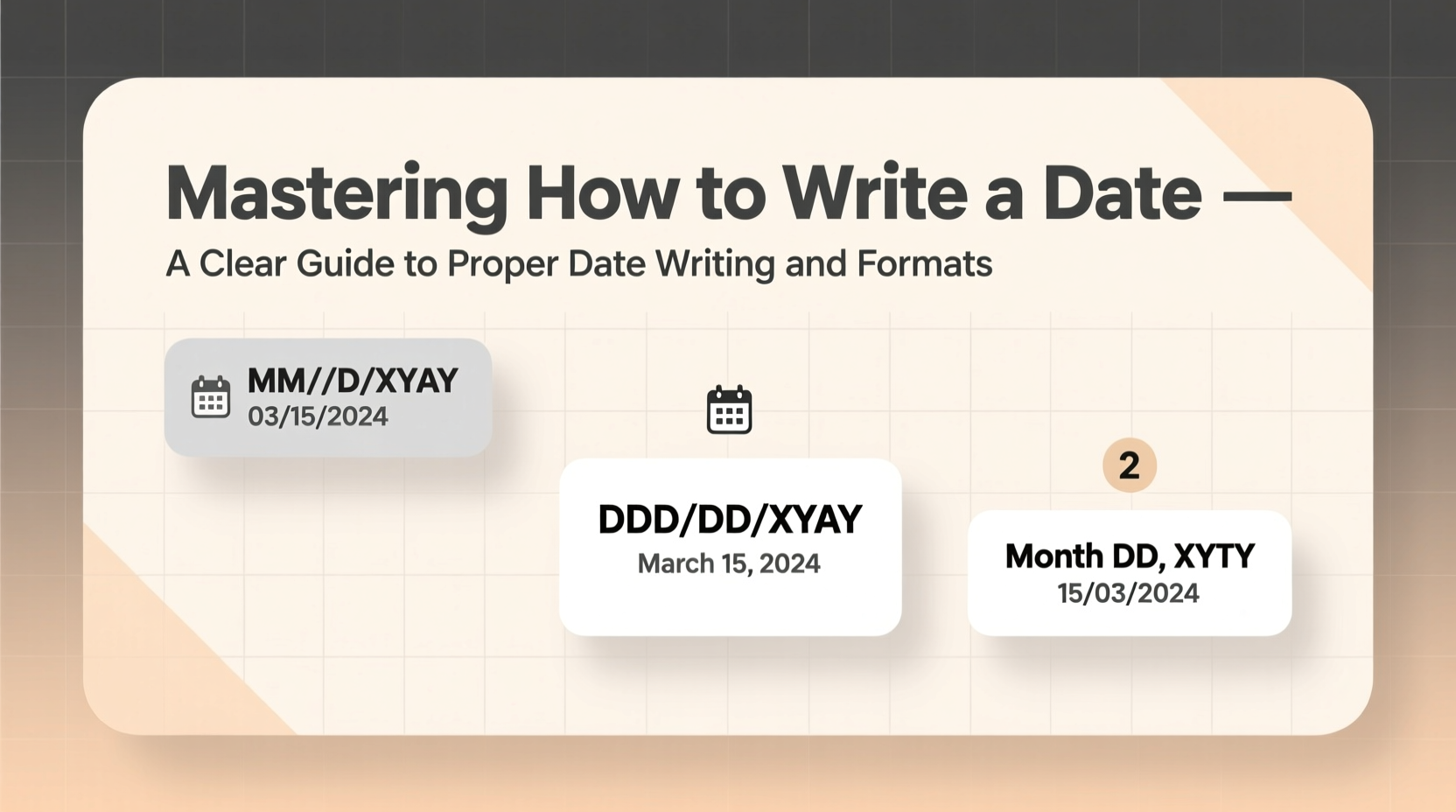
Date formats are far from universal. The order of day, month, and year differs globally, leading to confusion when documents cross borders. Three primary formats dominate international usage:
- DD/MM/YYYY – Common in the UK, Australia, and most of Europe.
- MM/DD/YYYY – Predominant in the United States.
- YYYY-MM-DD – The ISO 8601 international standard, used in science, technology, and global documentation.
The ISO format is unambiguous and machine-readable, making it ideal for databases, file naming, and international correspondence. For example, February 14, 2025, becomes 2025-02-14. This eliminates confusion entirely—no one will mistake it for October 2nd or misread the month.
Regional Variations and Cultural Sensitivity
While standards exist, real-world communication requires awareness of local conventions. Misapplying a U.S.-centric format in a European email may not break trust, but it signals a lack of attention to detail.
In France, dates are typically written as 14 février 2025, with the month spelled out in lowercase. In Japan, the format follows the Japanese era system (e.g., Reiwa 7) alongside the Gregorian calendar: 令和7年2月14日.
For international audiences, consider using fully spelled-out months in English: February 14, 2025. This format is widely understood and avoids numeric ambiguity.
“Clarity trumps brevity when it comes to date writing. A slightly longer format that prevents confusion is always better than a short one that causes errors.” — Dr. Lena Patel, Communication Specialist at GlobalTech Solutions
Best Practices for Professional and Digital Use
In professional settings—especially legal, medical, and technical fields—precision is non-negotiable. Follow these guidelines to maintain accuracy and credibility:
- Avoid ambiguous numerals. Never use 03/04/2025 without context. Spell out the month or use ISO format.
- Use four-digit years. “25” could mean 1925 or 2025—always write “2025” to prevent misinterpretation.
- Be consistent within a document. Don’t switch between “March 3, 2025” and “03/04/25” in the same report.
- Consider your audience. For internal U.S. teams, MM/DD/YYYY may suffice. For global clients, default to YYYY-MM-DD or spelled-out formats.
| Format | Example | Recommended Use |
|---|---|---|
| YYYY-MM-DD (ISO) | 2025-02-14 | Databases, file names, international documents |
| Month DD, YYYY | February 14, 2025 | Emails, letters, general business communication |
| DD Month YYYY | 14 February 2025 | UK/EU correspondence, formal reports |
| MM/DD/YYYY | 02/14/2025 | Internal U.S. use only; avoid internationally |
Step-by-Step Guide to Writing Dates Correctly
Follow this sequence to ensure your date writing is accurate and appropriate for any context:
- Identify your audience. Are they based in the U.S., EU, or a global team? Adjust accordingly.
- Choose a format based on purpose. Use ISO for digital logs, spelled-out months for emails, and numeric only if universally accepted.
- Spell out the month when in doubt. “April 5, 2025” is safer than “04/05/2025”.
- Double-check time zone implications. If scheduling virtual meetings, include the time zone: “Meeting: March 10, 2025, 10:00 AM EST”.
- Review for consistency. Scan your document to ensure all dates follow the same style.
Common Mistakes and How to Avoid Them
Even experienced professionals slip up. Here are frequent errors and how to fix them:
- Mistake: Using two-digit years.
Solution: Always write “2025”, never “25”. - Mistake: Mixing formats in one document.
Solution: Pick one standard and stick to it. - Mistake: Assuming everyone reads MM/DD/YYYY.
Solution: When in doubt, spell it out. - Mistake: Omitting time zones in global communications.
Solution: Include abbreviations like UTC, EST, or CET.
Mini Case Study: The Cost of a Misread Date
A marketing agency in Chicago scheduled a product launch webinar for “07/08/2025” at 9:00 AM. Their design partner in Berlin assumed the date was August 7th, not July 8th. By the time the error was caught, the promotional assets were already printed with the wrong date. The delay cost the company $12,000 in reprints and lost momentum.
The solution? From then on, the agency adopted a policy: all project timelines use YYYY-MM-DD format, and all meeting invites include both the numeric and spelled-out date: 2025-07-08 (July 8, 2025). Clarity became part of their brand standard.
Checklist: Date Writing Best Practices
Use this checklist before finalizing any document, email, or schedule:
- ✅ Used four-digit years
- ✅ Chose a format appropriate for the audience
- ✅ Spelled out the month if using a mixed audience
- ✅ Applied the same format throughout the document
- ✅ Included time zone for scheduled events
- ✅ Verified regional settings in digital tools
- ✅ Avoided slashes in file names (use hyphens instead)
Frequently Asked Questions
Is it acceptable to write dates as “Feb 5, 2025”?
Yes, abbreviated months are acceptable in informal or semi-formal contexts, especially in American English. However, for formal documents, use the full month name: “February 5, 2025”.
Why is the ISO format YYYY-MM-DD considered superior?
Because it sorts chronologically in file systems and databases. For example, “2025-01-10” comes before “2025-02-01” alphabetically, unlike “01/10/2025” vs. “02/01/2025”, which can sort incorrectly.
Should I use commas in dates?
In American English, yes: “June 12, 2025”. In British English, commas are often omitted unless the date starts a sentence. Consistency matters more than regional preference in most professional writing.
Conclusion: Write Dates That Work for Everyone
Mastering how to write dates properly isn’t about memorizing rules—it’s about respecting your audience’s understanding. Whether you’re drafting a contract, scheduling a meeting, or archiving data, the right date format prevents errors, builds professionalism, and ensures your message lands clearly.
Start today: audit your recent documents. Are your dates consistent? Unambiguous? Future-proof? Make one change—adopt the ISO format for digital files, or commit to spelling out months in client emails. Small adjustments lead to significant improvements in communication quality.




 浙公网安备
33010002000092号
浙公网安备
33010002000092号 浙B2-20120091-4
Comments
No comments yet. Why don't you start the discussion?