
The word \"choose\" is deceptively simple. While it appears frequently in daily conversation and writing, many non-native speakers—and even some native speakers—struggle with its correct pronunciation, especially in fast speech or different tenses. Mispronouncing \"choose\" can lead to misunderstandings, particularly because it sounds similar to other words like \"chews,\" \"shoes,\" or \"lose.\" Mastering how to say \"choose\" accurately involves understanding its phonetic structure, recognizing its variations across verb forms, and applying it correctly in context.
This guide breaks down the precise way to pronounce \"choose,\" explores its grammatical role, compares common mispronunciations, and offers real-world examples to solidify your understanding. Whether you're refining your spoken English for professional settings, preparing for language exams, or simply aiming for clarity in communication, this comprehensive overview will equip you with the tools to use \"choose\" confidently and correctly.
Pronunciation Breakdown: How to Say \"Choose\"
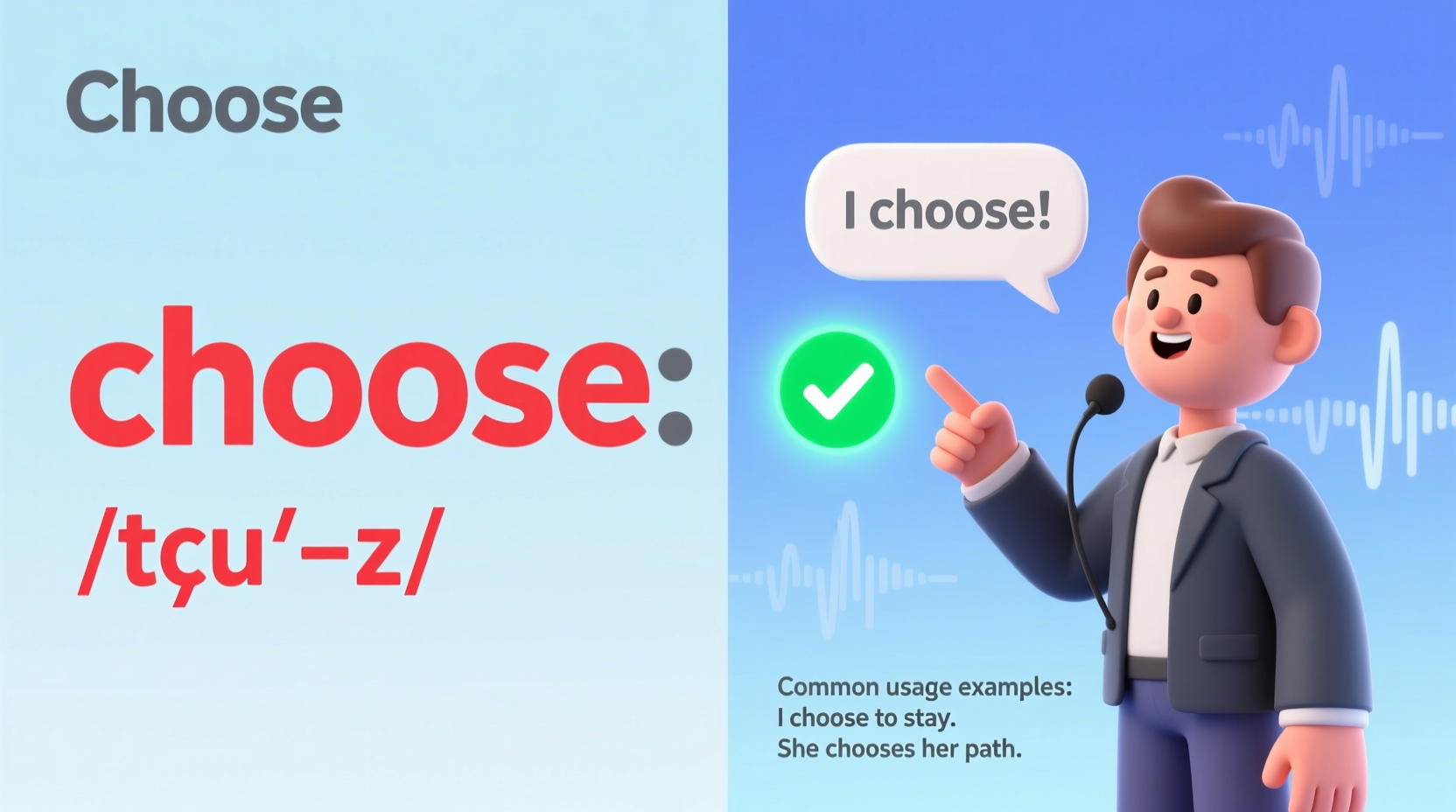
The word \"choose\" is pronounced as /tʃuːz/ in the International Phonetic Alphabet (IPA). Let's dissect this:
- tʃ – This symbol represents the \"ch\" sound, as in \"chair,\" \"chip,\" or \"lunch.\"
- uː – A long \"oo\" sound, similar to \"blue,\" \"true,\" or \"through.\"
- z – The final consonant is a voiced \"z\" sound, not an unvoiced \"s.\"
Put together, \"choose\" rhymes with \"booze\" and \"lose\" (when \"lose\" is pronounced with a /z/ sound, as it typically is). It does not rhyme with \"goose\" or \"moose,\" which end in an unvoiced /s/.
Common Mispronunciations
Many learners mistakenly pronounce \"choose\" as:
- /tʃus/ – Ending with an \"s\" instead of a \"z,\" making it sound like \"chews\" (as in \"I chews gum\").
- /tʃoʊz/ – Using a diphthong like \"oh\" instead of the pure \"oo\" sound, which shifts it closer to \"chose\" but still incorrect.
- /ʃuz/ – Dropping the \"ch\" entirely and starting with a \"sh\" sound, turning it into \"shoe-z.\"
These errors may seem minor, but they can alter meaning. For example, \"I choose to go\" could be misheard as \"I chews to go\" or \"I lose to go,\" both of which are nonsensical.
Verb Forms and Their Pronunciations
\"Choose\" is an irregular verb, and its forms change significantly in spelling and pronunciation:
| Form | Spelling | Pronunciation (IPA) | Phonetic Spelling |
|---|---|---|---|
| Base Form | choose | /tʃuːz/ | CHOOZ |
| Past Simple | chose | /tʃoʊz/ | CHOHZ |
| Past Participle | chosen | /ˈtʃoʊzn̩/ | CHOHZ-n |
| Present Participle | choosing | /ˈtʃuːzɪŋ/ | CHOO-zing |
Note the key differences: \"choose\" uses a long /uː/, while \"chose\" uses the diphthong /oʊ/. Despite the spelling shift from \"oo\" to \"o,\" the pronunciation evolves naturally in spoken English. \"Chosen\" adds a soft nasal /n̩/ at the end, often barely audible in casual speech.
“Pronunciation accuracy in irregular verbs like 'choose' separates intermediate from advanced English speakers.” — Dr. Lydia Grant, ESL Linguistics Researcher
Common Usage and Contextual Examples
\"Choose\" functions primarily as a transitive verb, meaning it requires a direct object. It expresses the act of selecting one option from multiple possibilities.
Examples in everyday use:
- \"Please choose a seat before the movie starts.\"
- \"She chose the red dress over the black one.\"
- \"We’re choosing a new vendor for office supplies.\"
- \"Have you chosen where to go on vacation?\"
In formal contexts, \"choose\" can also appear in passive constructions:
- \"The winner was chosen by a panel of judges.\"
- \"Candidates will be chosen based on experience and qualifications.\"
Avoid common errors such as using \"choose\" in place of \"choice\" (a noun):
Collocations and Natural Phrases
Native speakers often use \"choose\" with specific prepositions and phrases that sound more natural:
- Choose between X and Y – \"We had to choose between driving or flying.\"
- Choose from – \"You can choose from over twenty flavors.\"
- Choose to + infinitive – \"He chose to stay behind and help.\"
- Can’t choose / Don’t know what to choose – Expresses indecision.
Step-by-Step Guide to Mastering \"Choose\" in Speech
Follow these steps to internalize the correct pronunciation and usage of \"choose\":
- Listen and Repeat: Find audio examples of native speakers saying \"choose,\" \"chose,\" and \"chosen\" in sentences. Use platforms like BBC Learning English or YouGlish to hear real-world usage.
- Isolate the Sounds: Practice each component: start with \"ch,\" then \"oo,\" then add the voiced \"z.\" Say them slowly: \"ch-oo-z.\"
- Use Minimal Pairs: Compare \"choose\" (/tʃuːz/) with \"chews\" (/tʃuːz/ – same pronunciation), \"shoes\" (/ʃuːz/), and \"lose\" (/luːz/). Record yourself and compare.
- Practice Verb Conjugation Aloud: Say: \"I choose, I chose, I have chosen, I am choosing.\" Focus on shifting smoothly between /uː/ and /oʊ/.
- Apply in Sentences: Create five original sentences using \"choose\" in different tenses. Speak them aloud daily for a week.
Mini Case Study: Maria Improves Her Job Interview Skills
Maria, a software developer from Argentina, prepared for a remote job interview with a U.S.-based company. During her mock interviews, she repeatedly said, “I choosed Python as my main language,” and pronounced \"choose\" with an /s/ ending, making it sound like \"chews.\"
Her coach corrected her: “You *chose* Python—it’s past tense. And remember, ‘choose’ ends with a buzzing ‘z,’ not a hissing ‘s.’”
Maria practiced daily using minimal pairs and recorded herself. By the actual interview, she confidently said, “I chose Python because it allows rapid development,” with perfect pronunciation. She got the job—and credited her success partly to mastering small but critical details like \"choose.\"
Frequently Asked Questions
Is \"choose\" pronounced the same as \"chews\"?
Yes, \"choose\" and \"chews\" are homophones—they sound identical (/tʃuːz/). Context determines meaning. For example: \"I choose freedom\" vs. \"Cows chews cud.\"
Why do people confuse \"choose\" and \"chose\"?
The confusion arises because the spelling changes dramatically while the pronunciation shifts only slightly—from /tʃuːz/ to /tʃoʊz/. Learners often apply regular verb patterns (e.g., \"help → helped\") and incorrectly say \"choosed.\"
How do I use \"chosen\" correctly?
\"Chosen\" is the past participle and is used with auxiliary verbs: \"have/has/had chosen.\" Example: \"She has chosen to resign.\" Never use it alone as a past tense verb: ❌ \"She chosen the blue car.\"
Checklist: Mastering \"Choose\" in 7 Steps
- ✅ Understand the IPA: /tʃuːz/
- ✅ Distinguish between \"choose\" (/tʃuːz/) and \"chose\" (/tʃoʊz/)
- ✅ Practice the voiced /z/ at the end
- ✅ Avoid saying \"choosed\"—use \"chose\" or \"chosen\"
- ✅ Use \"choose\" with objects: \"choose a book,\" not just \"I choose\"
- ✅ Learn common collocations: \"choose between,\" \"choose from\"
- ✅ Record yourself weekly to track improvement
Conclusion
Mastering how to say \"choose\" goes beyond mere pronunciation—it’s about integrating the word seamlessly into fluent, accurate English. From distinguishing subtle vowel shifts to avoiding common grammatical traps, attention to detail transforms your speaking clarity. Whether you're making decisions in a meeting, expressing preferences in conversation, or writing professionally, using \"choose\" correctly signals linguistic precision and confidence.




 浙公网安备
33010002000092号
浙公网安备
33010002000092号 浙B2-20120091-4
Comments
No comments yet. Why don't you start the discussion?