
Quadratic equations are a cornerstone of algebra, appearing frequently in mathematics, physics, engineering, and even economics. Understanding how to solve them efficiently and accurately is essential for students and professionals alike. A quadratic equation takes the standard form \\( ax^2 + bx + c = 0 \\), where \\( a \ eq 0 \\). While this may seem intimidating at first, breaking it down into structured methods makes solving for \\( x \\) both logical and achievable.
The goal is not just to find solutions but to understand the reasoning behind each step. Whether you're preparing for an exam or applying math in real-world scenarios, mastering these techniques builds a strong foundation for advanced problem-solving.
Understanding the Structure of Quadratic Equations
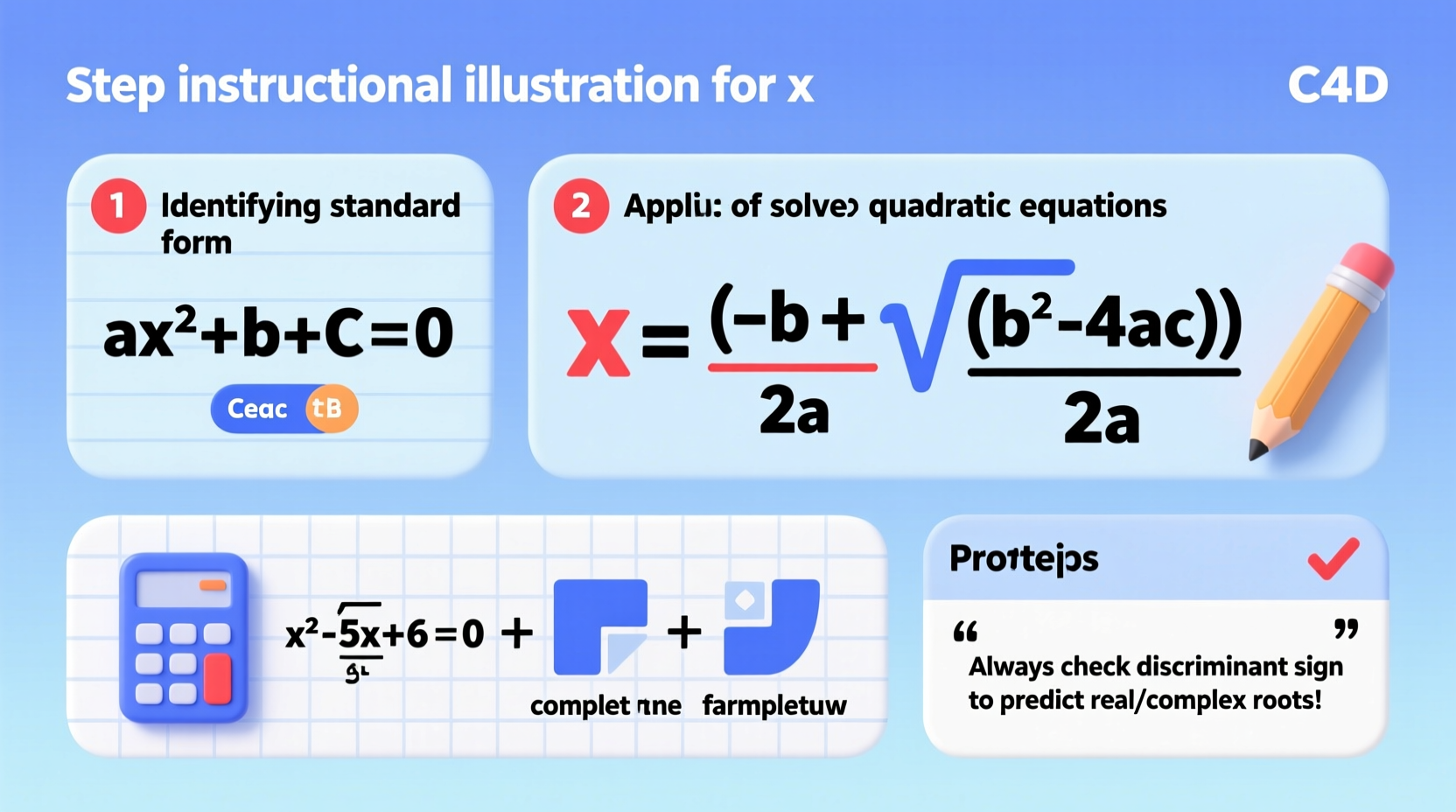
Before diving into solution methods, it’s crucial to recognize the components of a quadratic equation:
- a: coefficient of \\( x^2 \\) (must be non-zero)
- b: coefficient of \\( x \\)
- c: constant term
For example, in the equation \\( 2x^2 - 5x + 3 = 0 \\), \\( a = 2 \\), \\( b = -5 \\), and \\( c = 3 \\).
The solutions to a quadratic equation are also known as its roots or zeros. These represent the points where the parabola (the graph of the quadratic) intersects the x-axis. Depending on the values of \\( a \\), \\( b \\), and \\( c \\), there can be two real solutions, one repeated solution, or two complex solutions.
Step-by-Step Methods to Solve Quadratic Equations
There are four primary methods used to solve quadratic equations. Each has its strengths depending on the specific equation.
1. Factoring
This method works best when the quadratic can be easily factored into two binomials.
- Ensure the equation is in standard form: \\( ax^2 + bx + c = 0 \\).
- Find two numbers that multiply to \\( ac \\) and add to \\( b \\).
- Rewrite the middle term using those numbers.
- Factor by grouping.
- Set each factor equal to zero and solve for \\( x \\).
Example: Solve \\( x^2 + 5x + 6 = 0 \\)
- Find two numbers that multiply to 6 and add to 5 → 2 and 3.
- Factor: \\( (x + 2)(x + 3) = 0 \\)
- Solutions: \\( x = -2 \\) or \\( x = -3 \\)
2. Completing the Square
This technique transforms the equation into a perfect square trinomial, making it easier to solve.
- Divide all terms by \\( a \\) if \\( a \ eq 1 \\).
- Move the constant term to the right side.
- Add \\( \\left(\\frac{b}{2a}\\right)^2 \\) to both sides.
- Write the left side as a squared binomial.
- Take the square root of both sides.
- Solve for \\( x \\).
Example: Solve \\( x^2 + 6x + 5 = 0 \\)
- Move constant: \\( x^2 + 6x = -5 \\)
- Add \\( (6/2)^2 = 9 \\): \\( x^2 + 6x + 9 = 4 \\)
- Perfect square: \\( (x + 3)^2 = 4 \\)
- Square root: \\( x + 3 = \\pm 2 \\)
- Solutions: \\( x = -1 \\) or \\( x = -5 \\)
3. Quadratic Formula
The most reliable method, applicable to any quadratic equation.
The formula is:
\\[ x = \\frac{-b \\pm \\sqrt{b^2 - 4ac}}{2a} \\]
- Identify \\( a \\), \\( b \\), and \\( c \\).
- Calculate the discriminant: \\( D = b^2 - 4ac \\).
- Evaluate based on the discriminant:
- If \\( D > 0 \\): Two distinct real roots
- If \\( D = 0 \\): One real root (repeated)
- If \\( D < 0 \\): Two complex roots
- Substitute into the formula and simplify.
Example: Solve \\( 2x^2 - 4x - 6 = 0 \\)
- \\( a = 2 \\), \\( b = -4 \\), \\( c = -6 \\)
- \\( D = (-4)^2 - 4(2)(-6) = 16 + 48 = 64 \\)
- \\( x = \\frac{4 \\pm \\sqrt{64}}{4} = \\frac{4 \\pm 8}{4} \\)
- Solutions: \\( x = 3 \\) or \\( x = -1 \\)
4. Graphical Method
Use a graphing calculator or software to plot \\( y = ax^2 + bx + c \\). The x-intercepts are the solutions.
This method is helpful for visual learners and verifying answers, though less precise without digital tools.
“Knowing multiple methods gives students flexibility and deeper insight. Relying solely on the quadratic formula can obscure understanding.” — Dr. Alan Reyes, Mathematics Educator
Common Mistakes and How to Avoid Them
Even experienced learners make errors when solving quadratics. Recognizing these pitfalls improves accuracy.
| Mistake | Why It Happens | How to Fix It |
|---|---|---|
| Forgetting to set the equation to zero | Starting factoring or using the formula without standard form | Always move all terms to one side first |
| Misapplying signs in the quadratic formula | Incorrectly handling negative coefficients | Double-check substitution, especially with \\( -b \\) |
| Ignoring the discriminant | Assuming all quadratics have real solutions | Analyze \\( D \\) before solving to anticipate result type |
| Arithmetic errors in simplification | Rushing through square roots or fractions | Work slowly; verify each calculation step |
Real-World Application Example
Consider a small business owner launching a drone delivery service. The height \\( h(t) \\) of a drone in meters after \\( t \\) seconds is modeled by:
\\( h(t) = -5t^2 + 20t + 15 \\)
To determine when the drone lands, set \\( h(t) = 0 \\):
\\( -5t^2 + 20t + 15 = 0 \\)
Using the quadratic formula:
- \\( a = -5 \\), \\( b = 20 \\), \\( c = 15 \\)
- \\( D = 400 - 4(-5)(15) = 400 + 300 = 700 \\)
- \\( t = \\frac{-20 \\pm \\sqrt{700}}{-10} \\approx \\frac{-20 \\pm 26.46}{-10} \\)
- \\( t \\approx -0.646 \\) (discarded) or \\( t \\approx 4.65 \\) seconds
The drone lands after approximately 4.65 seconds. This shows how quadratic equations model motion under gravity—practical knowledge for engineers and entrepreneurs alike.
Essential Tips and Checklist for Mastery
Becoming proficient requires consistent practice and strategic habits. Follow this checklist to improve speed and accuracy.
- ✅ Rewrite equation in standard form
- ✅ Check if factoring is possible (look for integer pairs)
- ✅ If unsure, use the quadratic formula—it always works
- ✅ Calculate the discriminant first to predict solution type
- ✅ Verify solutions by plugging back into the original equation
- ✅ Practice with mixed difficulty problems weekly
Frequently Asked Questions
Can a quadratic equation have only one solution?
Yes. When the discriminant \\( b^2 - 4ac = 0 \\), the equation has exactly one real solution (a repeated root). For example, \\( x^2 - 6x + 9 = 0 \\) factors to \\( (x - 3)^2 = 0 \\), so \\( x = 3 \\) is the only solution.
What if the quadratic doesn’t factor neatly?
If no two integers multiply to \\( ac \\) and add to \\( b \\), factoring won’t work easily. In such cases, switch to the quadratic formula or complete the square. Not all quadratics factor over integers.
Do I always need to use the quadratic formula?
No. Use factoring when possible—it's faster. Reserve the formula for equations that don't factor cleanly or when you're verifying results. Knowing multiple approaches makes you more adaptable.
Final Thoughts and Next Steps
Mastering how to solve quadratic equations for \\( x \\) is more than a classroom requirement—it’s a fundamental skill that sharpens logical thinking and problem-solving abilities. With practice, what once seemed complex becomes routine. The key lies in understanding the structure, applying the right method, and learning from mistakes.
Start with simple equations and gradually tackle more challenging ones. Combine theory with application, like modeling projectile motion or optimizing business models. Each solved problem builds confidence and competence.




 浙公网安备
33010002000092号
浙公网安备
33010002000092号 浙B2-20120091-4
Comments
No comments yet. Why don't you start the discussion?