
Finding the percent of a number is a fundamental math skill used daily in personal finance, shopping, business analytics, and academic settings. Whether you're calculating a tip at a restaurant, analyzing sales data, or budgeting household expenses, understanding percentages accurately saves time and reduces errors. Despite its simplicity, many people struggle due to unclear methods or reliance on memorized formulas without comprehension. This guide breaks down the process into logical, repeatable steps, supported by real-life examples and structured practice.
The Core Concept: What Does \"Percent of a Number\" Mean?
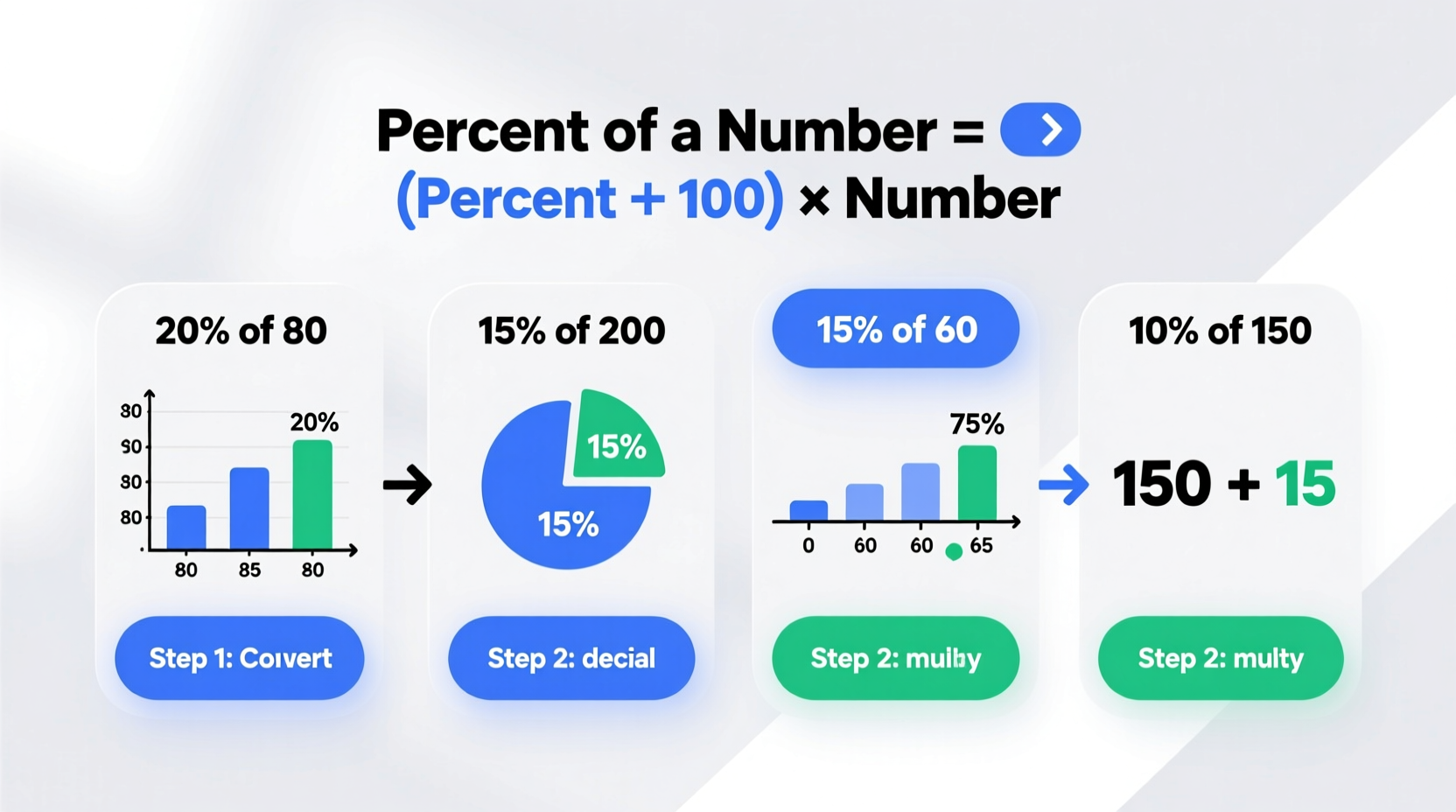
“Percent” means “per hundred.” So, when you’re asked to find 20% of 80, you’re essentially determining what part of 80 corresponds to 20 out of every 100. The key is converting the percentage into a decimal before multiplying it by the given number. This conversion is straightforward: divide the percentage by 100.
For example:
- 25% becomes 0.25
- 7% becomes 0.07
- 150% becomes 1.50
Once converted, multiply the decimal by the number in question. This method works universally—whether dealing with whole numbers, decimals, or large figures.
Step-by-Step Guide to Solving Percent Problems
- Identify the percentage and the number. Determine which value is the percent (e.g., 30%) and which is the total amount (e.g., $250).
- Convert the percentage to a decimal. Divide the percentage by 100 (e.g., 30 ÷ 100 = 0.30).
- Multiply the decimal by the number. (e.g., 0.30 × 250 = 75).
- Interpret the result. In this case, 30% of $250 is $75.
This sequence applies to all types of percentage calculations involving “percent of” scenarios. Let’s explore several real-world applications to reinforce the method.
Practical Example 1: Calculating a Restaurant Tip
You finish a meal that costs $68, and you want to leave a 20% tip. How much should you add?
- Percentage: 20%, Number: 68
- Convert 20% → 20 ÷ 100 = 0.20
- Multiply: 0.20 × 68 = 13.6
The tip is $13.60. Adding this to the bill gives a total of $81.60.
Practical Example 2: Sales Discount on Clothing
A jacket is priced at $120 with a 35% discount. What is the amount saved?
- Percentage: 35%, Number: 120
- Convert 35% → 0.35
- Multiply: 0.35 × 120 = 42
You save $42. The final price is $120 – $42 = $78.
Practical Example 3: Interest Earned on Savings
You deposit $1,500 in a savings account with an annual interest rate of 2.5%. How much interest will you earn in one year?
- Percentage: 2.5%, Number: 1500
- Convert 2.5% → 0.025
- Multiply: 0.025 × 1500 = 37.5
You’ll earn $37.50 in interest over the year.
Common Mistakes and How to Avoid Them
Even simple percentage problems can go wrong if basic errors are overlooked. Here are frequent pitfalls and their solutions:
| Mistake | Why It Happens | How to Fix It |
|---|---|---|
| Using the percentage directly (e.g., 25 × 80) | Forgetting to convert % to decimal | Always divide by 100 first: 25% → 0.25 |
| Confusing \"percent of\" with \"percent increase\" | Mixing up base values | Clarify: “percent of” uses original number; “increase” adds to it |
| Rounding too early | Reducing precision in multi-step problems | Keep full decimals until the final answer |
Expert Insight: Why Accuracy Matters Beyond Math Class
“Understanding percentages isn’t just about passing a test—it’s a life skill. From reading nutritional labels to evaluating investment returns, misinterpreting percentages leads to poor decisions.” — Dr. Alan Reyes, Mathematics Education Specialist
In professional environments like finance, healthcare, and marketing, small percentage errors can compound into significant financial losses or misleading reports. Mastering this foundational concept builds confidence in more complex quantitative reasoning.
Mini Case Study: Budget Planning for a Freelancer
Sophia is a freelance graphic designer earning $4,200 per month. She allocates 30% of her income to taxes, 20% to retirement, and 15% to business expenses. How much does she set aside for each category?
Taxes: 0.30 × 4200 = $1,260
Retirement: 0.20 × 4200 = $840
Business Expenses: 0.15 × 4200 = $630
Total allocated: $1,260 + $840 + $630 = $2,730
Remaining for living expenses: $4,200 – $2,730 = $1,470
By applying percentage calculations consistently, Sophia maintains a clear financial picture and avoids overspending.
Quick Checklist: Solve Any Percent Problem
Use this checklist whenever you encounter a “percent of” problem:
- ☑ Identify the percentage and the total number
- ☑ Convert the percentage to a decimal (÷ 100)
- ☑ Multiply the decimal by the number
- ☑ Check units (dollars, people, grams) and label your answer
- ☑ Verify reasonableness (e.g., 50% should be about half)
Advanced Applications and Mental Shortcuts
While the standard method works every time, mental math tricks speed up everyday calculations:
- 10% Rule: Move the decimal point one place left. (10% of 90 = 9)
- 5% Shortcut: Take 10% and halve it. (5% of 90 = 4.5)
- 20% Tip Trick: Double 10%. (10% of $75 = $7.50 → 20% = $15)
- 25% = 1/4: Divide the number by 4. (25% of 80 = 20)
These shortcuts rely on fraction equivalents of common percentages and improve numerical fluency over time.
FAQ: Common Questions About Percentages
Can I use fractions instead of decimals to find a percent?
Yes. Since percentages are fractions out of 100, you can rewrite them. For example, 25% = 1/4, so 25% of 80 = 80 ÷ 4 = 20. This method is especially useful with benchmark percentages like 10%, 25%, 50%, and 75%.
What if the percentage is over 100%?
The same rule applies. For instance, 150% of 60 is calculated as 1.50 × 60 = 90. This means the result exceeds the original number, which is common in growth comparisons or markup pricing.
How do I calculate a percentage of a decimal number?
The process doesn’t change. For example, 12% of 0.8: convert 12% → 0.12, then 0.12 × 0.8 = 0.096. Treat decimals just like whole numbers once the percentage is converted.
Conclusion: Build Confidence Through Practice
Mastering how to solve the percent of a number is not about memorizing formulas—it’s about understanding a simple, universal process: convert, multiply, interpret. With consistent application, this skill becomes second nature, empowering you to make informed decisions in both personal and professional contexts. Start by practicing with everyday situations: tipping, shopping discounts, progress tracking, or budget allocations. Each calculation strengthens your numerical intuition.




 浙公网安备
33010002000092号
浙公网安备
33010002000092号 浙B2-20120091-4
Comments
No comments yet. Why don't you start the discussion?