
Email remains one of the most powerful tools for communication in business, sales, networking, and customer outreach. Yet, even the most compelling message fails if the recipient doesn’t read it. The opening lines of an email determine whether your message gets attention or disappears into the void. A strong opening isn't just polite—it's strategic. It builds relevance, establishes trust, and prompts action. Mastering this skill transforms your inbox from a graveyard of ignored messages into a dynamic channel of engagement.
The Psychology Behind Effective Email Openings
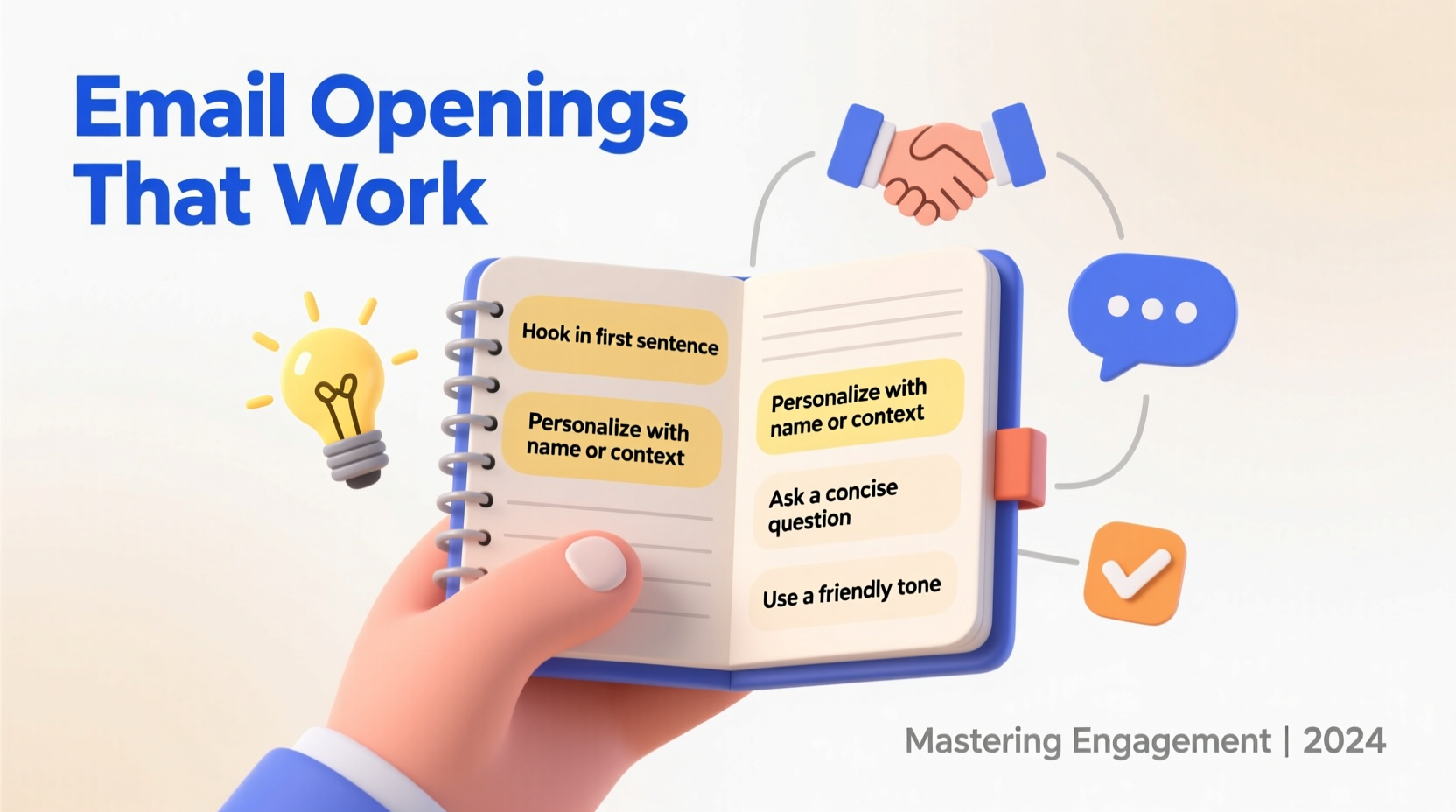
People decide whether to continue reading an email within seconds. Cognitive load theory suggests that individuals avoid information that feels overwhelming or irrelevant. An effective opening reduces mental effort by immediately answering the unspoken question: “Why should I care?”
Three psychological triggers dominate successful email intros:
- Relevance: Show that you understand the recipient’s world—industry, challenges, or recent activities.
- Curiosity: Pose a thought-provoking question or share a surprising insight without being clickbaity.
- Credibility: Establish authority quickly through mutual connections, shared experience, or demonstrated knowledge.
When these elements align, recipients are more likely to keep reading—and respond.
5 Proven Email Opening Templates That Work
Structure matters. While creativity has its place, tested frameworks deliver consistent results. Below are five high-converting email opening styles backed by outreach professionals and conversion experts.
- The Compliment + Connection Hook:
“I loved your recent article on sustainable packaging—especially the point about lifecycle analysis. We’ve been exploring similar strategies at [Your Company], and I’d love to hear your take on scaling those ideas.” - The Mutual Reference Opener:
“Sarah Thompson mentioned you’re leading the UX redesign at NexaFlow. She said you’re focused on reducing friction in onboarding—something we helped Streamly achieve a 40% drop in user drop-off.” - The Problem-Agitate-Solve (PAS) Start:
“Many SaaS founders we work with struggle to convert free trial users. If that’s a challenge for your team, I have a quick case study showing how one company improved activation by 57% in six weeks.” - The Direct Value Statement:
“You could save 8–10 hours a week on client reporting by automating your analytics workflow. Here’s how we did it for three agencies last quarter.” - The Curiosity Spark:
“Only 12% of cold emails get replies. But when we changed one line in the opening, our client saw response rates jump to 68%. Want to see what we wrote?”
Each template balances clarity with intrigue, offering enough context to feel trustworthy while leaving room for curiosity.
Avoid These Common Opening Mistakes
Even well-intentioned emails fail when they rely on outdated or generic phrasing. The following patterns signal low effort and reduce response likelihood.
| Do’s | Don’ts |
|---|---|
| “Congrats on launching your new product—I saw the demo video and the onboarding flow is seamless.” | “I hope you're having a great week!” (Generic and adds no value) |
| “We worked with firms in your niche and reduced CAC by 30%—here’s how.” | “I’m reaching out to see if you need help with marketing.” (Vague and assumptive) |
| “Noticed your team is hiring for a DevOps role—our tool cut deployment time by 70% for companies like yours.” | “Dear Sir/Madam,” (Impersonal and outdated) |
| “Your LinkedIn post on remote culture sparked a great discussion in our team.” | “This email won’t take more than 30 seconds of your time.” (Often untrue and manipulative) |
Generic greetings, empty pleasantries, and vague offers dilute your message. Replace them with specificity and intent.
Step-by-Step Guide to Crafting Your Next Email Opening
Follow this five-step process before hitting send:
- Research the Recipient (2 minutes): Check their LinkedIn, company news, or recent social posts. Look for signals: a promotion, product launch, or public commentary.
- Define the Core Benefit (1 minute): Ask: What do they gain from reading further? Be specific—e.g., “save time,” “increase conversions,” “solve X problem.”
- Select a Template That Fits (1 minute): Match your goal to one of the five templates above. Sales outreach? Use PAS. Networking? Try the compliment hook.
- Write & Trim Ruthlessly (2 minutes): Draft your opener, then cut all filler words. Aim for 1–2 sentences max. Remove “I hope this email finds you well” unless it serves a purpose.
- Test for Clarity and Tone (1 minute): Read it aloud. Does it sound natural? Would you respond if you received it?
Real Example: How One Line Doubled Response Rates
Jamie Chen, a B2B sales strategist, was struggling with cold email replies. Her initial outreach began with: “Hi Alex, I’m reaching out to discuss how our platform can help your team improve productivity.” Response rate: 11%.
After refining her approach, she rewrote the opener: “Alex, your team at Veridian recently expanded into APAC markets—that’s exciting. When we helped TerraLogic scale across Southeast Asia, their onboarding time dropped by 50%. Would you be open to a 15-minute chat on cross-regional setup?”
Result: Response rate jumped to 63%. The change wasn’t in the offer—but in the opening. By anchoring the message in the recipient’s reality, Jamie shifted from interruption to invitation.
“We don’t respond to pitches. We respond to relevance. If your first sentence shows you’ve done your homework, you’ve already won half the battle.” — Marcus Reed, Outreach Consultant, GrowthSignal Labs
Checklist: Build Better Openings in Seconds
Use this checklist before sending any professional email:
- ✅ Used the recipient’s name (and correct spelling)
- ✅ Referenced something specific about them or their work
- ✅ Eliminated generic greetings like “I hope you're well”
- ✅ Stated clear value in under two sentences
- ✅ Avoided jargon or self-focused language (“we’re the leader in…”)
- ✅ Kept the tone conversational, not formal or robotic
- ✅ Ended with a low-barrier next step or question
Frequently Asked Questions
How long should an email opening be?
Ideal openings are 1–3 sentences. Long enough to establish context, short enough to respect time. After that, transition quickly to value or ask a relevant question.
Is it okay to use humor in email openings?
Yes, but cautiously. Humor works best with warm leads or informal industries. Avoid sarcasm or inside jokes with strangers. When in doubt, prioritize clarity over cleverness.
Should I always personalize the opening?
For cold or semi-cold outreach, yes. Personalization increases reply rates by up to 50%, according to HubSpot’s 2023 outreach report. Even a small detail—like referencing a recent tweet—can make a difference.
Conclusion: Turn Openers Into Opportunities
An email opening is not just an introduction—it’s an invitation to engage. Every word should serve a purpose: to connect, resonate, and prompt action. Whether you're pitching a service, seeking advice, or building a relationship, the first few lines set the tone for everything that follows. Mastery comes not from memorizing formulas, but from practicing empathy, precision, and relevance.




 浙公网安备
33010002000092号
浙公网安备
33010002000092号 浙B2-20120091-4
Comments
No comments yet. Why don't you start the discussion?