
Understanding fractions is a cornerstone of mathematical fluency, and one essential skill within that domain is converting improper fractions into mixed numbers. An improper fraction—where the numerator is greater than or equal to the denominator—can often be more intuitively understood when expressed as a whole number plus a proper fraction. This transformation not only simplifies comprehension but also plays a vital role in real-world applications like cooking, construction, and financial calculations.
Whether you're a student brushing up on foundational math, a parent helping with homework, or someone re-engaging with basic arithmetic, mastering this conversion process builds confidence and accuracy in everyday problem-solving.
What Is an Improper Fraction and a Mixed Number?
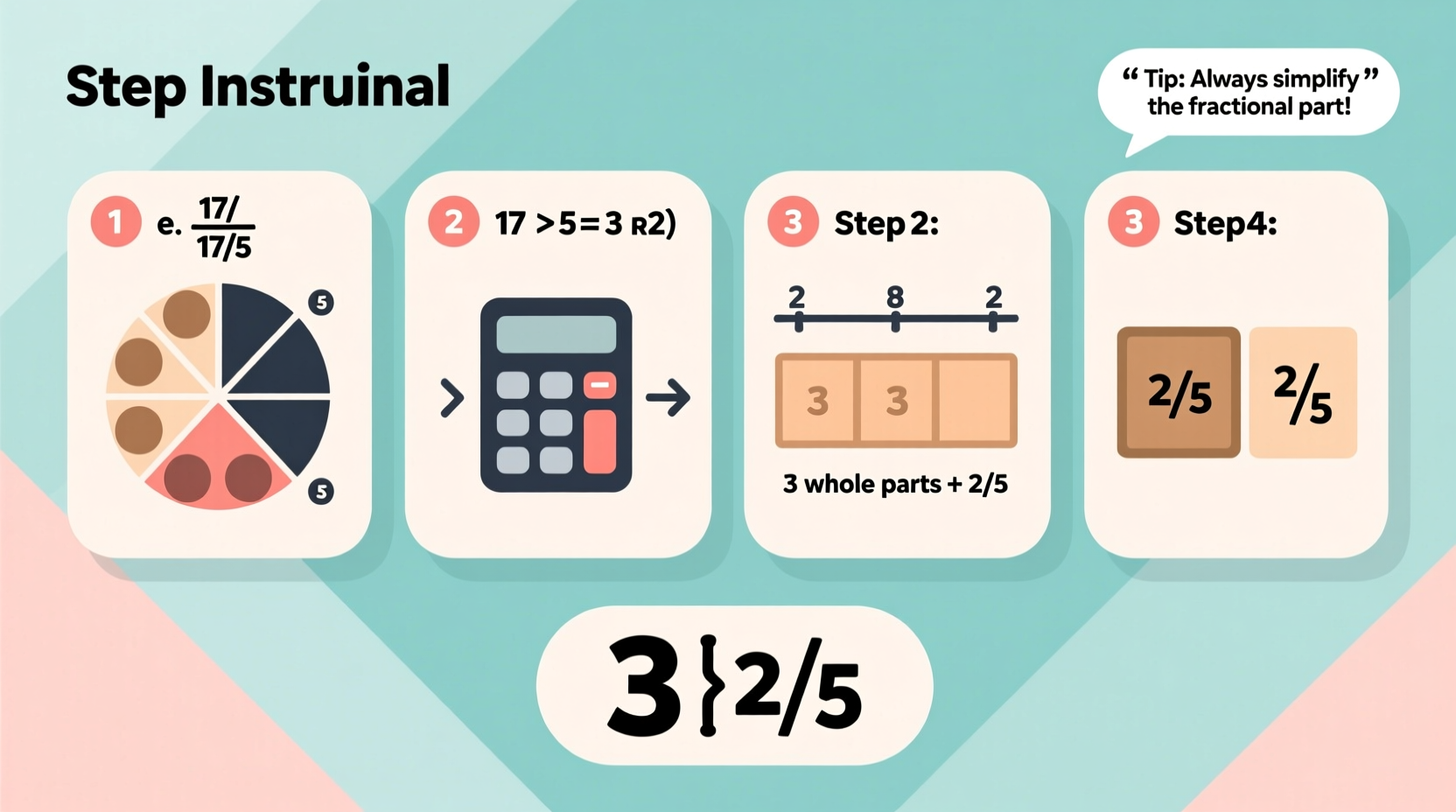
An **improper fraction** is any fraction where the numerator (top number) is greater than or equal to the denominator (bottom number). Examples include \\( \\frac{7}{4} \\), \\( \\frac{10}{3} \\), and \\( \\frac{16}{8} \\).
A **mixed number**, on the other hand, combines a whole number with a proper fraction (where the numerator is less than the denominator). For instance, \\( 1\\,\\frac{3}{4} \\), \\( 3\\,\\frac{1}{3} \\), and \\( 2\\,\\frac{2}{5} \\) are all mixed numbers.
The goal of converting an improper fraction to a mixed number is to express the same value in a format that’s easier to interpret, especially when dealing with quantities that exceed a single unit.
Step-by-Step Guide to Convert an Improper Fraction
Converting an improper fraction into a mixed number follows a clear, repeatable process based on division. Here's how to do it methodically:
- Divide the numerator by the denominator. This gives you the whole number part of the mixed number.
- Determine the remainder. This becomes the new numerator of the fractional part.
- Keep the original denominator. The denominator remains unchanged in the mixed number.
- Write the result as a whole number followed by the proper fraction.
Example: Convert \\( \\frac{19}{6} \\) to a Mixed Number
Step 1: Divide 19 by 6 → \\( 19 ÷ 6 = 3 \\) with a remainder of 1.
Step 2: The quotient (3) is the whole number.
Step 3: The remainder (1) becomes the new numerator.
Step 4: The denominator stays 6.
Result: \\( 3\\,\\frac{1}{6} \\)
This process works consistently across all improper fractions, regardless of size.
Common Pitfalls and How to Avoid Them
While the conversion process is straightforward, several common errors can trip up learners:
- Misidentifying the remainder. Some confuse the decimal result of division with the actual remainder. Remember: use long division or mental math to find the whole number and what’s left over—not the decimal.
- Forgetting to keep the original denominator. The denominator doesn’t change during conversion.
- Not simplifying the final fraction. While not always required, reducing the fractional part to lowest terms improves clarity.
| Improper Fraction | Division Step | Remainder | Mixed Number |
|---|---|---|---|
| \\( \\frac{11}{4} \\) | 11 ÷ 4 = 2 R3 | 3 | \\( 2\\,\\frac{3}{4} \\) |
| \\( \\frac{23}{5} \\) | 23 ÷ 5 = 4 R3 | 3 | \\( 4\\,\\frac{3}{5} \\) |
| \\( \\frac{18}{7} \\) | 18 ÷ 7 = 2 R4 | 4 | \\( 2\\,\\frac{4}{7} \\) |
Real-Life Application: Measuring Ingredients in Cooking
Consider a scenario where you’re doubling a recipe that calls for \\( \\frac{3}{4} \\) cup of sugar. Doubling it gives \\( \\frac{6}{4} \\), which is an improper fraction. To make sense of this while measuring, convert it:
\\( \\frac{6}{4} = 1\\,\\frac{2}{4} = 1\\,\\frac{1}{2} \\) cups.
Now it’s clear: you need one full cup plus half a cup. Without converting, you might misinterpret \\( \\frac{6}{4} \\) as more than two cups, leading to measurement errors. This example illustrates how transforming improper fractions enhances practical understanding.
“Students who master fraction conversions early develop stronger number sense, which supports success in algebra and beyond.” — Dr. Linda Peterson, Mathematics Education Researcher
Expert Tips for Mastery and Speed
Once you understand the mechanics, these strategies will help you perform conversions faster and with greater accuracy:
- Simplify the fraction after conversion if possible. For example, \\( \\frac{10}{4} = 2\\,\\frac{2}{4} = 2\\,\\frac{1}{2} \\).
- Use scratch paper for long division when needed. Accuracy matters more than speed at first.
- Check your answer by reversing: \\( 3\\,\\frac{1}{6} = (3 × 6) + 1 = 19 → \\frac{19}{6} \\).
Quick Conversion Checklist
- Identify the numerator and denominator.
- Divide numerator by denominator to get the whole number.
- Find the remainder for the new numerator.
- Retain the original denominator.
- Simplify the fraction if needed.
- Verify by converting back to the improper fraction.
Frequently Asked Questions
Can every improper fraction be written as a mixed number?
Yes, every improper fraction (where numerator ≥ denominator) can be converted into a mixed number. The only exception is when the fraction simplifies to a whole number (e.g., \\( \\frac{8}{4} = 2 \\)), in which case there’s no fractional part.
What if the remainder is zero?
If the numerator divides evenly by the denominator, the result is a whole number with no fractional part. For example, \\( \\frac{15}{5} = 3 \\). This is still considered a valid outcome of the conversion process.
Do I always have to simplify the mixed number?
Simplification isn’t mandatory, but it’s strongly recommended. A simplified fraction is clearer and more precise. For instance, writing \\( 2\\,\\frac{2}{6} \\) is correct, but \\( 2\\,\\frac{1}{3} \\) is preferred.
Conclusion: Build Confidence Through Practice
Turning an improper fraction into a mixed number is more than just a math exercise—it’s a practical skill that sharpens numerical reasoning and supports everyday decision-making. By following the division-based method, avoiding common mistakes, and applying the concept to real situations, you build a deeper understanding of how numbers relate to one another.
Consistent practice is key. Start with simple fractions like \\( \\frac{5}{2} \\) or \\( \\frac{9}{4} \\), then gradually tackle larger ones. Use the checklist, refer to the table, and test yourself regularly. Over time, the process will become second nature.




 浙公网安备
33010002000092号
浙公网安备
33010002000092号 浙B2-20120091-4
Comments
No comments yet. Why don't you start the discussion?