
Whether you're sending a business invoice, mailing legal documents, or shipping a personal gift, writing a U.S. address correctly is essential. A single formatting mistake can delay delivery, result in returned mail, or even compromise the credibility of your correspondence. In an age where digital communication dominates, physical mail still holds significant weight—especially in professional, legal, and formal contexts. Knowing how to format a U.S. address properly ensures clarity, efficiency, and respect for both recipient and postal systems.
The United States Postal Service (USPS) processes over 300 million pieces of mail daily. To keep that system running smoothly, standardized address formatting isn't just helpful—it's required. This guide breaks down every component of a correct U.S. address, provides real-world examples, and offers practical tools to avoid common errors.
Understanding the Standard U.S. Address Format
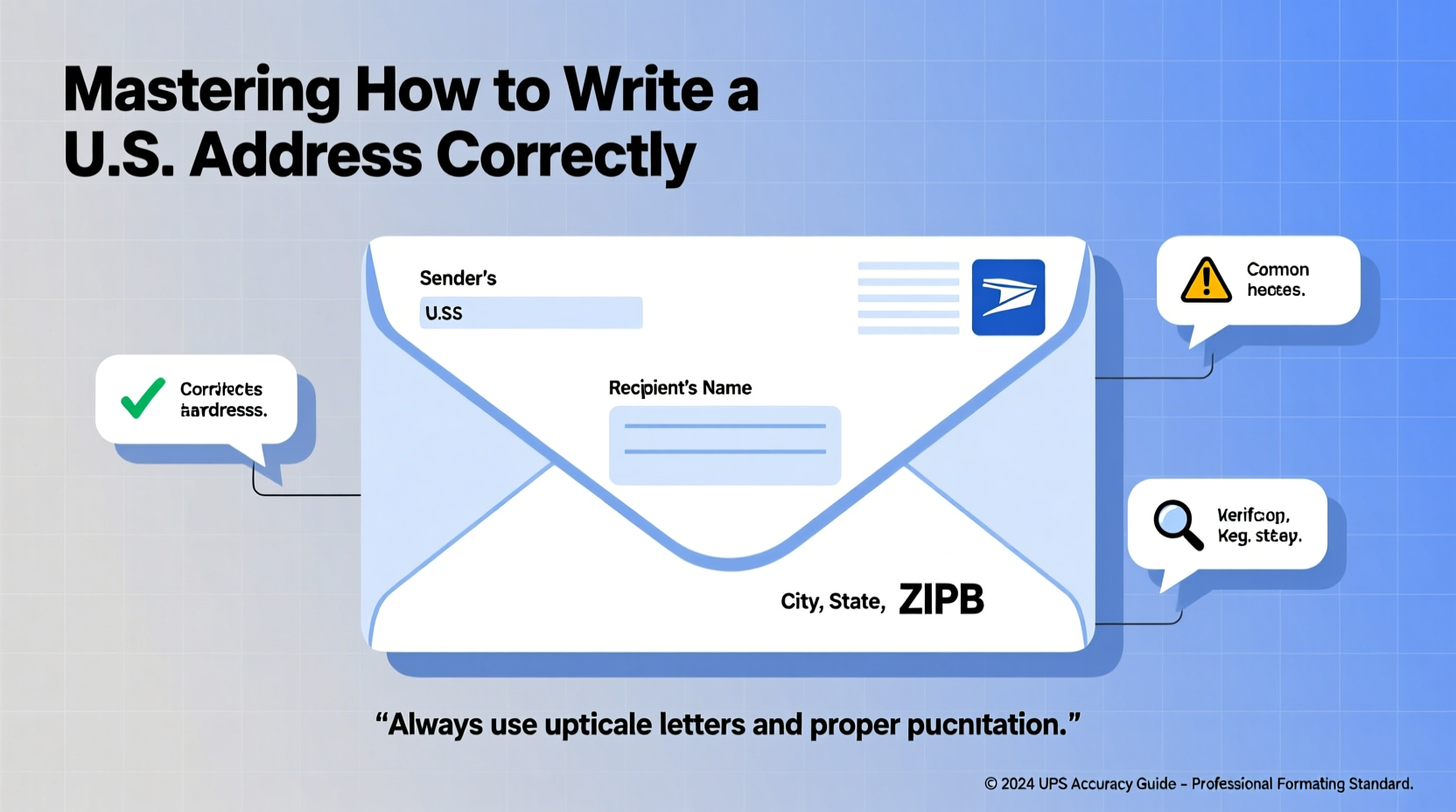
A properly formatted U.S. address follows a specific structure designed for optimal readability by both humans and automated sorting machines. The standard order includes:
- Recipient’s full name
- Street address (including apartment or suite number)
- City
- State (abbreviated using two-letter USPS codes)
- ZIP Code (5-digit or ZIP+4 format)
Each line serves a distinct purpose. The name identifies who should receive the mail. The street address locates the building. The city and state narrow the region, while the ZIP Code pinpoints the exact delivery route.
Step-by-Step Guide to Writing a Correct U.S. Address
Follow these steps to ensure your address is accurate and professionally presented:
- Start with the recipient’s full name. Use the proper title if known (e.g., Dr., Mr., Ms.). For businesses, include the department or attention line if applicable.
- Write the street address on the next line. Include the primary number, directional prefix/suffix (like N, S, E, W), street name, and any secondary unit designator such as “Apt,” “Ste,” or “Unit.”
- Add the city, followed by a comma, then the two-letter state abbreviation. Never spell out the state name.
- End with the ZIP Code. Whenever possible, use the full 9-digit ZIP+4 code for faster, more precise delivery.
Example of a Fully Formatted Address
JOHN M. CARTER
1234 OAK STREET APT B
LOS ANGELES, CA 90210-1234
Note the absence of punctuation (except the comma between city and state), consistent capitalization, and correct abbreviations. These details align with USPS guidelines and maximize deliverability.
Common Mistakes and How to Avoid Them
Even small errors can derail delivery. Here are frequent missteps and how to prevent them:
- Using informal abbreviations: “St.” instead of “ST” or “Ave.” instead of “AVE.” Stick to USPS-approved abbreviations.
- Incorrect state abbreviations: Using “Calif.” instead of “CA” or “Fla.” instead of “FL.” Only the official two-letter codes are valid.
- Omitting apartment numbers: Failing to include “APT 3B” or “UNIT 12” often results in undeliverable mail.
- Writing addresses diagonally or crowding lines: This confuses optical character recognition (OCR) systems used by postal facilities.
- Using periods or commas within the street line: “123 Main St., Apt. 4” — avoid punctuation; use “123 MAIN ST APT 4” instead.
“Over 25% of all mail we process requires manual correction due to address formatting issues. Proper formatting saves time, money, and frustration.” — USPS National Processing Center, Logistics Division
Do’s and Don’ts: A Quick Reference Table
| Do’s | Don’ts |
|---|---|
| Use uppercase letters only | Use lowercase or mixed case |
| Use USPS-approved abbreviations (e.g., ST, AVE, BLVD) | Use traditional abbreviations (e.g., St., Ave., Blvd.) |
| Include ZIP+4 when available | Use only a 5-digit ZIP Code unnecessarily |
| Place apartment/unit number on the same line as street address | Put apartment number on a separate line below |
| Use one space between words and elements | Crowd information or add extra spacing |
Real-World Example: A Business Shipping Error
A small e-commerce company in Denver shipped 50 product samples to clients across California. One package was returned with the label “Undeliverable: Incorrect Apartment Number.” Upon review, the team realized they had written:
SARAH LIN
5678 MAPLE DRIVE #5
SAN DIEGO, CA 92101
The issue? While “#5” is commonly used in conversation, it is not a recognized USPS unit designator. The correct format should have been:
SARAH LIN
5678 MAPLE DR UNIT 5
SAN DIEGO, CA 92101-8765
By updating their template to use “UNIT” instead of “#” and adopting USPS abbreviations like “DR” for Drive, the company reduced return rates by 90% over the next quarter. This minor change saved hundreds in reshipping costs and preserved client trust.
Expert Tips for Professional and International Senders
For businesses, legal professionals, and individuals sending mail abroad, precision becomes even more critical.
- Use the USPS Address Validation API if you manage high-volume mailing. It automatically standardizes addresses to meet national standards.
- When sending internationally, place “USA” on the last line below the ZIP Code to clarify country origin.
- For P.O. Boxes, list the box number as the primary address line: “PO BOX 1234” rather than a street address.
- Double-space lines when handwriting to improve legibility.
“Professionalism begins with presentation. A clean, correctly formatted address signals attention to detail—something clients and partners notice, even subconsciously.” — Rebecca Lang, Corporate Communications Consultant
FAQ
Can I use “Suite” instead of “Ste” in an address?
You may write “Suite” in personal correspondence, but for maximum compatibility with postal automation systems, use the abbreviated form “STE” in all capital letters. For example: “123 MAIN ST STE 200” is preferred over “123 Main Street Suite 200.”
What’s the difference between ZIP Code and ZIP+4?
The standard 5-digit ZIP Code identifies a general geographic area or post office. The extended ZIP+4 adds four more digits to specify a particular delivery route—such as a city block, building, or high-volume receiver. Using ZIP+4 increases accuracy and can speed up delivery by 1–2 days.
How do I format an address with a rural route or highway contract?
For rural areas, use “RR” for Rural Route or “HC” for Highway Contract, followed by the box number. Example:
JAMES WILSON
RR 2 BOX 100
SPRINGFIELD, MO 65801
Checklist: Final Review Before Mailing
Before sealing your envelope or printing a label, run through this checklist:
- ✅ Recipient name is complete and correctly spelled
- ✅ Street number and name use USPS abbreviations (ST, AVE, DR, etc.)
- ✅ Apartment or suite number is included on the same line as the street
- ✅ City is spelled correctly and capitalized
- ✅ State is abbreviated (e.g., NY, TX, WA)
- ✅ ZIP Code is accurate and preferably includes +4 extension
- ✅ All text is in uppercase with no punctuation
- ✅ Address is centered and clearly legible
Conclusion
Writing a U.S. address correctly is more than a technical skill—it's a mark of professionalism, reliability, and respect. Whether you're sending a holiday card or a corporate contract, the way you present an address reflects your attention to detail and commitment to effective communication. With standardized formatting, access to USPS tools, and awareness of common pitfalls, anyone can master this essential task.




 浙公网安备
33010002000092号
浙公网安备
33010002000092号 浙B2-20120091-4
Comments
No comments yet. Why don't you start the discussion?