
Writing an effective APA-style essay requires more than just content—it demands precision in formatting, clarity in tone, and consistency in citation. The American Psychological Association (APA) format is widely used across social sciences, education, and psychology disciplines. Whether you're a student submitting your first research paper or refining your academic writing skills, mastering APA means presenting your ideas professionally and ethically. This guide walks through every essential element of crafting an APA-compliant essay, from structure and headings to in-text citations and reference lists.
Understanding the Purpose of APA Format
APA style was developed to promote clarity, objectivity, and consistency in scholarly communication. It standardizes how information is presented so readers can focus on content without being distracted by inconsistent formatting. Key goals include:
- Ensuring credibility through proper source attribution
- Maintaining a formal, impersonal tone appropriate for academic discourse
- Allowing readers to easily navigate sections of a paper
- Facilitating peer review and publication processes
By adhering to APA guidelines, writers demonstrate respect for intellectual property and contribute to a shared academic language.
“Clarity, accuracy, and ethical scholarship are at the heart of APA style.” — Publication Manual of the American Psychological Association, 7th Edition
Step-by-Step Guide to Formatting Your APA Essay
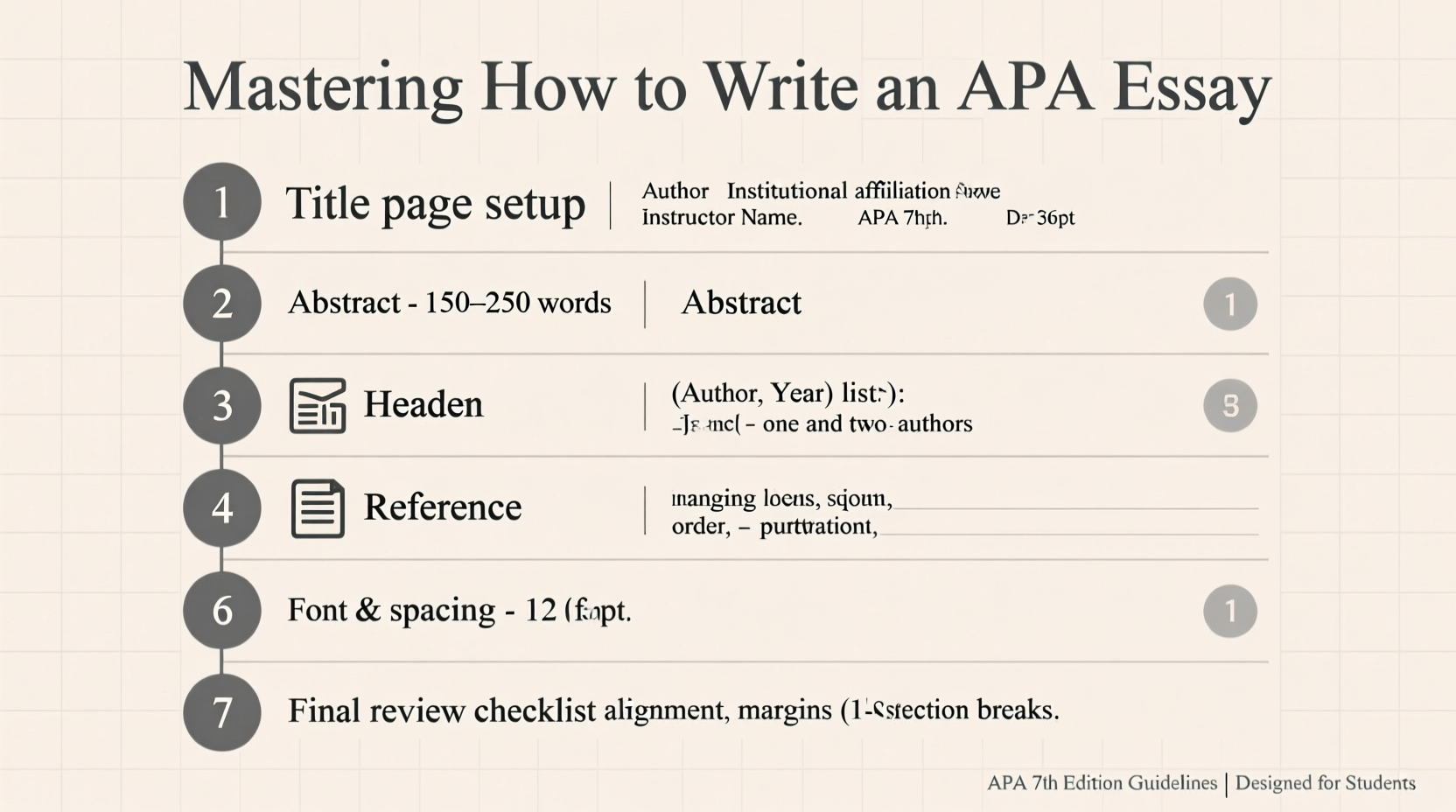
Creating a properly formatted APA document involves several precise steps. Follow this timeline to ensure compliance from start to finish.
- Set up your document settings: Use 1-inch margins on all sides, 12-point Times New Roman font, and double-spacing throughout.
- Create a title page: Include the paper title (in bold), your name, institutional affiliation, course name, instructor’s name, and due date—all centered and vertically aligned in the upper half of the page.
- Add a running head (for professional papers): For student submissions, most institutions no longer require a running head unless specified. In professional contexts, include a left-aligned page header with “Running head: SHORTENED TITLE” on the title page only.
- Insert page numbers: Right-align page numbers starting on the title page using the header function.
- Write the abstract (if required): On its own page, provide a concise summary of 150–250 words, including purpose, methods, results, and conclusions—without indentation.
- Begin the main body: Start with the title repeated at the top of the next page (bolded, centered). Organize content using appropriate section headings.
- Include references: List all cited sources alphabetically on a new page titled “References,” with hanging indents and double spacing.
Structural Components of an APA Essay
An APA-formatted paper typically includes the following sections, though exact requirements may vary depending on assignment type (e.g., literature review vs. empirical study).
| Section | Purpose | Formatting Notes |
|---|---|---|
| Title Page | Identifies author, institution, and paper title | Centered text; separate running head only for professional work |
| Abstract | Brief overview of key points | Single paragraph, no citation needed within |
| Introduction | States topic, context, and thesis | No heading needed if only one level of headings used |
| Method | Describes research design (for original studies) | Bold, centered Level 1 heading |
| Results | Presents findings | Bold, centered Level 1 heading |
| Discussion | Interprets results and implications | Bold, centered Level 1 heading |
| References | Lists all cited sources | Hanging indent, alphabetical order, double-spaced |
Using Headings Correctly
APA uses five levels of headings to organize content hierarchically. Most student essays use only Levels 1–3:
- Level 1: Bold, Centered, Title Case
- Level 2: Bold, Left-Aligned, Title Case
- Level 3: Bold Italic, Left-Aligned, Title Case
Proper use enhances readability and helps guide the reader logically through your argument.
In-Text Citations and Reference List Essentials
Citing sources correctly is non-negotiable in APA. Every idea borrowed from another author must be acknowledged both in-text and in the reference list.
In-text citations follow the author-date system. For example: (Smith, 2020). When quoting directly, include the page number: (Jones, 2019, p. 45).
The reference list provides full details of each source. Entries follow specific patterns based on source type:
- Book: Author, A. A. (Year). Title in italics. Publisher.
- Journal Article: Author, B. B. (Year). Article title. Journal Name, Volume(Issue), page range. https://doi.org/xx.xxxx
- Website: Organization. (Year, Month Date). Page title. Site name. URL
Avoiding Plagiarism Through Accurate Attribution
Even unintentional plagiarism can have serious academic consequences. Paraphrasing still requires citation. If you’re summarizing someone else’s idea—even in your own words—you must credit the source.
“Giving credit isn’t just about avoiding penalties—it’s about participating honestly in academic conversation.” — Dr. Laura Bennett, Academic Integrity Coordinator, University of Michigan
Real Example: From Draft to Final APA Submission
Sophia, a second-year psychology major, struggled with her first research paper on cognitive behavioral therapy. Her initial draft had strong content but lacked proper APA structure—no title page, inconsistent fonts, missing in-text citations, and a disorganized reference list.
After attending a university writing center workshop, she revised her paper using these actions:
- Reformatted the entire document to 12-pt Times New Roman, double-spaced
- Created a correct title page with course and instructor details
- Added Level 1 and Level 2 headings to improve flow
- Inserted parenthetical citations for every external source
- Used a citation manager (Zotero) to generate accurate references
Her final submission earned a B+, with feedback praising her improved organization and adherence to APA standards. More importantly, she built confidence in her ability to produce scholarly work.
Common APA Mistakes and How to Avoid Them
Even experienced writers make errors. Here are frequent pitfalls—and how to fix them:
| Do’s | Don’ts |
|---|---|
| Use hanging indents in the reference list | Left-align all lines without indentation |
| Italicize journal names and volume numbers | Italicize article titles |
| Capitalize only the first word in article titles (and proper nouns) | Use title case for article titles in references |
| Include DOIs as URLs (https://doi.org/10.xxxx) | Omit DOIs when available |
| Use “et al.” for three or more authors in in-text citations | List all authors every time after first mention |
FAQ
Do I need a running head in my student paper?
As of the 7th edition of the APA manual, student papers do not require a running head unless specifically requested by your instructor or institution.
How do I cite a source with no author?
If a source lacks an author, move the title to the author position in the reference list and use the first few words of the title in quotation marks for in-text citations. Example: (“Understanding Memory,” 2021).
Can I use first-person in APA?
Yes. Unlike older editions, APA 7th edition permits the use of first-person when describing your own actions or experiences (e.g., “I conducted the survey”). Avoid overuse and maintain a formal tone.
Final Checklist Before Submission
Before turning in your essay, run through this checklist to ensure full APA compliance:
- ✅ Title page includes all required elements and is properly formatted
- ✅ Entire document is double-spaced with 1-inch margins
- ✅ Font is 12-point Times New Roman (or approved alternative)
- ✅ Page numbers are inserted in the top right corner
- ✅ Headings follow APA hierarchy and formatting rules
- ✅ All sources are cited in-text using author-date format
- ✅ Reference list is alphabetized with hanging indents
- ✅ Each reference contains complete information including DOI or URL where applicable
- ✅ No grammar, spelling, or punctuation errors remain
Conclusion
Mastering how to write an APA essay is a foundational skill that pays dividends throughout your academic and professional career. Beyond fulfilling assignment requirements, APA formatting teaches discipline, attention to detail, and respect for scholarly integrity. With consistent practice, what once seemed tedious becomes second nature. Apply these principles to your next paper, refine your process, and take pride in producing work that meets the highest standards of academic excellence.




 浙公网安备
33010002000092号
浙公网安备
33010002000092号 浙B2-20120091-4
Comments
No comments yet. Why don't you start the discussion?