
Writing numbers clearly is a foundational skill, yet one often overlooked once basic numeracy is achieved. Among all digits, the number 5 presents unique challenges due to its curved structure and directional flow. Whether you're teaching children, refining your own handwriting, or working in fields where legible numeric notation matters—such as accounting, education, or healthcare—understanding how to form the number 5 correctly can significantly improve clarity and reduce errors.
The number 5 may seem simple, but small inconsistencies in stroke order, shape, or proportion can lead to confusion, especially when written quickly. Some people create loops too large, others flatten the top curve into a straight line, and many reverse the direction of strokes without realizing it. These variations might seem minor, but they impact readability across contexts—from filling out forms to interpreting medical dosages.
Why the Number 5 Is Often Miswritten
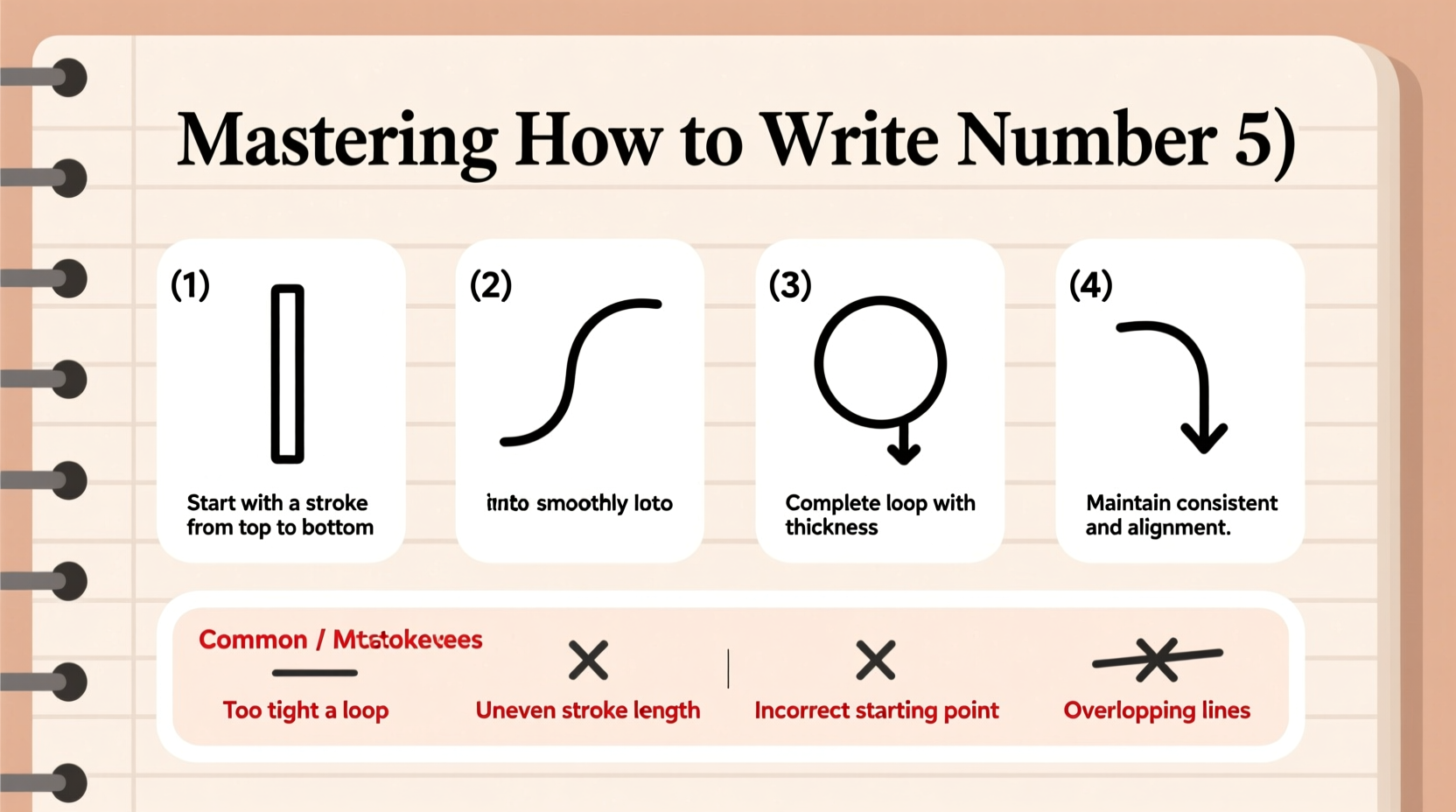
Unlike angular digits such as 1, 4, or 7, the number 5 relies heavily on smooth curves and precise transitions between segments. It combines three distinct parts: a short horizontal or slightly curved top stroke, a downward vertical arc, and a final clockwise loop at the base. When any of these components are out of balance, the digit becomes ambiguous—sometimes resembling a 6, a 9, or even a poorly formed S.
Developmental research shows that children frequently struggle with the number 5 because it requires fine motor control and an understanding of counterintuitive stroke direction. Even adults who learned cursive writing may carry over habits from letter formation, leading to inconsistent styles. In fast-paced environments, rushed writing exacerbates these issues, making standardization essential.
“Proper numeral formation isn’t just about aesthetics—it’s about preventing misinterpretation in critical settings like prescriptions and financial records.” — Dr. Linda Reeves, Educational Psychologist & Handwriting Specialist
5 Clear Tips for Writing the Number 5 Correctly
Improving your ability to write the number 5 starts with mastering the correct sequence and proportions. The following five tips provide actionable guidance for both beginners and those looking to refine their technique.
- Start at the Top Line: Begin just below the upper guideline (in lined paper) with a short, backward C-shaped curve moving leftward. This creates the rounded top of the 5 and sets the foundation for symmetry.
- Draw a Smooth Downward Arc: Without lifting the pen, continue downward in a sweeping right-to-left curve, forming the middle belly of the number. This stroke should resemble the left side of a capital D.
- Complete the Base Loop Clockwise: At the bottom, pivot smoothly into a clockwise circle that closes near the starting point. This loop distinguishes the 5 from other numbers and adds stability to its structure.
- Maintain Consistent Size and Slant: Keep the height of the 5 aligned with other numerals (typically filling the full cell height on graph paper). Avoid leaning it excessively forward or backward unless using a specific script style.
- Practice with Guided Tracing First: Use dotted-line templates or tracing sheets to internalize muscle memory before transitioning to freehand writing. Repetition builds automaticity and precision.
Common Mistakes When Writing the Number 5
Even experienced writers fall into bad habits. Recognizing these frequent errors is the first step toward correction.
- Reversing the Loop Direction: Drawing the base counterclockwise makes the 5 look like a mirrored version, which can be confusing, especially for young learners.
- Starting with the Loop: Some begin by drawing the bottom circle first, disrupting the natural flow and increasing the chance of misalignment.
- Flattening the Top Curve: A straight horizontal line instead of a gentle arc turns the 5 into something resembling a 7 or a broken Z.
- Overextending the Belly: An exaggerated middle curve causes the number to spill into adjacent characters, reducing spacing clarity.
- Inconsistent Proportions: Making the top too small or the loop too large distorts recognition, particularly in handwritten lists or tables.
Do’s and Don’ts Summary
| Do | Don't |
|---|---|
| Start with a small backward curve at the top | Begin with the bottom loop |
| Form the loop clockwise | Create a counterclockwise base |
| Keep the overall height consistent with other digits | Let the middle section extend beyond baseline or capline |
| Use smooth, connected strokes | Lift the pen mid-number |
| Align slant with surrounding text | Tilt the 5 dramatically unless stylistic |
Step-by-Step Guide to Practicing the Number 5
To master the correct form, follow this structured daily practice routine over the course of one week:
- Day 1–2: Observe and Trace – Print worksheets with dotted outlines of the number 5. Trace each number slowly, focusing on stroke order and direction.
- Day 3–4: Guided Freehand – Copy the number 5 from a model without tracing. Use lined or graph paper to maintain alignment and size.
- Day 5: Focus on Flow – Write sequences like “555” or “5 15 25” to build rhythm and consistency in context.
- Day 6: Speed with Control – Gradually increase writing speed while maintaining legibility. Record yourself if possible to spot deviations.
- Day 7: Real-World Application – Fill out a mock form or write prices, dates, or quantities using only the number 5 to test fluency under realistic conditions.
Mini Case Study: Improving Handwriting in a Primary Classroom
In a third-grade classroom in Portland, Oregon, students consistently confused the handwritten number 5 with the number 6 during math assessments. After analyzing samples, the teacher noticed most children were drawing the base loop counterclockwise. She introduced a new lesson using the “hat, slide, roll” method—where students verbalized each part as they wrote. Within two weeks, error rates dropped by 68%, and student confidence in number writing improved noticeably. The key was not just repetition, but mindful execution guided by clear imagery.
Frequently Asked Questions
Is there a standard way to write the number 5 in print?
Yes. The accepted print form begins with a short top curve from right to left, followed by a downward-left arc, ending in a clockwise closed loop at the base. This style ensures universal legibility and is taught in most early education systems.
Can I write the number 5 differently in cursive?
Yes, in some cursive scripts, the number 5 may connect to adjacent numbers with a tail or have a more elongated loop. However, even in cursive, the core structure should remain recognizable. Avoid overly decorative versions in professional or technical writing.
Why does my handwritten 5 look like a 6?
This usually happens when the top stroke is missing or too faint, and the clockwise loop dominates the shape. Make sure to emphasize the initial backward curve at the top—it’s what visually anchors the number and differentiates it from a 6.
Checklist: Mastering the Number 5
- ✅ Start with a small backward curve at the top
- ✅ Connect the downward arc without lifting the pen
- ✅ Finish with a clean clockwise loop
- ✅ Practice using lined or grid paper for alignment
- ✅ Review your writing for consistency in size and slant
- ✅ Compare your 5 to a printed model weekly
- ✅ Apply corrections in real-world writing tasks
Final Thoughts
Mastering how to write the number 5 goes beyond mere penmanship—it's about communication, accuracy, and attention to detail. Whether you're helping a child learn their numbers, improving personal handwriting, or ensuring precision in data entry, taking the time to write the 5 correctly pays dividends in clarity and professionalism. Small adjustments in stroke order, shape, and consistency yield significant improvements over time.




 浙公网安备
33010002000092号
浙公网安备
33010002000092号 浙B2-20120091-4
Comments
No comments yet. Why don't you start the discussion?