
Expressing your nationality in another language is more than a vocabulary exercise—it’s a bridge to deeper cultural connection. Saying “I am Irish” in Spanish may seem simple, but doing it correctly involves understanding grammar, mastering pronunciation, and respecting cultural nuances. Whether you're traveling, introducing yourself in a Spanish-speaking environment, or engaging in cross-cultural dialogue, getting this right builds credibility and rapport.
The phrase “I am Irish” translates to “Soy irlandés” (for men) or “Soy irlandesa” (for women). While the translation is straightforward, subtle differences in accent, gender agreement, and regional dialects can affect how natural you sound. This guide breaks down every aspect of using this expression effectively and respectfully.
Understanding the Translation and Grammar
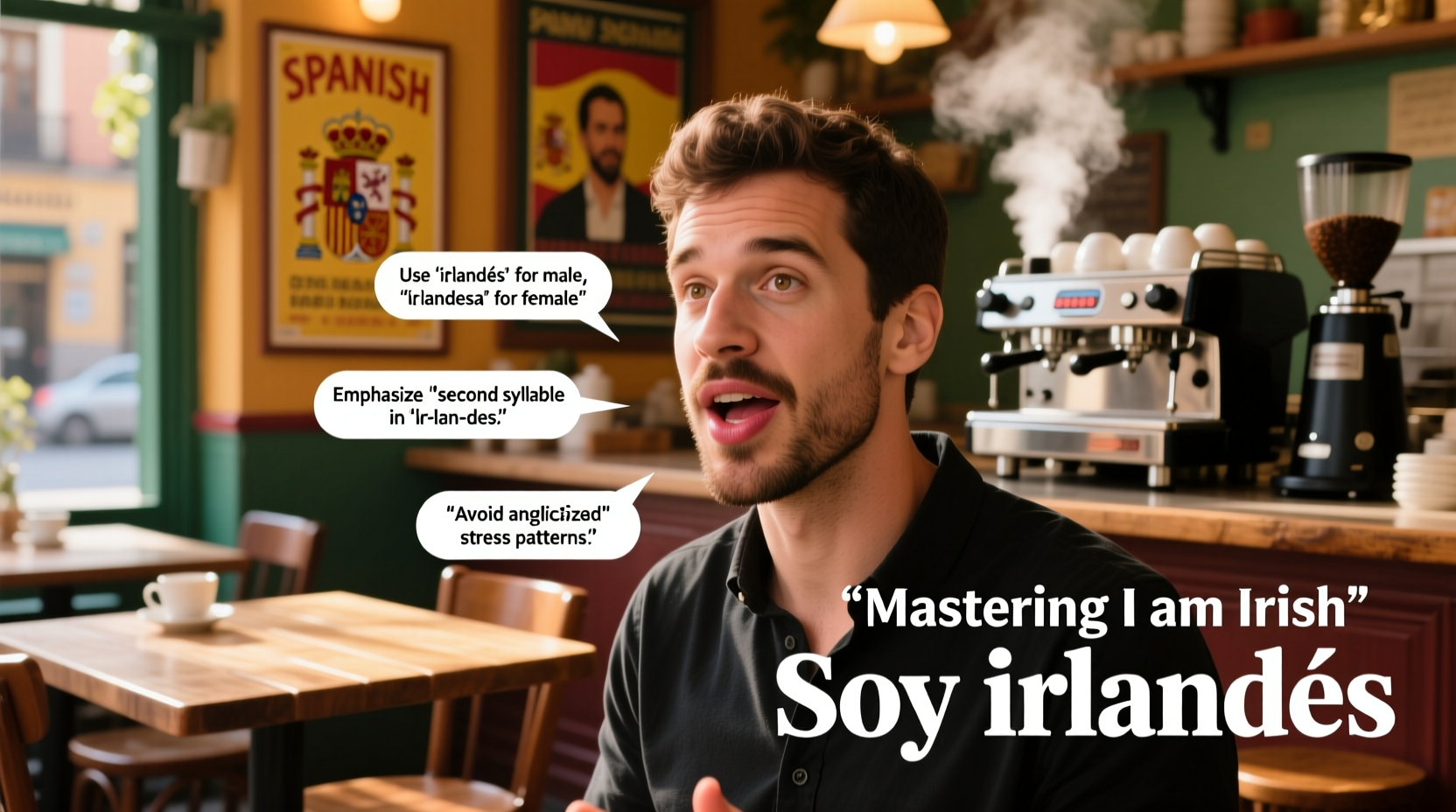
In Spanish, nationalities are adjectives that must agree in gender and number with the speaker. The verb “soy” comes from ser, meaning “to be,” and is used for permanent characteristics like nationality, origin, and profession.
- Soy irlandés – I am Irish (male speaker)
- Soy irlandesa – I am Irish (female speaker)
The word irlandés/irlandesa derives from Irlanda, the Spanish name for Ireland. Unlike English, where “Irish” remains the same regardless of gender, Spanish requires adjustment based on the speaker’s identity.
Regional Variations in Usage
While “Soy irlandés/irlandesa” is universally understood, pronunciation and intonation vary across Spanish-speaking regions. In Spain, particularly in Castilian Spanish, the “s” at the end of words is clearly pronounced, whereas in many Latin American countries, final consonants may be softened or dropped.
For example:
- Spain: /soi̯ iɾlanˈdes/ — crisp “s” sounds
- Mexico: /soi̯ iɾlanˈdeh/ — softer “s,” almost like “h”
- Argentina: /soi̯ iɾlanˈdɛs/ — with a slight “sh” quality due to yeísmo
These differences don’t change the meaning but influence how native speakers perceive fluency and authenticity.
Pronunciation Guide: Breaking Down the Sounds
Mastering pronunciation starts with syllable breakdown and phonetic awareness. Let's dissect “Soy irlandés”:
| Word | Syllables | Phonetic Spelling | English Approximation |
|---|---|---|---|
| Soy | soy | /soi̯/ | “soy” as in soy sauce (one syllable, diphthong) |
| Ir | ir | /iɾ/ | “eer” with a soft tap of the tongue |
| lan | lan | /lan/ | “lan” as in “lawn” |
| dés | dés | /ˈdes/ | “days” with emphasis on first syllable |
The stress falls on dés, so emphasize that syllable when speaking. Avoid saying “SOY IR-LAN-DES” with equal weight on each part. Instead, say “soy eer-lan-DAYS” (in Latin America) or “soy eer-lan-DETH” (in Spain).
“Pronunciation isn’t about perfection—it’s about intelligibility and respect. A well-placed accent shows effort, and that effort is noticed.” — Dr. Elena Ruiz, Linguist & Professor of Hispanic Studies, Universidad Complutense de Madrid
Cultural Nuances When Stating Nationality
In many Spanish-speaking cultures, stating your nationality opens the door to further conversation. It’s not just a fact—it’s an invitation to connect. Expect follow-up questions like:
- ¿De dónde en Irlanda eres? – Where in Ireland are you from?
- ¿Has estado en España? – Have you been to Spain?
- ¿Te gusta el fútbol? – Do you like soccer?
Being Irish often evokes associations with music, literature, and historical emigration. In Argentina, for instance, there’s a strong recognition of Irish heritage due to 19th-century immigration. Mentioning you’re Irish might prompt someone to share their own Irish ancestry.
Avoiding Common Mistakes
Learners often make small but noticeable errors. Here’s what to avoid:
| Mistake | Why It’s Wrong | Correct Version |
|---|---|---|
| “Soy de Irish” | Mixing languages; “Irish” isn’t Spanish | “Soy irlandés/irlandesa” |
| “Soy Irlanda” | That means “I am Ireland,” not “I am Irish” | Use adjective form, not country name |
| Using “irlandés” regardless of gender | Ignores grammatical agreement | Adjust ending to match gender |
| Stressing “soy” instead of “dés” | Alters rhythm and clarity | Emphasize the last syllable of “irlandés” |
Step-by-Step Guide to Confidently Say “I Am Irish” in Spanish
Follow this five-step process to internalize the phrase naturally:
- Learn the correct form: Choose irlandés or irlandesa based on your gender.
- Practice the pronunciation slowly: Break it into parts: “soy” → “eer” → “lan” → “DAYS”.
- Record yourself: Compare your speech to native audio samples from reliable sources like Forvo or SpanishDict.
- Use it in context: Practice in a full sentence: “Hola, me llamo Sarah y soy irlandesa.”
- Engage in conversation: Use the phrase when meeting Spanish speakers, then respond to common follow-ups.
Mini Case Study: Maria’s Networking Success in Mexico City
Maria, an Irish project manager from Galway, attended a business conference in Mexico City. During introductions, she said confidently, “Hola, soy María y soy irlandesa.” Her clear pronunciation and correct use of irlandesa caught the attention of a local entrepreneur who had studied abroad in Dublin.
They bonded over shared references to Irish music and Mexican-Irish cultural ties. That brief introduction led to a collaboration on a bilingual training program. Maria later reflected that getting the basics right—especially her self-introduction—set a tone of professionalism and openness.
Checklist: Mastering “I Am Irish” in Spanish
Use this checklist to ensure you’re fully prepared:
- ✅ Know whether to use irlandés or irlandesa
- ✅ Pronounce soy as a single diphthong (/soi̯/), not “so-ee”
- ✅ Stress the last syllable: “irlandÉS”
- ✅ Practice with native audio models
- ✅ Prepare for common follow-up questions
- ✅ Adjust for regional accents if needed (e.g., softer ‘s’ in Latin America)
- ✅ Use the phrase in a full self-introduction
Frequently Asked Questions
Can I say “Soy de Irlanda” instead of “Soy irlandés”?
Yes, “Soy de Irlanda” means “I am from Ireland” and is grammatically correct. However, it emphasizes origin rather than identity. If you want to express nationality (e.g., on a form or in a cultural context), “Soy irlandés/irlandesa” is more precise.
What if I’m from Northern Ireland?
This can be sensitive. Politically, Northern Ireland is part of the UK, but culturally, many identify as Irish. In Spanish, you might say “Soy del norte de Irlanda” to clarify. In casual settings, “Soy irlandés” is generally accepted unless specificity is required.
Do I need to capitalize “irlandés”?
No. Unlike in English, nationalities in Spanish are not capitalized unless they begin a sentence. Correct: soy irlandés. Incorrect: soy Irlandés.
Conclusion: Speak with Confidence and Cultural Awareness
Saying “I am Irish” in Spanish is a small phrase with big implications. When you pronounce it accurately, match the gender correctly, and understand the cultural context, you do more than communicate—you connect. Language is not just about words; it’s about showing respect, building trust, and opening doors.
Whether you’re introducing yourself at a social event, traveling through Seville, or collaborating with colleagues in Bogotá, mastering this simple statement sets the foundation for meaningful interaction. Don’t aim for perfection—aim for clarity, authenticity, and engagement.




 浙公网安备
33010002000092号
浙公网安备
33010002000092号 浙B2-20120091-4
Comments
No comments yet. Why don't you start the discussion?