
Accurate in-text citations are the backbone of credible academic writing. In the American Psychological Association (APA) style, proper citation not only gives credit to original authors but also strengthens your arguments by anchoring them in established research. Yet, many students and researchers struggle with the nuances of APA in-text citations—especially when handling multiple authors, direct quotes, or sources without dates. This guide breaks down every essential rule with clarity and precision, ensuring you can cite confidently and correctly.
Understanding the Basics of APA In-Text Citation
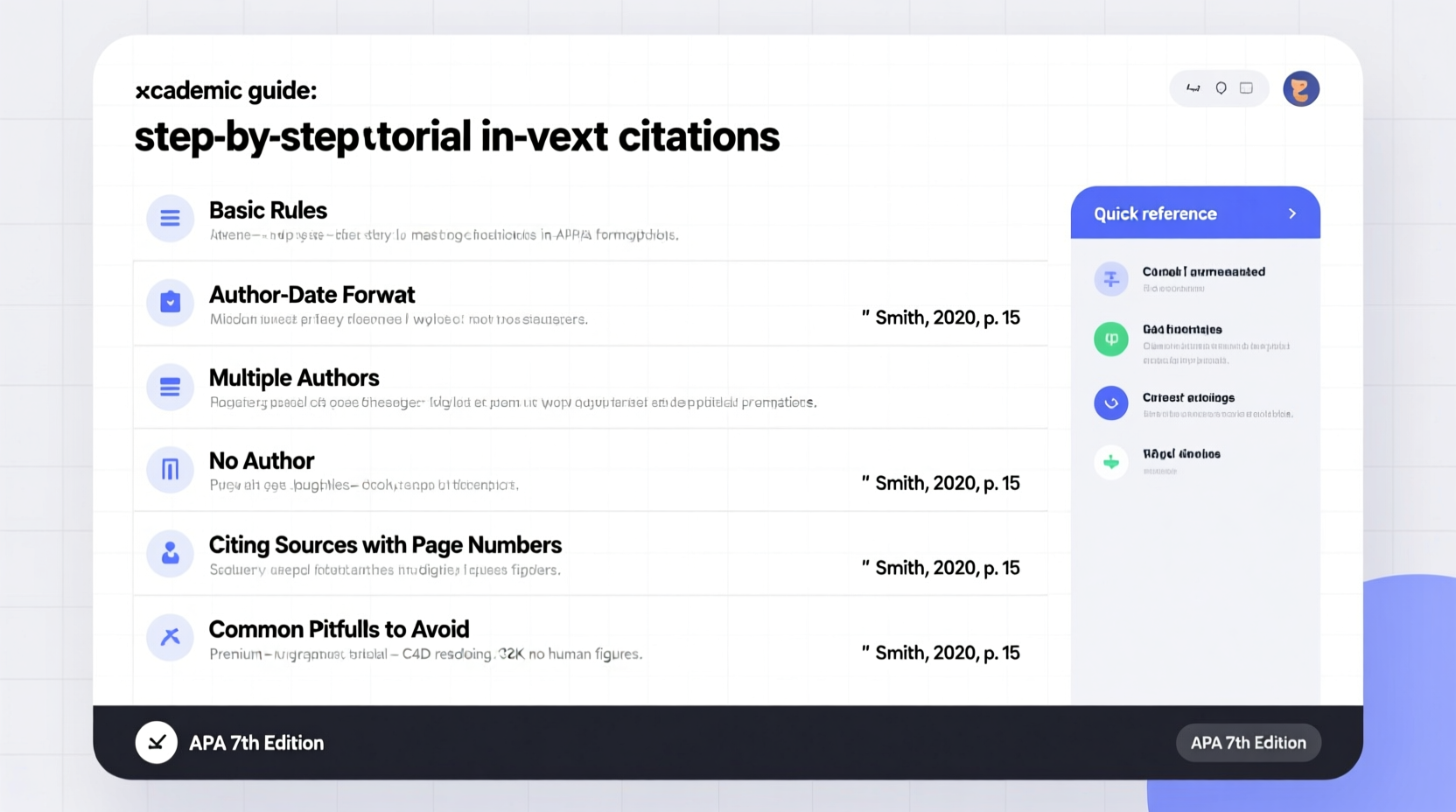
In APA 7th edition, in-text citations use the author-date method. This means that within the body of your paper, you include the last name of the author and the year of publication in parentheses. The goal is to briefly point readers to the full reference in your reference list at the end of the document.
For example:
Studies show that sleep quality impacts cognitive performance (Walker, 2017).
If you mention the author’s name in the sentence, only the year appears in parentheses:
Walker (2017) found that deep sleep enhances memory consolidation.
The citation style varies slightly depending on the number of authors, whether it's a direct quote, or if information like the date is missing. Mastering these variations ensures your work maintains academic integrity and meets scholarly standards.
Handling Different Numbers of Authors
The number of authors determines how you format the in-text citation. Here’s how to handle each case:
One Author
Use the author’s last name and year.
- (Smith, 2020)
- Smith (2020) argued that...
Two Authors
List both names every time, joined by an ampersand (&) in parentheses or “and” in narrative form.
- (Johnson & Lee, 2019)
- Johnson and Lee (2019) discovered...
Three or More Authors
From the first citation onward, use only the first author’s last name followed by “et al.” and the year.
- (Martinez et al., 2021)
- Martinez et al. (2021) reported significant improvements...
“Using 'et al.' correctly streamlines citations while maintaining clarity—especially important in fields with collaborative research.” — Dr. Rebecca Langford, Academic Writing Consultant
Citing Direct Quotes and Page Numbers
When quoting directly from a source, include the page number in your citation. Use “p.” for a single page and “pp.” for a range.
Example with parentheses:
“The brain undergoes critical reorganization during adolescence” (Thompson, 2015, p. 48).
Example in narrative form:
Thompson (2015) observed that “neural pruning peaks between ages 14 and 17” (p. 52).
If the source lacks page numbers—such as a website or e-book—use a paragraph number (para. #), section name, or heading instead.
(Fisher, 2022, para. 7)
(Rivera, 2021, Discussion section)
Special Cases and Common Pitfalls
Not all sources fit neatly into standard categories. Knowing how to adapt is key to accurate referencing.
Sources Without a Date
If no publication date is available, use “n.d.” (no date) in place of the year.
(Miller, n.d.)
Organizational Authors
When the author is an organization or government agency, spell out the full name in the first citation. You may abbreviate in subsequent citations if the abbreviation is well-known.
First citation: (National Institute of Mental Health [NIMH], 2020)
Later: (NIMH, 2020)
Multiple Sources in One Citation
To support a point with several studies, list all citations alphabetically, separated by semicolons.
(Chen, 2018; Gupta, 2019; Lee & Kim, 2020)
Same Author, Same Year
If an author has multiple works published in the same year, add lowercase letters (a, b, c) after the year, both in-text and in the reference list.
(Brown, 2021a); (Brown, 2021b)
| Situation | In-Text Citation Example | Notes |
|---|---|---|
| One author | (Taylor, 2020) | Always include year. |
| Two authors | (Adams & Bell, 2019) | Use & in parentheses, \"and\" in text. |
| Three+ authors | (Nguyen et al., 2022) | Use et al. from first citation. |
| No date | (Roberts, n.d.) | Use n.d. consistently. |
| Direct quote | (Fleming, 2021, p. 103) | Include page number. |
Step-by-Step Guide to Perfect In-Text Citations
Follow this sequence to ensure every citation is accurate:
- Identify the author(s): Is it an individual, group, or corporate entity?
- Determine the publication year: Check the source carefully; if missing, use “n.d.”
- Note the number of authors: Adjust citation format accordingly (e.g., et al. for three or more).
- Check for direct quotes: If quoting, include page or paragraph number.
- Integrate smoothly: Choose between parenthetical or narrative citation based on sentence flow.
- Cross-reference: Ensure every in-text citation matches an entry in your reference list.
Mini Case Study: From Confusion to Clarity
Sophia, a graduate student in psychology, was preparing her thesis on anxiety interventions. She had compiled dozens of journal articles but struggled with inconsistent citations. In one paragraph, she wrote:
Recent therapies combine mindfulness and CBT techniques (Jones, 2020). Others argue exposure therapy remains most effective (Miller, 2020) (Smith, 2020).
Her advisor flagged the last sentence—two citations in parentheses should be combined. After reviewing APA rules, Sophia revised it:
Recent integrative approaches show promise (Jones, 2020), though some researchers maintain that exposure therapy is still the gold standard (Miller, 2020; Smith, 2020).
This small correction improved clarity and compliance. By learning to merge multiple sources properly, Sophia strengthened the professionalism of her entire manuscript.
FAQ
Do I need to cite every sentence in a paragraph?
No. If an entire paragraph is based on one source, introduce it clearly and cite once—usually at the end. However, if you’re drawing from multiple ideas or sources, cite as needed to avoid ambiguity.
Can I use “ibid.” in APA?
No. Unlike Chicago or legal styles, APA does not use “ibid.” Repeat the author-year format each time, even for consecutive citations of the same source.
What if two authors have the same last name and same publication year?
Include the initials in all in-text citations to differentiate them, even if the first citation seems clear.
(J. A. Reed, 2019); (M. T. Reed, 2019)
Final Checklist for Flawless APA In-Text Citations
- ✅ Author names spelled correctly
- ✅ Correct year (or “n.d.” if missing)
- ✅ Proper use of “&” vs. “and”
- ✅ “et al.” used for three or more authors
- ✅ Page or paragraph numbers included for quotes
- ✅ Multiple sources separated by semicolons and listed alphabetically
- ✅ All in-text citations have matching references
Conclusion
Precision in in-text citation reflects rigor in scholarship. Mastering APA format isn’t about memorizing rules—it’s about respecting intellectual property, enhancing readability, and building trust with your readers. Whether you're writing a research paper, thesis, or journal article, consistent and correct citations demonstrate your commitment to academic excellence.




 浙公网安备
33010002000092号
浙公网安备
33010002000092号 浙B2-20120091-4
Comments
No comments yet. Why don't you start the discussion?