
Accurate and consistent referencing is the backbone of credible academic writing. Whether you're drafting a research paper, thesis, or journal article, properly citing your sources strengthens your argument, avoids plagiarism, and gives credit where it’s due. Among the most critical components of citation systems are in-text citations—brief references within the body of your text that point readers to the full source in your reference list. Yet many writers struggle with formatting, placement, and style consistency. This guide breaks down the process into clear, actionable steps to help you master in-text citations across major styles like APA, MLA, and Chicago.
Understanding the Purpose of In-Text Citations
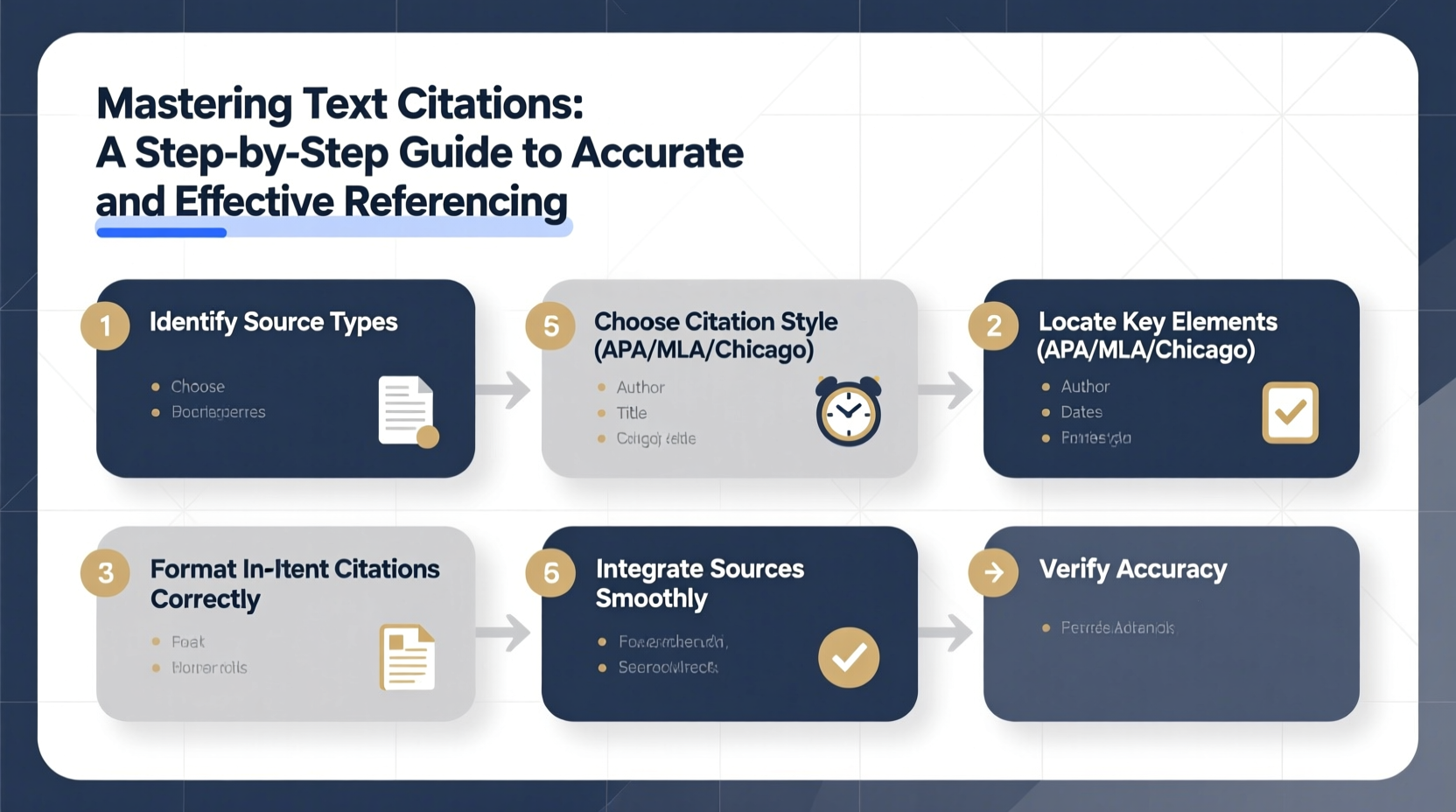
In-text citations serve two essential functions: they acknowledge the original author's intellectual contribution and allow readers to trace claims back to their source. Without them, even unintentional plagiarism can occur. A well-placed citation shows academic integrity and builds trust with your audience.
Different disciplines favor different citation styles. For example, APA (American Psychological Association) is common in social sciences, MLA (Modern Language Association) in humanities, and Chicago in history and publishing. While each has unique rules, all share the goal of clarity and consistency.
“Citing sources isn’t just about avoiding penalties—it’s about joining an ongoing scholarly conversation.” — Dr. Rebecca Lang, Academic Writing Consultant
A Step-by-Step Guide to Creating Accurate In-Text Citations
Follow this structured approach to ensure every citation is precise and correctly formatted.
- Identify the source type: Determine whether you’re citing a book, journal article, website, or another format. Each may have specific requirements.
- Select the appropriate citation style: Confirm which style your institution or publication requires.
- Locate key information: Gather the author’s name, publication year, page number (if applicable), and title as needed.
- Insert the citation at the right point: Place the citation immediately after the referenced idea, quote, or data.
- Match the in-text citation to the reference list: Ensure every in-text citation corresponds to a full entry in your bibliography.
Common In-Text Citation Formats by Style
| Style | Format (One Author) | Example |
|---|---|---|
| APA (7th ed.) | (Author, Year) | (Smith, 2020) |
| MLA (9th ed.) | (Author Page) | (Smith 245) |
| Chicago (Author-Date) | (Author Year, Page) | (Smith 2020, 245) |
For direct quotes, always include a page number when available. When paraphrasing, including a page or paragraph number is encouraged in APA and Chicago for precision.
Handling Complex Scenarios
Not all sources fit neatly into basic templates. Here’s how to manage more complicated cases.
Multiauthor Sources
- APA: Two authors: (Smith & Lee, 2019). Three or more: use et al. after first mention: (Johnson et al., 2021).
- MLA: Two authors: (Smith and Lee 45). Three or more: (Brown et al. 112).
- Chicago: Similar to APA: (Taylor, Rivera, and Kim 2023, 78).
Sources Without Page Numbers
When citing websites or e-books without pagination, use paragraph numbers (para. 5) or section headings if available. If not, omit the number but still include author and year (APA) or author only (MLA).
Multiple Sources in One Citation
To cite several works supporting the same point, separate them with semicolons: (Jones, 2018; Miller, 2020; Patel, 2021).
Real Example: Applying In-Text Citations in Practice
Consider a student writing a psychology paper on cognitive behavioral therapy (CBT). She reads a 2022 study by Dr. Elena Martinez showing CBT improves anxiety symptoms in adolescents. She summarizes the finding in her own words:
Recent studies indicate that cognitive behavioral therapy leads to measurable reductions in adolescent anxiety over an eight-week period (Martinez, 2022).
Later, she quotes directly:
As Martinez (2022) observed, “Over 70% of participants reported a significant decrease in panic episodes after completing the CBT intervention” (p. 134).
Both uses are correct: the first is a paraphrase with proper attribution, the second a direct quote with author, year, and page. In her reference list, she includes the full details of Martinez’s article, enabling readers to locate it.
Checklist for Flawless In-Text Citations
Before submitting any academic work, run through this checklist to ensure accuracy:
- ✅ Every borrowed idea, quote, or data point is cited.
- ✅ Citations match the required style (APA, MLA, Chicago, etc.).
- ✅ Author names and years are spelled and formatted correctly.
- ✅ Page numbers are included for direct quotes when available.
- ✅ All in-text citations appear in the reference list.
- ✅ No citation is missing parentheses or punctuation.
- ✅ Consistent formatting is maintained throughout the document.
Do’s and Don’ts of In-Text Citation
| Do’s | Don’ts |
|---|---|
| Cite immediately after introducing someone else’s idea. | Wait until the end of a paragraph to cite multiple sources vaguely. |
| Use et al. appropriately based on citation style rules. | Assume “et al.” works the same in all styles. |
| Double-check spelling of author names. | Guess the author’s name or year from memory. |
| Include DOIs or URLs in references when required. | Forget to verify link functionality in digital sources. |
Frequently Asked Questions
Do I need to cite common knowledge?
No. General facts widely known and accepted (e.g., “Water boils at 100°C”) do not require citation. However, if a fact is debated or comes from a specific study, cite it.
What if I can’t find the author of a source?
In APA and Chicago, use the organization as author (e.g., World Health Organization, 2023). In MLA, use the title of the work in quotation marks: (“Understanding Climate Change” 12).
Can I cite a source I found in another author’s work?
Yes, but only if you cannot access the original. This is called a secondary citation. In APA, write: (as cited in Lee, 2021). Always try to locate and cite the primary source directly.
Final Thoughts and Call to Action
Mastering in-text citations isn’t just about following rules—it’s about respecting intellectual labor and contributing responsibly to academic discourse. With practice, proper citation becomes second nature, enhancing both the credibility and clarity of your writing. Whether you're a student, researcher, or professional writer, investing time in accurate referencing pays dividends in reputation and rigor.




 浙公网安备
33010002000092号
浙公网安备
33010002000092号 浙B2-20120091-4
Comments
No comments yet. Why don't you start the discussion?