
Citing sources correctly is a cornerstone of academic integrity. While books and journal articles are often straightforward to reference, digital media like YouTube videos can be confusing—especially when applying APA (American Psychological Association) style. Missteps in citation not only risk credibility but may lead to accusations of plagiarism. This guide breaks down the process of creating accurate in-text citations for YouTube videos in APA 7th edition, offering clarity, structure, and practical advice to ensure your work meets scholarly standards.
Understanding APA In-Text Citations: The Basics
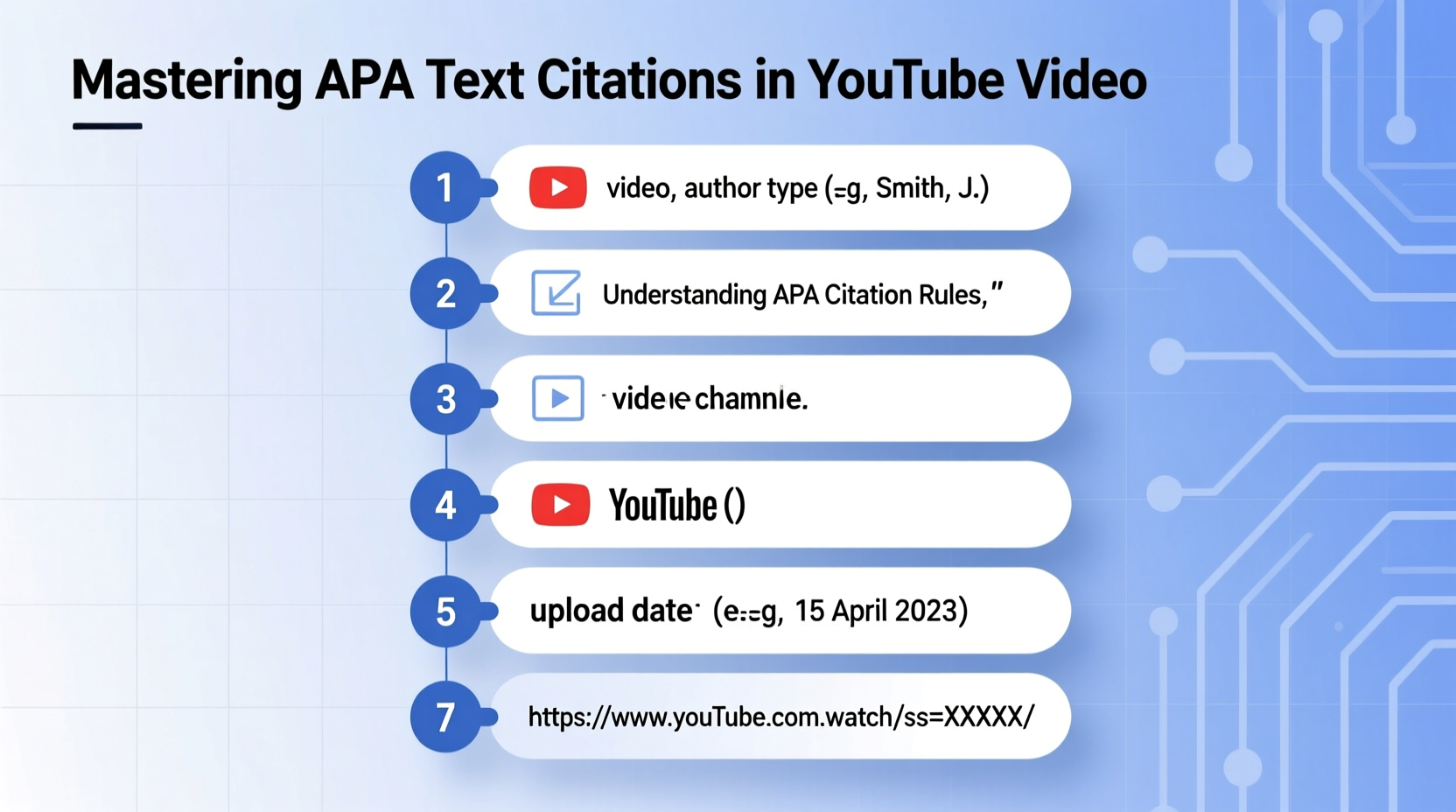
In APA format, every source cited in the body of your paper must correspond to a full reference entry in the reference list. An in-text citation typically includes the author’s last name and the year of publication. When citing a YouTube video, the “author” is usually the uploader or the channel name, and the “publication date” is the upload date.
The two main formats for in-text citations are:
- Narrative citation: The author’s name appears in the sentence itself, followed by the year in parentheses. Example: \"According to TechInsights (2023), AI tools are reshaping content creation.\"
- Parenthetical citation: Both the author and year appear in parentheses at the end of the sentence. Example: \"AI tools are reshaping content creation (TechInsights, 2023).\"
These rules apply consistently across source types, but YouTube videos introduce nuances such as pseudonyms, organizational channels, and missing dates.
Step-by-Step Guide to Citing a YouTube Video in APA
Creating a correct in-text citation starts with gathering the right information from the video. Follow these steps to ensure accuracy:
- Identify the uploader. This could be an individual (e.g., “Jane Chen”) or an organization (e.g., “Khan Academy”). Use the display name exactly as it appears on the channel.
- Find the upload date. Click on the video details to locate the precise date the video was published. Format it as YYYY, MM DD if needed for the reference list, but only the year is used in in-text citations.
- Determine if the uploader uses a real name or pseudonym. If the name is clearly a pseudonym (e.g., “ScienceScribe”), use it as-is. Do not attempt to find the person’s legal name.
- Use the correct citation format. For in-text citations, include the author (uploader) and year only.
- Match the in-text citation to the reference list entry. Ensure consistency between your parenthetical citation and the full reference.
Example Scenario
You’re writing a paper on climate change education and reference a 2022 video titled “How Glaciers Melt” uploaded by the channel “EarthExplained.” Your in-text citation would be:
(EarthExplained, 2022)
If mentioned narratively: “EarthExplained (2022) demonstrated glacier retreat using time-lapse satellite imagery.”
Special Cases and Exceptions
Not all YouTube videos follow standard naming or publishing patterns. Here’s how to handle common complications:
No Clear Author
If the video is uploaded by a generic account (e.g., “User_8823”), use the screen name as the author. Example: (User_8823, 2021).
Real Name vs. Channel Name
If the uploader uses their real name (e.g., Dr. Lisa Park), cite them as you would any individual author. If they use a brand name (e.g., “HealthyMind”), treat it as a group author.
No Date Available
Rarely, a video may lack a visible upload date. In such cases, use “n.d.” (no date) in place of the year. Example: (GreenFuture, n.d.).
Multiple Videos from the Same Author in the Same Year
If citing more than one video from the same channel in the same year, differentiate them with lowercase letters (a, b, c) after the year—both in-text and in the reference list. Example: (NASA, 2023a); (NASA, 2023b).
“Digital sources require the same rigor as print. Credibility in research hinges on precise citation, regardless of medium.” — Dr. Alan Reyes, Academic Writing Consultant
Common Mistakes to Avoid
Even experienced writers make errors when citing online videos. These pitfalls can compromise your work’s reliability:
| Mistake | Correct Approach |
|---|---|
| Citing the video title instead of the uploader | Always use the channel or individual who uploaded the content as the author |
| Using the viewing date instead of upload date | Only the upload date counts as the publication date |
| Adding URLs to in-text citations | APA in-text citations never include URLs—only the reference list does |
| Confusing speaker with author | If a guest speaks in the video but didn’t upload it, cite the uploader, not the speaker |
Checklist for Accurate YouTube Citations in APA
Before finalizing your paper, run through this checklist to ensure your in-text citations meet APA standards:
- ✅ Identified the correct author (uploader/channel)
- ✅ Verified the upload year
- ✅ Used consistent formatting (author, year) in all citations
- ✅ Differentiated multiple 2023 videos with “a,” “b,” etc.
- ✅ Matched each in-text citation to a complete reference list entry
- ✅ Avoided including titles, URLs, or timestamps in the in-text citation
Mini Case Study: From Confusion to Clarity
Sophia, a psychology undergraduate, was writing a paper on social media’s impact on teen anxiety. She referenced a compelling video essay titled “The Algorithmic Trap” uploaded by the channel “MindfulScroll” in June 2023. Initially, she cited it as (“The Algorithmic Trap,” 2023), thinking the title was the key identifier. Her professor returned the draft with a note: “Cite the creator, not the title.”
After reviewing APA guidelines, Sophia corrected her citation to (MindfulScroll, 2023) and updated her reference list accordingly. The change improved her paper’s consistency and adherence to academic norms. Later, she shared: “I didn’t realize YouTube citations followed the same logic as journals. Now I always check the channel first.”
Frequently Asked Questions
Do I need to include a timestamp in the in-text citation?
No, unless you are quoting a specific moment. In that case, include the timestamp in the parenthetical citation. Example: (Khan Academy, 2020, 12:34). Note that this applies only when directly quoting spoken words.
What if the YouTube channel is run by a company, like TED or PBS?
Treat corporate channels as group authors. Use the official name as it appears: (TED, 2021). No abbreviation unless it’s the recognized public name.
Can I cite a deleted or private video?
APA advises against citing sources that are not retrievable by readers. If a video has been removed, try to find an alternative or contact the creator. If citing unpublished material is unavoidable, consult your instructor or editor for guidance.
Final Thoughts and Action Steps
Mastering in-text citations for YouTube videos in APA isn’t about memorizing obscure rules—it’s about understanding the principles of attribution and consistency. Whether you're analyzing a TED Talk, referencing a tutorial, or discussing a documentary clip, treating digital content with the same care as traditional sources strengthens your academic voice.
Start by auditing your current citations. Are they based on the uploader and year? Do they align with your reference list? Small adjustments today can significantly improve your writing’s professionalism tomorrow.




 浙公网安备
33010002000092号
浙公网安备
33010002000092号 浙B2-20120091-4
Comments
No comments yet. Why don't you start the discussion?