
Finding the square root of a number is a fundamental mathematical skill with applications ranging from geometry and physics to finance and data analysis. While calculators offer instant results, understanding how to compute square roots manually deepens numerical intuition, strengthens problem-solving abilities, and proves invaluable in test environments where electronic devices are restricted. This guide explores reliable, time-tested methods for extracting square roots without technological assistance, equipping you with practical knowledge that stands the test of time.
The Importance of Manual Square Root Calculation
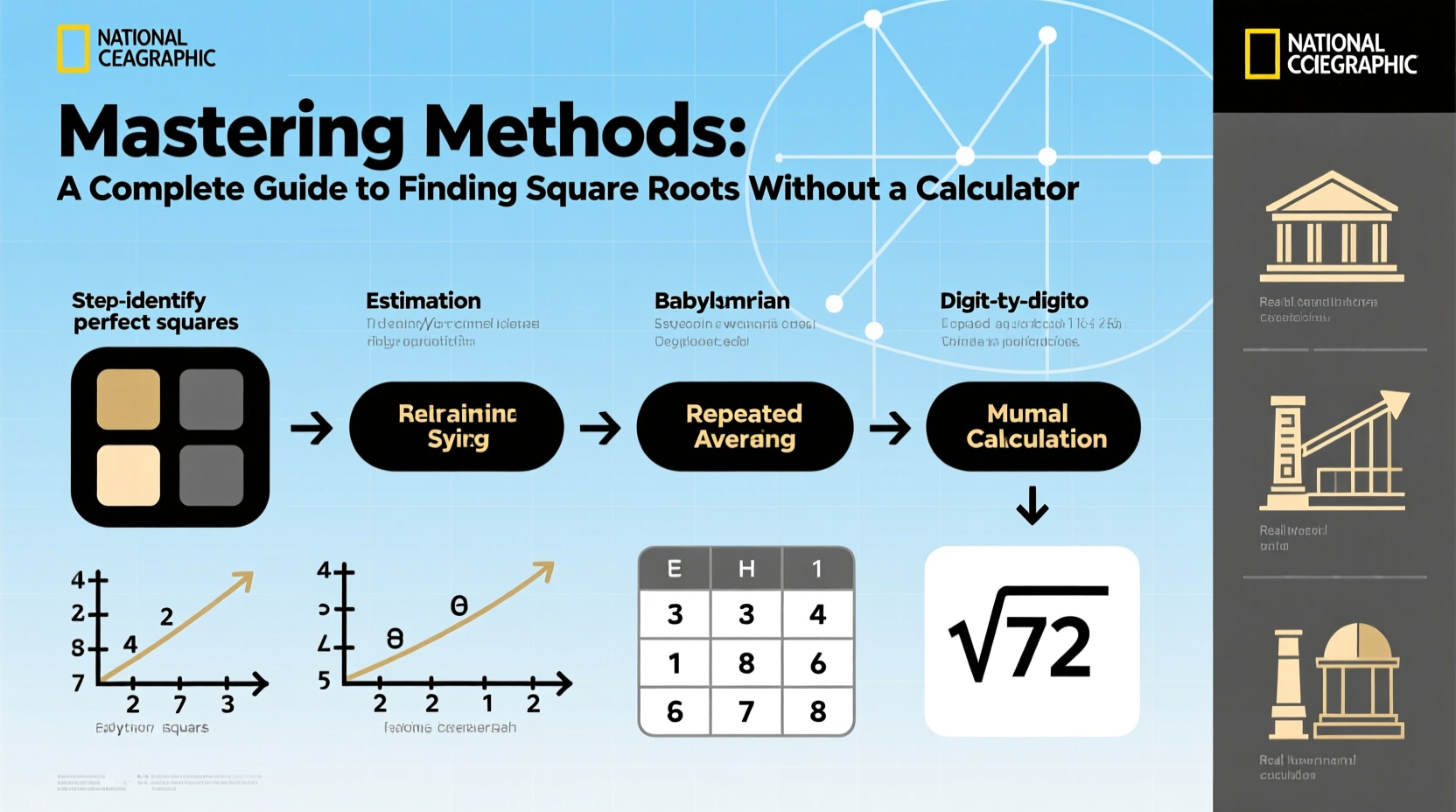
In an age dominated by digital tools, mastering manual computation may seem outdated. However, the ability to estimate or calculate square roots mentally or on paper fosters number sense and mathematical confidence. It allows for quick verification of calculator outputs, supports performance in standardized exams like the SAT or GRE, and enhances logical reasoning. Historically, mathematicians across cultures—from Babylonian scholars to Indian astronomers—developed sophisticated algorithms to approximate square roots long before modern computing existed.
“Understanding the mechanics behind square roots transforms math from rote memorization into a dynamic exploration of patterns.” — Dr. Alan Reyes, Mathematics Educator
Method 1: Prime Factorization (Perfect Squares Only)
This method works exclusively for perfect squares—numbers whose square roots are integers. The process involves breaking down the number into its prime factors and pairing identical ones.
- Decompose the number into prime factors using division.
- Group the prime factors into pairs of identical numbers.
- Multiply one factor from each pair to obtain the square root.
Example: Find √144
- 144 = 2 × 2 × 2 × 2 × 3 × 3
- Pair them: (2×2), (2×2), (3×3)
- Take one from each pair: 2 × 2 × 3 = 12
- Therefore, √144 = 12
Method 2: Long Division Method (For Any Number)
The long division method is the most accurate manual technique for finding square roots of both perfect and non-perfect squares. It yields digit-by-digit precision and can be extended to decimal places as needed.
Step-by-Step Guide to the Long Division Method
- Group digits in pairs starting from the decimal point—moving left for whole numbers and right for decimals. Add trailing zeros in pairs if necessary.
- Find the largest square less than or equal to the first group. Write its root above, subtract its square, and bring down the next pair.
- Double the current quotient and use it as the starting digit of the next divisor.
- Determine the next digit such that when appended to the doubled quotient and multiplied by itself, the product is ≤ the current remainder.
- Repeat until desired precision is achieved.
Example: Compute √625
- Group: 6 | 25
- Largest square ≤ 6 is 4 (from 2²). Write 2 above. Subtract 4, remainder 2.
- Bring down 25 → 225.
- Double quotient: 2×2=4. Find digit X such that (4X)×X ≤ 225.
- Try X=5: 45×5 = 225. Perfect match.
- Square root is 25.
| Step | Action | Result |
|---|---|---|
| 1 | Group digits: 6 | 25 | Two groups |
| 2 | √6 ≈ 2; 2² = 4 | Remainder: 2 |
| 3 | Bring down 25 → 225 | New dividend: 225 |
| 4 | Double 2 → 4; find X: 4X × X ≤ 225 | X = 5 → 45×5=225 |
| 5 | Subtract 225 − 225 = 0 | Exact root found: 25 |
Method 3: Estimation and Averaging (Newton-Raphson Approximation)
Also known as the Babylonian method, this iterative approach converges rapidly to the true value. It’s ideal for approximating square roots of non-perfect squares.
Process:
- Make an initial guess based on nearby perfect squares.
- Divide the original number by your guess.
- Average the result with your guess.
- Use this average as the new guess and repeat until stable.
Example: Estimate √50
- Closest squares: 7² = 49, 8² = 64 → Start with 7.
- 50 ÷ 7 ≈ 7.1429
- Average: (7 + 7.1429)/2 ≈ 7.0714
- Next iteration: 50 ÷ 7.0714 ≈ 7.0707; average ≈ 7.0710
- Converging to √50 ≈ 7.071
Mini Case Study: Calculating Tile Dimensions
A homeowner wants to lay square tiles over a 72-square-foot patio. To determine the side length of each tile if they were perfectly square, they need √72. Using estimation:
- 8² = 64, 9² = 81 → Guess: 8.5
- 72 ÷ 8.5 ≈ 8.47
- Average: (8.5 + 8.47)/2 ≈ 8.485
- Second round: 72 ÷ 8.485 ≈ 8.487; average ≈ 8.486
The tile would measure approximately 8.49 feet per side. This approximation helps in planning cuts and layout without needing a calculator on-site.
Method 4: Using Known Values and Linear Approximation
When high precision isn’t required, linear interpolation between known squares provides a fast mental estimate.
If N lies between a² and b², then:
√N ≈ a + (N − a²)/(b² − a²) × (b − a)
Example: Estimate √30
- 25 (5²) < 30 < 36 (6²)
- √30 ≈ 5 + (30−25)/(36−25) × (6−5) = 5 + 5/11 ≈ 5.45
- Actual √30 ≈ 5.477 — error less than 0.5%
Checklist: Mastering Manual Square Root Techniques
- ✅ Memorize squares from 1² to 25² for quick reference.
- ✅ Use prime factorization for perfect squares only.
- ✅ Apply the long division method for exact or high-precision results.
- ✅ Employ Newton-Raphson (estimation and averaging) for rapid approximation.
- ✅ Practice daily with random numbers to build speed and accuracy.
- ✅ Verify results by squaring your answer to check proximity.
Common Pitfalls and How to Avoid Them
Even experienced learners make mistakes when applying these methods. Awareness of common errors improves reliability.
| Pitfall | Why It Happens | How to Avoid |
|---|---|---|
| Incorrect grouping in long division | Starting from wrong end or misplacing decimal | Always group from decimal outward in pairs |
| Overestimating the next digit | Choosing a digit that makes (divisor)(digit) too large | Test values incrementally; never exceed remainder |
| Poor initial guess in averaging method | Guessing far from actual root slows convergence | Use nearest perfect square as baseline |
| Forgetting to double the quotient | Skipping step in long division setup | Write it down explicitly each time |
FAQ
Can I find the square root of a decimal without a calculator?
Yes. Treat the decimal like any other number. Group digits in pairs from the decimal point outward. For example, √0.49 becomes √(49/100) = √49 / √100 = 7/10 = 0.7. For non-perfect decimals, apply the long division or averaging method.
Is there a way to tell if a number is a perfect square quickly?
Yes. Check the last digit—perfect squares end in 0, 1, 4, 5, 6, or 9. Also, perform prime factorization: all exponents must be even. For instance, 144 = 2⁴ × 3²—both exponents even → perfect square.
How accurate is the estimation method?
The Newton-Raphson method typically achieves three decimal places of accuracy within two iterations. Its convergence is quadratic, meaning each step roughly doubles the number of correct digits.
Conclusion: Embrace the Power of Mental Computation
Finding square roots without a calculator is not merely a nostalgic exercise—it’s a powerful cognitive tool. Whether you're preparing for exams, teaching students, or simply enriching your numeracy, mastering these methods builds resilience and insight. Each technique offers unique advantages: elegance in factorization, precision in long division, and efficiency in averaging. With consistent practice, what once seemed daunting becomes second nature.




 浙公网安备
33010002000092号
浙公网安备
33010002000092号 浙B2-20120091-4
Comments
No comments yet. Why don't you start the discussion?