
In Minecraft, time behaves differently than in the real world. The day-night cycle repeats every 20 minutes in real time, which can make it difficult to track when night will fall or how long you’ve been exploring. While watches don’t exist in this blocky universe, the clock serves as your personal timekeeping device. Understanding how to craft, use, and strategically deploy clocks can significantly improve your survival efficiency, farming schedules, and mob-spawning awareness. This guide breaks down everything you need to know about clocks — from basic crafting to advanced applications in multiplayer and redstone systems.
Understanding the Clock’s Functionality
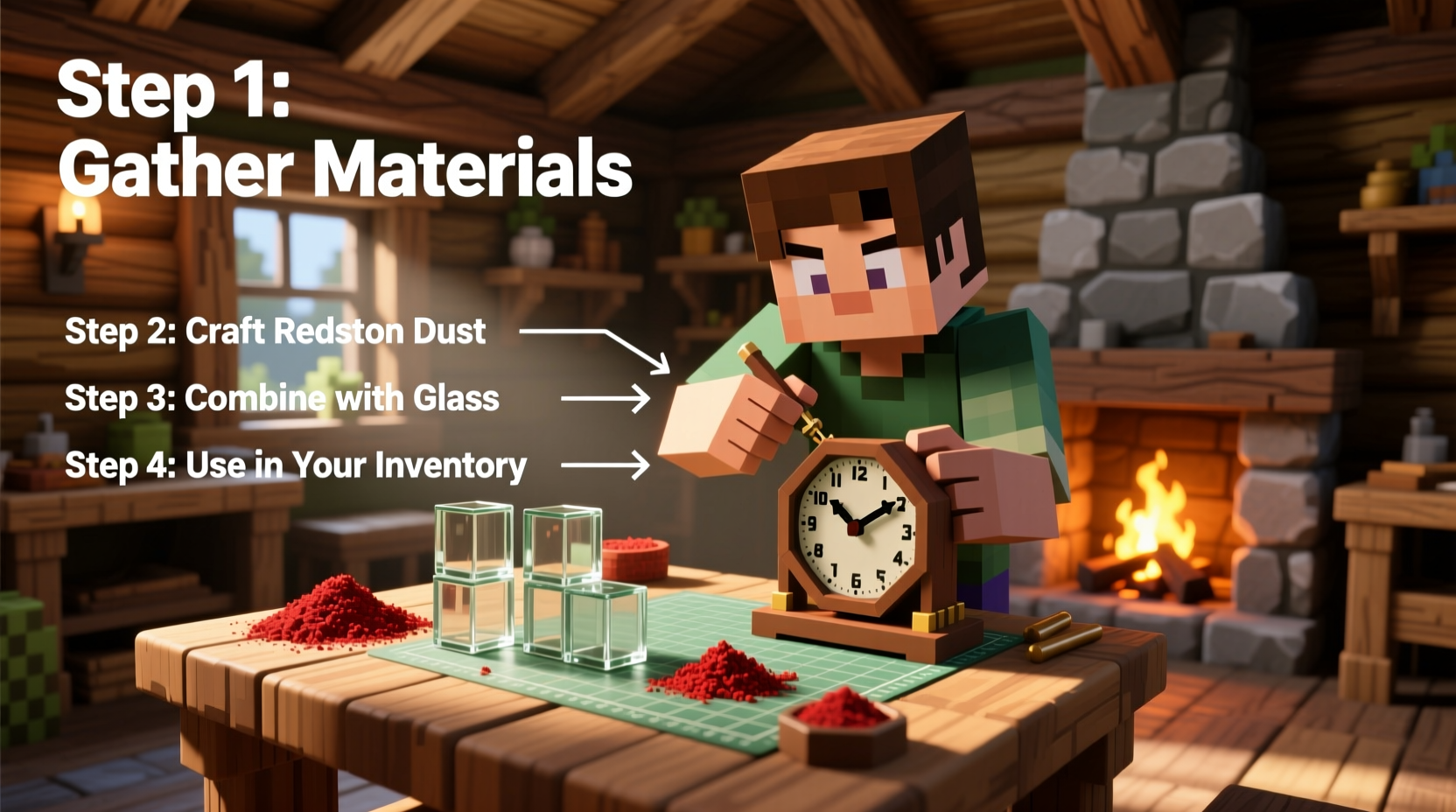
A clock in Minecraft displays the current phase of the day-night cycle. When held or placed, it shows the position of the sun or moon in the sky, allowing players to determine whether it’s morning, midday, evening, or deep into the night. Unlike real-world clocks, it doesn’t show hours and minutes but instead provides a visual indicator of in-game time.
The clock only works in dimensions where time passes normally — primarily the Overworld. In the Nether or the End, where time is static, the clock spins erratically and becomes useless for time tracking. This limitation makes it essential to understand when and where to rely on your clock.
“Time management in survival mode separates casual players from seasoned builders. A well-placed clock can prevent countless zombie door-kicks.” — Jordan Hale, Minecraft Survival Strategist
Step-by-Step Guide to Crafting a Clock
Crafting a clock requires specific materials that are readily available once you’ve progressed beyond the first day. Follow these steps to create your first timepiece:
- Gather 4 Gold Ingots: Mine gold ore with an iron pickaxe or better. Smelt the ore in a furnace to obtain ingots.
- Obtain 1 Redstone Dust: Mine redstone ore at level 16 or below in the Overworld. Each block yields 4–5 dust when mined with an iron pickaxe.
- Open Your Crafting Table: Place the 3×3 grid interface.
- Arrange the Materials: Place the redstone dust in the center square. Surround it with gold ingots in all four adjacent side slots (top, bottom, left, right).
- Collect the Clock: Drag the crafted clock into your inventory.
Practical Uses of Clocks in Gameplay
While seemingly simple, clocks serve multiple strategic purposes across different playstyles:
- Nightfall Prediction: Monitor the clock before venturing out. If the sun is setting, prepare for hostile mob spawns.
- Farming Automation: Use clocks alongside daylight sensors or redstone circuits to automate crop irrigation or animal breeding cycles.
- Base Lighting Control: Combine clocks with redstone mechanisms to activate lights at dusk and deactivate them at dawn.
- Multiplayer Coordination: In shared worlds, place clocks in communal areas so all players stay synchronized on in-game time.
- Adventure Mapping: When exploring caves or ruins, keep a clock in your hotbar to avoid losing track of surface conditions.
Mini Case Study: The Underground Explorer’s Dilemma
Samuel spent three real-life hours mining deep beneath a mountain biome. Without a clock, he had no idea how many in-game days had passed. Upon returning to the surface, he emerged at midnight — surrounded by a horde of creepers and zombies. His base was destroyed, and his dog had perished. After that experience, Samuel began carrying a clock at all times. He now checks it every time he ascends, ensuring he surfaces during daylight. This small change saved him dozens of respawns and preserved his builds.
Do’s and Don’ts of Clock Usage
| Do’s | Don’ts |
|---|---|
| Keep a clock in your hotbar during exploration | Use clocks in the Nether or End expecting accurate readings |
| Place clocks near beds or spawn points for quick reference | Assume the clock tells exact time — it only shows relative position |
| Combine with redstone for automated farms | Rely solely on memory instead of checking the clock regularly |
| Use clocks to time mob farm resets (every 20 minutes) | Waste gold on decorative clocks if resources are scarce |
Advanced Applications: Clocks in Redstone Engineering
For technical players, clocks aren't just tools — they’re components. Although the crafted clock itself isn’t a redstone component, its visual feedback complements redstone-powered timekeeping systems. Players often build “clock circuits” — redstone loops that pulse at regular intervals — mimicking real clocks. However, the crafted clock remains invaluable for calibrating these systems.
Example: A player building a fully automated wheat farm uses a daylight sensor to trigger harvesters at noon. To verify the sensor’s timing, they compare its activation with their handheld clock over several in-game days. This ensures precision without relying solely on guesswork.
FAQ
Can I make a clock without redstone?
No. Redstone dust is a required ingredient in the crafting recipe. There is no alternative material that substitutes for it in clock crafting.
Why does my clock spin randomly?
Your clock is likely in the Nether or the End. These dimensions do not have a natural day-night cycle, causing the clock’s internal mechanism to malfunction visually. It’s normal behavior, not a bug.
How accurate is the Minecraft clock?
The clock is highly accurate in showing the progression of the day-night cycle. It completes one full rotation every 20 minutes (real time), aligning perfectly with the 24,000-tick Minecraft day. However, it does not display numerical time, so estimation is still needed.
Checklist: Mastering Clock Use in 7 Steps
- ✅ Craft your first clock using 4 gold ingots and 1 redstone dust
- ✅ Test it in the Overworld to see the sun/moon movement
- ✅ Carry it in your hotbar during extended exploration
- ✅ Place one near your main base entrance or respawn anchor
- ✅ Avoid using it in the Nether or End for time tracking
- ✅ Combine with daylight sensors for smart lighting systems
- ✅ Teach fellow players in multiplayer how to interpret the clock
Conclusion
The clock may seem like a minor item in Minecraft’s vast toolkit, but its role in time awareness cannot be overstated. From preventing deadly nighttime encounters to optimizing farm efficiency, mastering the clock enhances both safety and productivity. Whether you're a solo survivalist or part of a large server community, integrating clocks into your routine adds a layer of control over an otherwise unpredictable environment. Now that you understand how to craft and use clocks effectively, put this knowledge into practice. Track time wisely, plan your adventures, and never get caught outside at night unprepared again.




 浙公网安备
33010002000092号
浙公网安备
33010002000092号 浙B2-20120091-4
Comments
No comments yet. Why don't you start the discussion?