
In the vast, blocky world of Minecraft, time is both invisible and essential. Unlike real life, there are no wristwatches or wall clocks—yet players still need to track day and night cycles for farming, mob spawning, or coordinating builds. This is where the Minecraft clock comes in. More than just a decorative item, the clock serves as a functional tool that reveals the in-game time. Mastering its use opens up new possibilities in navigation, automation, and gameplay efficiency. Whether you're a survivalist building your first shelter or a redstone engineer designing complex contraptions, understanding how to craft and leverage clocks can significantly enhance your experience.
Understanding the Minecraft Clock: Function and Limitations
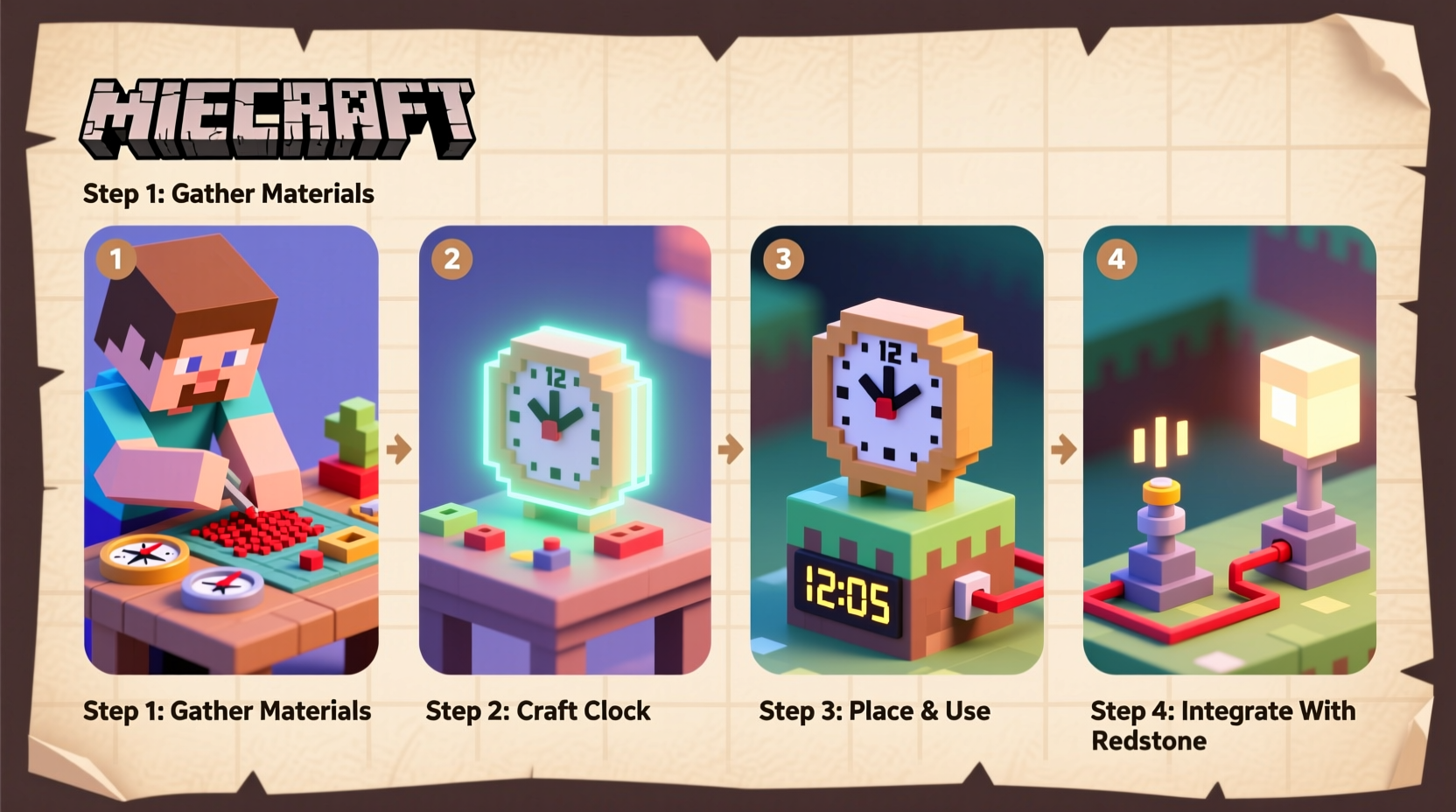
The clock in Minecraft is a unique item that displays the current phase of the day-night cycle. When held or placed in an item frame, it rotates like a real analog clock, pointing toward the sun or moon depending on the time. However, unlike real-world clocks, it only works under open sky. In caves, strongholds, or Nether portals, the clock spins erratically because the game cannot determine celestial position. This limitation makes it unreliable underground but highly effective in overworld environments.
One key distinction is that the clock reflects server time—not real-world time. A full day-night cycle lasts exactly 20 minutes (24,000 ticks), with daylight lasting 10 minutes, sunset/sunrise taking 1.5 minutes each, and night spanning 7 minutes. The clock continuously updates based on this internal timer, making it ideal for anticipating events such as zombie spawns at dusk or village raids during full moons.
“Clocks may seem simple, but they’re foundational tools for timing-sensitive builds and survival planning.” — Aris Bellweather, Redstone Engineer & Minecraft Educator
Step-by-Step Guide to Crafting a Clock
Crafting a clock requires specific materials and access to a crafting table. It’s not something you can make from basic inventory grids. Follow these steps precisely:
- Gather 4 gold ingots. These can be obtained by mining gold ore (found between Y-levels -16 to 32), smelting raw gold in a furnace, or trading with villagers.
- Obtain 1 redstone dust. Mine redstone ore with an iron pickaxe or higher. Each block yields 4–5 dust, which can also be found in chests in dungeons or temples.
- Open your crafting table interface (3x3 grid).
- Place the redstone dust in the center slot.
- Surround the redstone with gold ingots in all four adjacent side slots (top, bottom, left, right). Leave corners empty.
- Drag the crafted clock into your inventory.
Practical Uses of Clocks in Gameplay
Beyond merely checking the time, clocks serve several strategic purposes across different playstyles:
- Survival Timing: Know when hostile mobs will spawn so you can return to shelter before nightfall.
- Farming Optimization: Track growth cycles of crops like wheat or melons, especially when using bone meal and needing precise replanting intervals.
- Navigation Aid: On large maps or multiplayer servers without clear landmarks, a clock helps orient yourself by indicating sunrise (east) and sunset (west).
- Redstone Synchronization: Use clocks as visual feedback for timed redstone circuits, such as pulsars, hoppers, or automatic farms.
- Decoration and Roleplay: Place clocks in item frames above mantles or workbenches in towns, libraries, or train stations to enhance immersion.
Mini Case Study: The Desert Outpost Timer
Jenna, a seasoned survival player, built a remote desert outpost primarily for cactus farming. Since deserts lack trees and natural cover, nighttime visits were dangerous due to frequent spider spawns. To minimize risk, she installed a clock in an item frame outside her base door. Before venturing out, she’d glance at the clock to ensure she had at least 15 minutes of daylight remaining. Over two weeks, this small habit prevented three potential deaths and improved her resource collection efficiency by 40%. The clock became her silent guardian, allowing her to plan short expeditions with confidence.
Optimizing Clock Usage: Tips and Advanced Techniques
To get the most out of your clock, consider integrating it into broader systems. Here are proven strategies used by experienced players:
Using Multiple Clocks for Redundancy
In large bases or multiplayer homes, place clocks in multiple locations—near entrances, farms, and storage rooms. This eliminates the need to run back to one central point just to check the time.
Synchronizing Farms with Daylight Cycles
Some plants, like sugar cane and bamboo, grow faster during the day. Pairing a clock with a hopper-based collector allows you to harvest only during peak growth windows, maximizing yield per session.
Testing Redstone Pulse Frequency
When building repeater-based clocks or comparator loops, place a regular Minecraft clock nearby. While it won’t measure milliseconds, observing how many times the in-game clock hand moves between circuit activations gives a rough estimate of cycle duration—especially useful for beginner redstone learners.
Do’s and Don’ts: Clock Usage Table
| Do | Don't |
|---|---|
| Use clocks in open-air builds for reliable time tracking | Rely on clocks underground or in the Nether |
| Combine with item frames for wall-mounted decor | Expect accuracy during thunderstorms (clock still works) |
| Carry one in your hotbar during exploration | Waste gold on multiple clocks early game unless necessary |
| Use as part of educational redstone tutorials | Assume it shows real-world time—it follows game ticks only |
FAQ: Common Questions About Minecraft Clocks
Can clocks work in the Nether or End?
No. The Nether has no day-night cycle, and the End remains perpetually “night.” As a result, clocks spin randomly in both dimensions and cannot provide accurate time readings.
Why does my clock spin nonstop?
This happens when you're indoors, underground, or in a dimension without a sky. The game cannot detect the sun or moon position, so the clock defaults to random rotation. Move to an open area to restore functionality.
Is there a way to make a clock that works everywhere?
Not natively. However, some data pack creators and modders have developed custom time-tracking items. In vanilla Minecraft, the standard clock is limited to the overworld with direct sky access.
Checklist: Mastering Your Minecraft Clock
- ✅ Gather 4 gold ingots and 1 redstone dust
- ✅ Access a crafting table to assemble the clock
- ✅ Test the clock outdoors to confirm it displays correct time
- ✅ Mount it in an item frame near your base entrance
- ✅ Use it daily to anticipate nightfall and mob spawns
- ✅ Integrate with redstone systems for timing feedback
- ✅ Replace if lost—keep spare materials stored in chest
Conclusion: Time Well Spent
The Minecraft clock may appear minor compared to enchanted gear or elaborate redstone machines, but its value lies in consistency and simplicity. By knowing exactly when night falls or how long until your crops mature, you gain control over chaos. That single crafted item becomes a quiet ally in your journey—from surviving the first night to orchestrating automated cities. Now that you understand how to craft it, where to use it, and how to maximize its potential, take a moment to add one to your next build. Observe how even the smallest attention to time transforms your gameplay.




 浙公网安备
33010002000092号
浙公网安备
33010002000092号 浙B2-20120091-4
Comments
No comments yet. Why don't you start the discussion?