
Quoting poetry in academic writing requires precision, respect for the original text, and strict adherence to formatting rules. When using the Modern Language Association (MLA) style, even minor errors in quotation can undermine credibility or result in lost points. Whether you're analyzing a Shakespearean sonnet or a contemporary free verse poem, understanding how to integrate poetic lines into your essay is essential. This guide breaks down the process into clear, actionable steps, ensuring you quote poems accurately and present your analysis professionally.
Understanding MLA Basics for Poetry Quotations
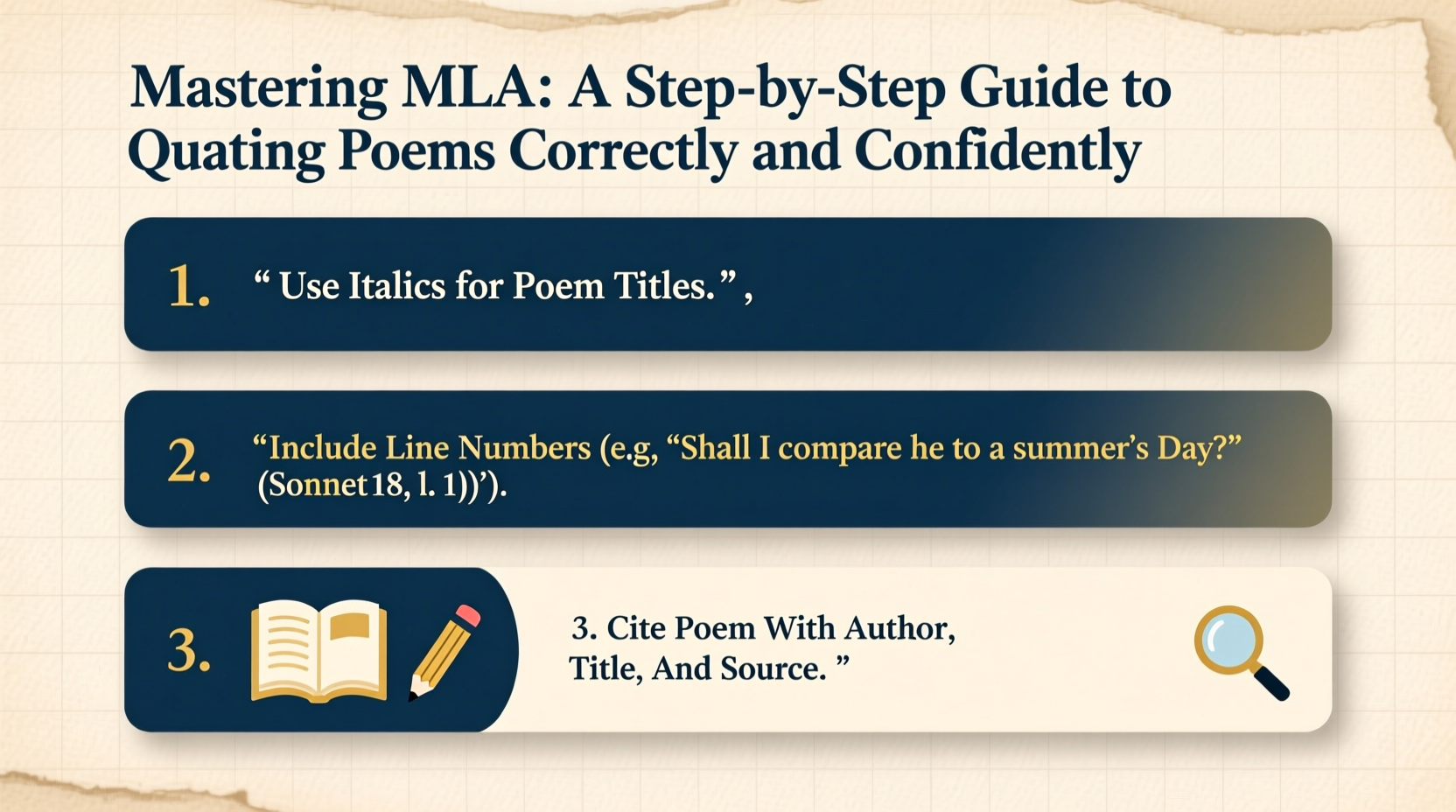
MLA format emphasizes clarity, consistency, and integrity in citing sources. When quoting poetry, the structure of the quote—line breaks, spacing, punctuation, and citation—must reflect the original while fitting naturally into your prose. The key principle: preserve the poet’s voice without distorting meaning through incorrect formatting.
Unlike prose, poetry relies heavily on lineation, rhythm, and visual layout. Therefore, MLA provides specific guidelines depending on the length of the quoted passage:
- Short quotes (fewer than three lines): Incorporated into your sentence with a forward slash (/) separating lines.
- Long quotes (three or more lines): Set as a block quote, indented one inch from the left margin, without quotation marks.
Each method maintains readability while honoring the poem’s form.
Step-by-Step Guide to Quoting Poems in MLA Format
Follow these seven steps to ensure every poetic quotation meets MLA standards.
- Select the relevant lines carefully. Choose only what supports your argument. Avoid over-quoting; let your analysis take center stage.
- Determine the length of the quote. Count the lines. If it’s fewer than three, use inline formatting. Three or more require a block quote.
- Introduce the quote contextually. Use signal phrases like “As Dickinson writes,” or “In the final stanza, the speaker observes.”
- Format short quotes with slashes. For example: “Because I could not stop for Death – / He kindly stopped for me –” (Dickinson 1–2).
- For longer quotes, create a block quote. Start a new line, indent the entire passage one inch (or 0.5 inches in some styles), double-space, and maintain original line breaks.
- Maintain original punctuation and spelling. Even if a line ends mid-sentence, do not alter capitalization at the start of a new line unless integrating into your syntax.
- Cite properly in parentheses. Include the author’s last name (if not mentioned in signal phrase) and line numbers, not page numbers.
Example of a Short Quote
In Robert Frost’s “The Road Not Taken,” the speaker reflects on life choices: “Two roads diverged in a wood, and I— / I took the one less traveled by” (Frost 18–19). This moment captures both individuality and regret.
Example of a Block Quote
When analyzing extended passages, such as the opening of T.S. Eliot’s “The Love Song of J. Alfred Prufrock,” formatting becomes critical:
Let us go then, you and I,
When the evening is spread out against the sky
Like a patient etherized upon a table;
Let us go, through certain half-deserted streets,
The muttering retreats
Of restless nights in one-night cheap hotels
And sawdust restaurants with oyster-shells… (Eliot 1–7)
This imagery establishes a tone of paralysis and alienation central to the poem’s theme.
Do’s and Don’ts When Quoting Poetry
| Do | Don’t |
|---|---|
| Use forward slashes with spaces before and after when quoting two lines inline. | Run lines together without indicating line breaks. |
| Preserve original capitalization at the beginning of each line in block quotes. | Capitalize the first word of every line just because it starts a new line. |
| Italicize the title of the poem only if it’s part of a longer work (e.g., an epic); otherwise, use quotation marks. | Italicize all poem titles regardless of length or publication context. |
| Cite line numbers in parentheses immediately after the quote. | Use page numbers instead of line numbers in poetry citations. |
| Double-space everything, including block quotes, in your final document. | Single-space block quotes to save room. |
Real Example: Analyzing a Poem Using Correct MLA Formatting
Sophia, a sophomore literature student, was writing about Gwendolyn Brooks’ “We Real Cool.” Her initial draft incorrectly merged lines and misattributed punctuation:
Incorrect version: She wrote, “we real cool we left school we lurk late” (Brooks). No slashes, no line numbers, and missing em-dashes that appear in the original.
After reviewing MLA guidelines, she revised her passage:
Corrected version: The poem begins abruptly with collective defiance: “We real cool. We / Left school. We / Lurk late. We” (Brooks 1–3). These fragmented declarations, punctuated by strategic pauses, establish the speakers’ identity through rhythm and repetition.
The change improved clarity, demonstrated attention to detail, and strengthened her analytical claim by respecting the poem’s form.
“Proper quotation isn’t just about rules—it’s about honoring the artistry of the poet. Every line break carries meaning.” — Dr. Lena Torres, Professor of Literary Studies, University of Chicago
Essential Checklist for Quoting Poems in MLA
Before submitting any paper containing poetry quotations, run through this checklist:
- ✅ Have I introduced the quote with a signal phrase?
- ✅ Did I use forward slashes with spaces for short quotes?
- ✅ For long quotes, is the block indented one inch and double-spaced?
- ✅ Have I preserved original line breaks and punctuation?
- ✅ Are line numbers included in parentheses after the quote?
- ✅ Is the poet’s name provided either in the signal phrase or citation?
- ✅ Have I avoided altering capitalization at the start of quoted lines?
- ✅ If quoting multiple non-consecutive lines, have I used ellipses appropriately?
Frequently Asked Questions
How do I cite a poem without line numbers?
If the poem appears in a source without line numbers (such as a website or anthology without them), cite the page number instead. If neither exists, mention the section or stanza: (Angelou, stanzas 2–3).
Can I change the capitalization in a quoted line to fit my sentence?
No. In block quotes, retain the original capitalization. In inline quotes, you may adjust only the first letter of the entire quote to fit grammatical flow, but indicate changes with brackets if necessary. For example: “[t]wo roads diverged in a yellow wood” (Frost 1).
What if I’m quoting a poem from a translated collection?
Credit both the original poet and the translator. In-text citation still uses the poet’s name and line numbers. In the Works Cited, list: Poet Last Name, First Name. “Title of Poem.” Title of Collection, translated by Translator Name, Publisher, Year, pp. XX–XX.
Final Thoughts: Confidence Through Precision
Quoting poetry in MLA format is not merely a technical requirement—it’s an act of scholarly respect. Each line break, dash, and indentation serves a purpose in conveying the poet’s intent. By mastering these conventions, you elevate your writing from mechanical citation to thoughtful engagement.
Accuracy builds trust. When your reader sees that you’ve taken care to represent the poem faithfully, they’re more likely to engage deeply with your interpretation. These small details signal rigor, preparation, and intellectual honesty.




 浙公网安备
33010002000092号
浙公网安备
33010002000092号 浙B2-20120091-4
Comments
No comments yet. Why don't you start the discussion?