
In the digital age, YouTube has become a vital source of information, education, and commentary. From academic lectures to expert interviews and documentary clips, students and researchers increasingly rely on video content. However, citing these sources correctly in academic writing—especially using Modern Language Association (MLA) style—can be confusing. Unlike traditional print sources, YouTube videos have unique elements like uploaders, timestamps, and URLs that must be handled precisely. This guide breaks down the MLA 9th edition standards for citing YouTube videos, offering a clear, practical approach to ensure your work meets scholarly expectations.
Understanding MLA Format Basics for Digital Sources
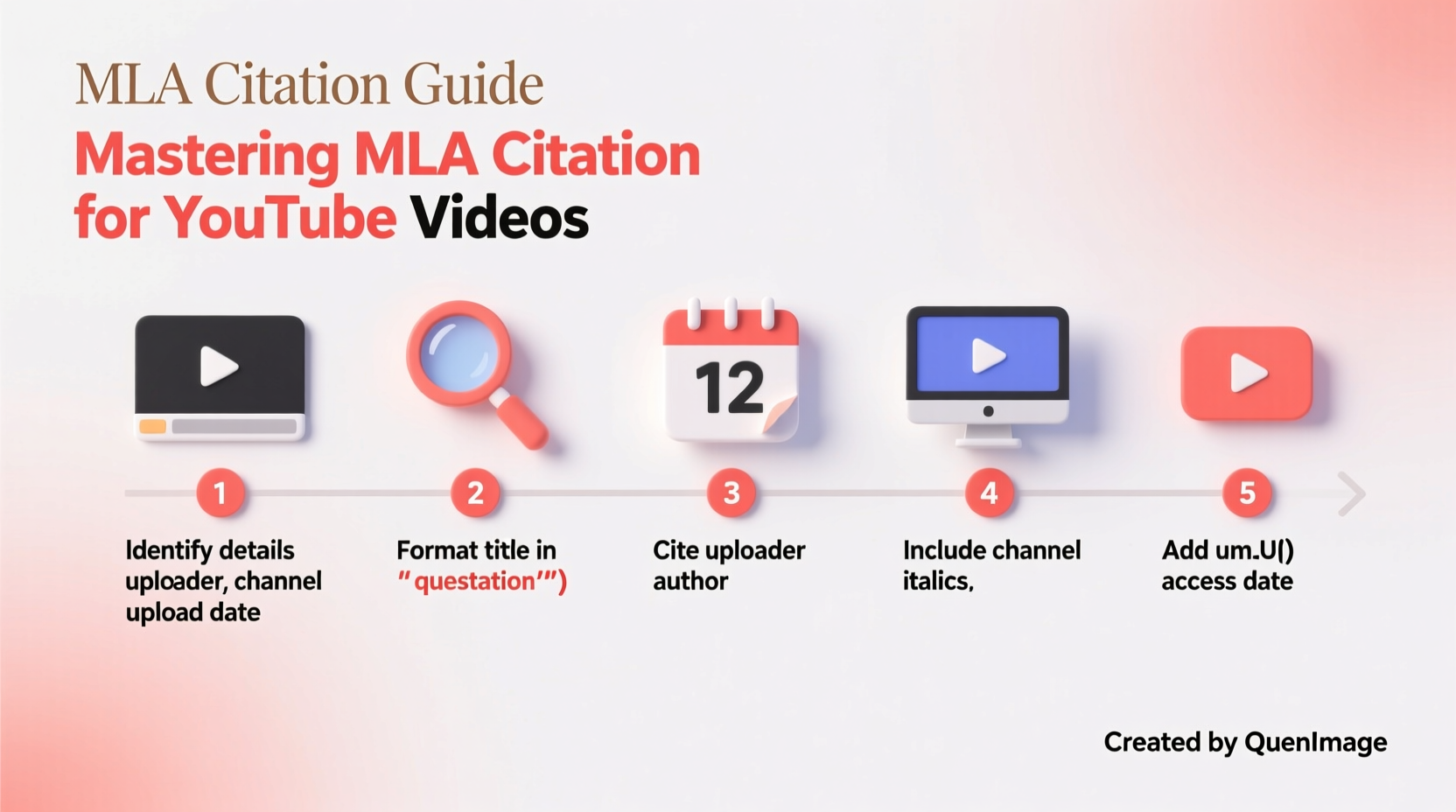
MLA format emphasizes clarity, consistency, and accessibility. When citing online sources like YouTube videos, the goal is to provide enough information so readers can easily locate the original content. The core structure follows the “container” model introduced in MLA 9, which separates the source (the video) from its container (YouTube) and includes relevant contributors, version details, publisher, date, and location (URL).
The general template for citing a YouTube video in MLA is:
Author/Uploader’s Name (or Channel). \"Title of Video.\" YouTube, uploaded by Uploader (if different), Day Month Year, URL.
Note: Italicize the title of the video and the platform (YouTube). Use sentence case for the video title—only capitalize the first word and proper nouns.
Step-by-Step Guide to Citing a YouTube Video
Citing a YouTube video in MLA doesn’t require memorization—just attention to detail. Follow these six steps to build a correct citation.
- Determine the author or uploader. If the creator’s real name is available and listed, use it (Last Name, First Name). If not, use the channel name. Example: CrashCourse.
- Capture the full video title. Copy it exactly as shown, then apply MLA capitalization rules: only the first word, proper nouns, and the first word after a colon are capitalized.
- Identify the website as the container. In most cases, this is simply YouTube, italicized.
- Include the uploader if different from the author. Use “uploaded by” followed by the username or channel name.
- Add the publication date. Use the day-month-year format (e.g., 15 Mar. 2023). Avoid using “n.d.” unless no date is visible.
- Provide the full URL. Remove the “https://” prefix and use the shortened link without tracking parameters. Example: www.youtube.com/watch?v=abc123.
Example of a complete citation:
Sanders, John. \"The Impact of Climate Change on Coastal Cities.\" YouTube, uploaded by GreenFuture Network, 7 Apr. 2022, www.youtube.com/watch?v=xYz9pRt2qLm.
Common Mistakes and How to Avoid Them
Even experienced writers make errors when citing dynamic online content. Below are frequent pitfalls and how to correct them.
| Mistake | Correct Approach |
|---|---|
| Using all caps or quotation marks incorrectly in the video title | Apply sentence case: “How I studied for finals in one night” not “HOW I STUDIED FOR FINALS IN ONE NIGHT” |
| Omitting the uploader when different from the author | Always credit both if roles differ: e.g., interviewee vs. channel host |
| Leaving “https://” in the URL | Remove protocol: use “youtube.com/watch?v=abc” not “https://youtube.com/...” |
| Citing the viewing date instead of upload date | Use the video’s published date, not when you accessed it (unless required by instructor) |
| Confusing speaker with uploader | If Dr. Lee speaks in a TEDxTalk but TED uploads it, cite: TED. \"The Power of Silence.\" YouTube, uploaded by TED, 12 May 2021... |
Real Example: Citing a Popular Educational Video
Consider a student writing a paper on cognitive psychology who uses a CrashCourse video titled “Memory and Forgetting.” Here's how the citation process unfolds.
- Video Title: Memory and Forgetting
- Channel: CrashCourse
- Actual Author: Hosted by Hank Green, but the channel is the primary contributor
- Date Uploaded: 28 Feb. 2014
- URL: youtube.com/watch?v=PRHedL1OaJw
Final citation:
CrashCourse. \"Memory and Forgetting.\" YouTube, 28 Feb. 2014, www.youtube.com/watch?v=PRHedL1OaJw.
Expert Insight on Digital Source Credibility
While ease of access makes YouTube appealing, not all content carries equal academic weight. Proper citation isn’t just about formatting—it’s also about evaluating source reliability.
“Citing a YouTube video is valid only if the content is credible, well-sourced, and relevant. Always assess the creator’s expertise before including it in scholarly work.” — Dr. Laura Bennett, Associate Professor of English and Composition Studies
This means favoring channels affiliated with institutions (e.g., Khan Academy, PBS, university departments) over anonymous or sensationalist creators. When in doubt, ask: Would this source be acceptable in a peer-reviewed context?
Checklist for Accurate MLA YouTube Citations
Before submitting your paper, run through this quick verification list:
- ✅ Is the video title in sentence case and enclosed in quotation marks?
- ✅ Is “YouTube” italicized as the container?
- ✅ Is the upload date in Day Month Year format (e.g., 5 June 2023)?
- ✅ Is the URL clean, without “https://” or tracking strings?
- ✅ If the uploader differs from the author, is “uploaded by” included?
- ✅ Are all names formatted correctly (Last, First for individuals)?
- ✅ Have I verified the details directly on YouTube, not from third-party sites?
Frequently Asked Questions
Do I need to include the duration of the video?
No, MLA does not require video length in the Works Cited entry. However, you may include it in a parenthetical note if relevant to your discussion.
What if there’s no clear author or channel name?
If no identifiable creator exists, begin the citation with the video title. Example: \"Understanding Black Holes.\" YouTube, uploaded by SpaceExplained, 10 Jan. 2021, www.youtube.com/watch?v=xyz789.
Should I include access dates?
MLA 9 generally does not require access dates for stable online sources. However, some instructors may request them, especially for content prone to change. If needed, add at the end: Accessed 12 Apr. 2024.
Conclusion: Confidence in Every Citation
Accurate citation reflects respect for intellectual property and strengthens the credibility of your writing. Mastering MLA citations for YouTube videos empowers you to integrate rich digital resources into your academic work with confidence and precision. Whether you're analyzing a TED Talk, referencing a science tutorial, or quoting a historian’s lecture, following the structured approach outlined here ensures your references meet current scholarly standards. The key lies not in rote memorization, but in understanding the logic behind each component—from authorship to platform to permanence of links.




 浙公网安备
33010002000092号
浙公网安备
33010002000092号 浙B2-20120091-4
Comments
No comments yet. Why don't you start the discussion?