
Chemistry often feels like learning a new language, and nowhere is that more true than when dealing with moles. The mole is a fundamental unit in chemistry, essential for quantifying atoms, molecules, and compounds in measurable amounts. For beginners, mole calculations can seem intimidating—filled with abstract numbers and unfamiliar formulas. But once you understand the logic behind them, they become one of the most powerful tools in your chemical toolkit.
The mole allows chemists to count particles by weighing them. Since atoms and molecules are far too small to count individually, scientists use the mole as a bridge between the microscopic world of atoms and the macroscopic world we can observe. One mole contains exactly 6.022 × 10²³ particles—a number known as Avogadro’s constant. This article breaks down mole calculations into manageable steps, equipping you with the skills to tackle stoichiometry, solution preparation, and reaction yields with confidence.
Understanding the Mole Concept
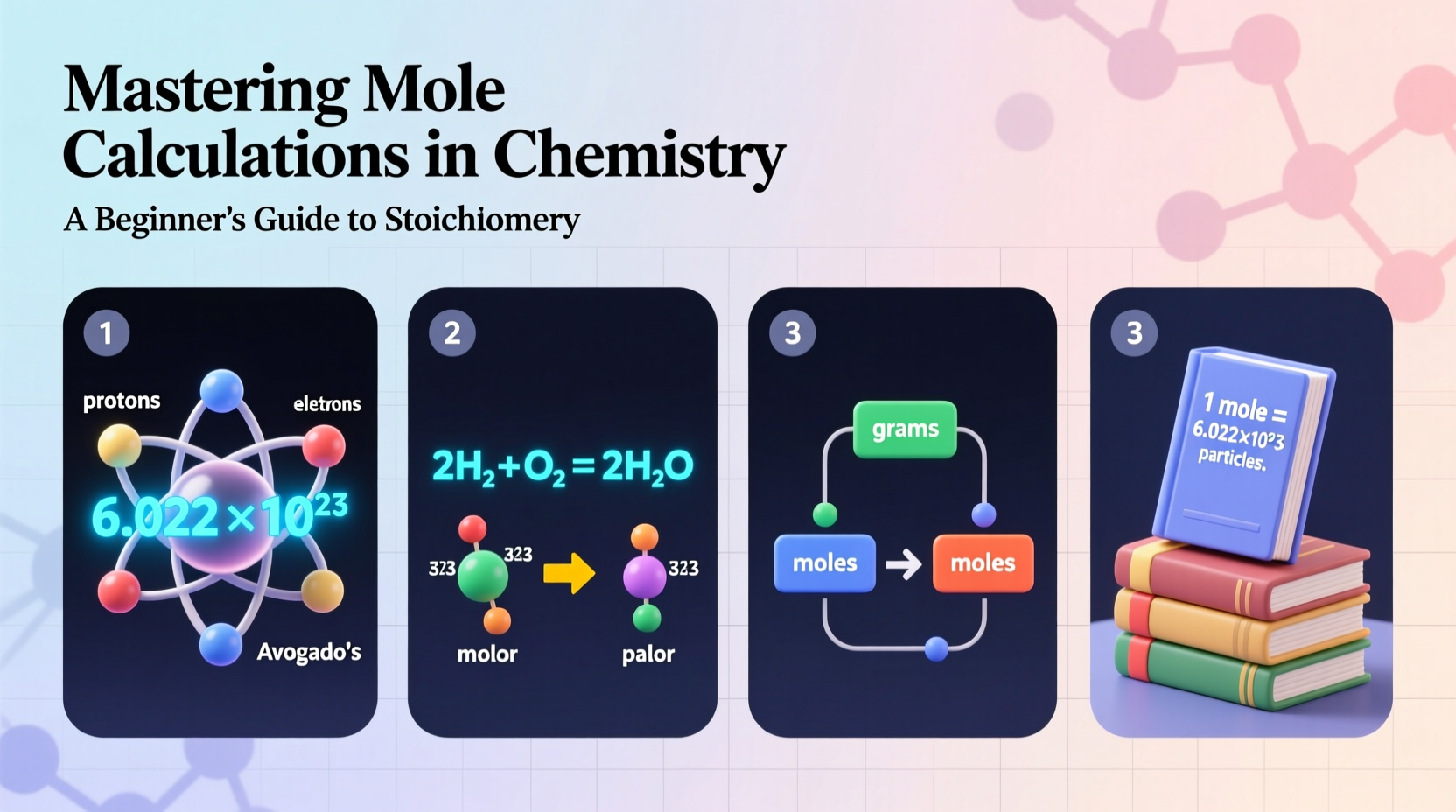
At its core, a mole is simply a counting unit—like a dozen or a gross—but much larger. While a dozen refers to 12 items, a mole refers to 6.022 × 10²³ particles. These particles can be atoms, molecules, ions, or electrons, depending on the substance.
The reason this number was chosen is that it links atomic mass to grams. Specifically, one mole of any element has a mass in grams equal to its atomic mass from the periodic table. For example:
- Carbon has an atomic mass of 12.01 amu → 1 mole of carbon atoms = 12.01 grams
- Oxygen has an atomic mass of 16.00 amu → 1 mole of oxygen atoms = 16.00 grams
- Iron has an atomic mass of 55.85 amu → 1 mole of iron atoms = 55.85 grams
This relationship is critical because it allows us to convert between mass (grams) and number of particles using the mole as an intermediary.
“Without the mole concept, modern chemistry wouldn’t function. It’s the linchpin connecting theory to practical measurement.” — Dr. Alan Reyes, Professor of Chemical Education
Step-by-Step Guide to Mole Calculations
Follow this structured approach to solve any basic mole calculation problem. Whether you're converting mass to moles, particles to mass, or working with compounds, these steps apply universally.
- Determine what you’re given and what you need to find. Identify whether the input is in grams, moles, or number of particles, and clarify the desired output.
- Use the correct molar mass. For elements, use the atomic mass from the periodic table. For compounds, sum the atomic masses of all constituent atoms.
- Apply the appropriate conversion factor. Use:
- Moles = mass (g) / molar mass (g/mol)
- Mass (g) = moles × molar mass (g/mol)
- Number of particles = moles × (6.022 × 10²³)
- Check units and significant figures. Ensure your final answer uses correct units and reflects the precision of the given data.
- Double-check your math. Simple arithmetic errors are common; verify each step.
Working with Compounds: Molar Mass Made Easy
Calculating the molar mass of a compound is essential for accurate mole conversions. Here’s how to do it correctly:
Take water (H₂O) as an example:
- Hydrogen (H): 1.008 g/mol × 2 atoms = 2.016 g/mol
- Oxygen (O): 16.00 g/mol × 1 atom = 16.00 g/mol
- Total molar mass = 2.016 + 16.00 = 18.016 g/mol
For more complex compounds like calcium nitrate, Ca(NO₃)₂:
- Ca: 40.08 g/mol × 1 = 40.08 g/mol
- N: 14.01 g/mol × 2 = 28.02 g/mol
- O: 16.00 g/mol × 6 = 96.00 g/mol
- Total = 40.08 + 28.02 + 96.00 = 164.10 g/mol
Accuracy matters—small rounding differences can accumulate in multi-step problems. Keep at least two decimal places until the final answer.
Essential Conversion Table
| Given | To Find | Formula |
|---|---|---|
| Mass (g) | Moles | moles = mass / molar mass |
| Moles | Mass (g) | mass = moles × molar mass |
| Moles | Particles | particles = moles × (6.022 × 10²³) |
| Particles | Moles | moles = particles / (6.022 × 10²³) |
| Mass (g) | Particles | Convert to moles first, then to particles |
Real Example: How Much Salt Is That?
Imagine you're preparing a solution in lab and need to know how many sodium ions are in 5.85 grams of table salt (NaCl).
Step 1: Calculate molar mass of NaCl
Na: 22.99 g/mol, Cl: 35.45 g/mol → 22.99 + 35.45 = 58.44 g/mol
Step 2: Convert mass to moles
moles = 5.85 g / 58.44 g/mol ≈ 0.100 moles
Step 3: Determine number of formula units
0.100 mol × (6.022 × 10²³) = 6.022 × 10²² formula units of NaCl
Step 4: Since each NaCl unit releases one Na⁺ ion, there are also 6.022 × 10²² sodium ions.
This kind of reasoning is foundational in analytical chemistry and pharmaceutical dosing, where precise particle counts matter.
Common Mistakes to Avoid
Even bright students stumble on mole calculations due to avoidable errors. Watch out for these pitfalls:
- Using atomic number instead of atomic mass. Always refer to the weighted average atomic mass (bottom number), not the proton count.
- Forgetting to multiply subscripts in compounds. In Al₂(SO₄)₃, there are 3 sulfate groups, so oxygen count is 4 × 3 = 12 atoms.
- Sloppy unit tracking. Writing “g” instead of “g/mol” leads to incorrect setups.
- Rounding too early. Maintain extra digits during intermediate steps to preserve accuracy.
- Confusing molecules with moles. Remember: moles measure quantity, not identity.
FAQ: Frequently Asked Questions
Why is the mole such a large number?
Atoms are incredibly small. Using a smaller unit would make chemical measurements impractically tiny. The mole scales atomic-level quantities to laboratory-sized samples we can weigh and handle.
Do I always need Avogadro’s number?
No. Only when converting between moles and actual particle counts. If you're only moving between mass and moles, molar mass is sufficient.
Can I use mole calculations for gases?
Absolutely. At standard temperature and pressure (STP), one mole of any gas occupies 22.4 liters. This adds a third dimension: volume ↔ moles ↔ particles ↔ mass.
Final Checklist: Mastering Mole Calculations
Before attempting exams or lab work, ensure you can confidently do the following:
- Locate atomic masses accurately on the periodic table
- Calculate molar mass for any compound, including hydrates and polyatomic ions
- Convert between grams, moles, and number of particles fluently
- Set up dimensional analysis with correct units
- Solve multi-step problems involving compounds and ions
- Explain the meaning of a mole in plain language
Conclusion: Build Confidence Through Practice
Mastery of mole calculations doesn’t come overnight—it comes from consistent practice and conceptual clarity. Each time you perform a conversion, you’re reinforcing a skill used daily by chemists in research, medicine, engineering, and environmental science. Start with simple elements, progress to compounds, and gradually integrate these skills into stoichiometry and reaction analysis.
The mole is not just a number; it’s a mindset for thinking proportionally about matter. With the right foundation, what once seemed abstract becomes intuitive. Begin today: pick a compound, calculate its molar mass, and convert a sample mass into molecules. Repeat regularly, and soon, mole calculations will feel second nature.




 浙公网安备
33010002000092号
浙公网安备
33010002000092号 浙B2-20120091-4
Comments
No comments yet. Why don't you start the discussion?