
Negative exponents often confuse students because they seem to defy the basic logic of multiplication and growth. However, once you understand their underlying principle, they become not only manageable but predictable. Far from being an abstract mathematical quirk, negative exponents are essential in scientific notation, engineering, computer science, and finance. The key lies in recognizing that a negative exponent does not indicate a negative number—it signals division or the reciprocal of a base raised to a positive power.
This guide demystifies negative exponents by breaking down their meaning, providing structured techniques for simplification, and offering practical applications. Whether you're preparing for an algebra exam or brushing up on foundational math, mastering negative exponents will sharpen your overall fluency in algebraic manipulation.
Understanding the Meaning of Negative Exponents
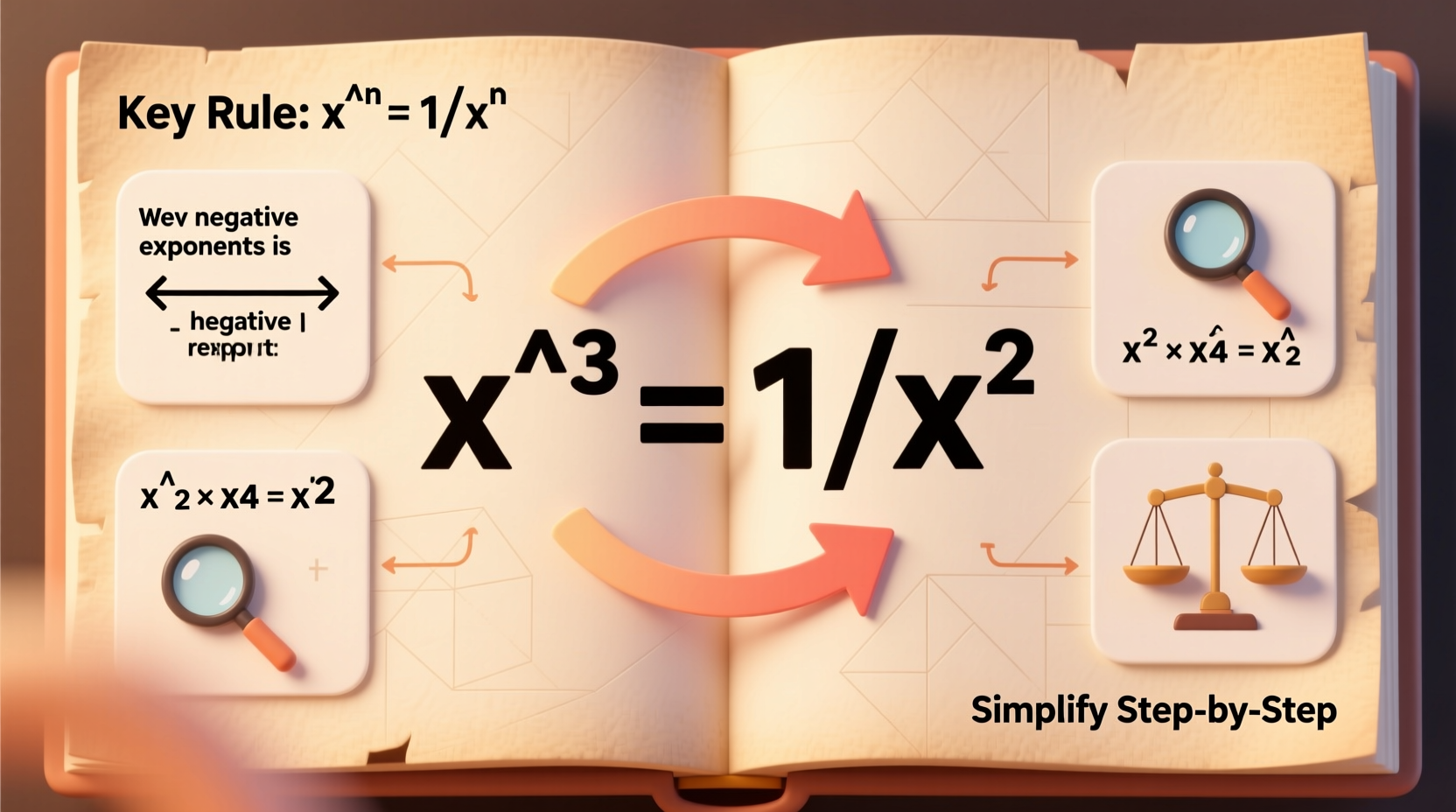
The foundation of working with negative exponents is understanding what they represent. By definition:
a⁻ⁿ = 1 / aⁿ
This means that any base raised to a negative exponent is equivalent to the reciprocal of that base raised to the corresponding positive exponent. For example:
- 2⁻³ = 1 / 2³ = 1 / 8
- x⁻⁵ = 1 / x⁵
- 10⁻² = 1 / 10² = 0.01
This rule applies regardless of whether the base is a number, variable, or expression—so long as the base is not zero (since division by zero is undefined).
“Negative exponents are not about negativity—they’re about reciprocation. Once students internalize this shift in perspective, simplification becomes intuitive.” — Dr. Alan Reyes, Mathematics Education Specialist
Step-by-Step Guide to Simplify Expressions with Negative Exponents
Simplifying expressions involving negative exponents follows a logical sequence. Use this five-step process to handle even complex-looking problems with confidence.
- Identify all terms with negative exponents. Scan the entire expression and highlight any components where exponents are negative.
- Rewrite each term using the reciprocal rule. Convert every a⁻ⁿ into 1/aⁿ, or move the term between numerator and denominator as appropriate.
- Apply exponent rules to combine like bases. Use multiplication (aᵐ × aⁿ = aᵐ⁺ⁿ) or division (aᵐ / aⁿ = aᵐ⁻ⁿ) rules when applicable.
- Simplify coefficients and constants. Reduce fractions, multiply numbers, and write numerical results in simplest form.
- Ensure final answer has only positive exponents. Unless otherwise specified, standard form requires no negative exponents in the result.
Let’s apply this to a sample problem:
Simplify: (3x⁻²y⁴) / (6x³y⁻¹)
Step 1: Identify negative exponents: x⁻² and y⁻¹
Step 2: Move x⁻² to denominator and y⁻¹ to numerator:
= (3y⁴ × y¹) / (6x³ × x²)
Step 3: Combine exponents:
= (3y⁵) / (6x⁵)
Step 4: Simplify coefficient: 3/6 = 1/2
Final Answer: y⁵ / (2x⁵)
Strategies for Rewriting Complex Expressions
Some expressions involve multiple variables, parentheses, or powers raised to powers. In such cases, strategy matters more than speed. Here are three effective approaches:
1. Work Inside-Out with Parentheses
If you see (a⁻²b³)⁻⁴, first apply the outer exponent to each part inside using the power-of-a-power rule (aᵐ)ⁿ = aᵐ×ⁿ:
(a⁻²b³)⁻⁴ = a⁽⁻²ˣ⁻⁴⁾ b⁽³ˣ⁻⁴⁾ = a⁸b⁻¹² = a⁸ / b¹²
2. Group Like Bases Early
In expressions like (x⁻³y²)(x⁵y⁻⁴), rearrange and group same bases before applying exponent rules:
= (x⁻³x⁵)(y²y⁻⁴) = x²y⁻² = x² / y²
3. Handle Fractions with Power Rules
When a fraction is raised to a negative exponent, flip the fraction and make the exponent positive:
(a/b)⁻ⁿ = (b/a)ⁿ
Example: (2/x)⁻³ = (x/2)³ = x³ / 8
Common Mistakes and How to Avoid Them
Even capable students trip up on negative exponents due to misconceptions. Below is a summary of frequent errors and corrections.
| Mistake | Why It’s Wrong | Correct Approach |
|---|---|---|
| Thinking 5⁻² = -25 | Negative exponent ≠ negative result. This confuses sign with operation. | 5⁻² = 1/5² = 1/25 |
| Leaving x⁻³ in final answer without rewriting | Most contexts require positive exponents unless specified otherwise. | Rewrite as 1/x³ |
| Applying negative exponent only to the variable, not the coefficient | In (2x)⁻², both 2 and x are affected. | (2x)⁻² = 1/(4x²), not 1/(2x²) |
| Incorrectly combining unlike bases | You can't add exponents of different bases (e.g., x²y⁻³ ≠ (xy)⁻¹). | Keep bases separate; simplify only within same base. |
Real Example: Scientific Notation Application
Astronomers frequently use negative exponents when measuring tiny quantities. Consider the mass of a proton: approximately 1.67 × 10⁻²⁷ kg.
Suppose a physicist needs to calculate how many protons are in a sample weighing 0.00000167 kg (1.67 × 10⁻⁶ kg). The calculation involves division:
(1.67 × 10⁻⁶) / (1.67 × 10⁻²⁷) = (1.67 / 1.67) × 10⁻⁶⁻⁽⁻²⁷⁾ = 1 × 10²¹
This shows there are about 10²¹ protons in the sample. Without understanding how to manipulate negative exponents, such calculations would be error-prone and inefficient. This real-world scenario underscores why fluency with negative exponents extends beyond the classroom.
Checklist: Mastering Negative Exponents
Use this checklist to ensure consistent accuracy when simplifying expressions with negative exponents:
- ☑ Recognize that a⁻ⁿ = 1/aⁿ
- ☑ Distinguish between negative bases and negative exponents
- ☑ Apply exponent rules correctly (product, quotient, power)
- ☑ Move terms across fraction bars to eliminate negative exponents
- ☑ Simplify coefficients separately from variables
- ☑ Check final answer for unwanted negative exponents
- ☑ Verify work by substituting simple values (e.g., let x = 2)
Frequently Asked Questions
Can zero have a negative exponent?
No. Since a⁻ⁿ = 1/aⁿ, if a = 0, then 1/0ⁿ is undefined. Therefore, 0⁻ⁿ is undefined for any positive n.
What happens if the exponent is negative and the base is negative?
The sign of the base is handled independently. For example, (-3)⁻² = 1/(-3)² = 1/9. But be careful: -3⁻² (without parentheses) means -(3⁻²) = -1/9.
Do negative exponents always produce fractions?
Yes, in their simplified form, expressions with negative exponents are rewritten as fractions. Even whole numbers like 2⁻³ = 1/8 are expressed as rational numbers.
Conclusion: Build Confidence Through Practice
Mastering negative exponents isn’t about memorizing tricks—it’s about understanding a fundamental relationship between powers and reciprocals. With deliberate practice and attention to structure, what once seemed counterintuitive becomes second nature. The ability to simplify and rewrite expressions efficiently opens doors to higher-level mathematics and technical fields.
Start small: revisit basic definitions, work through guided examples, and gradually tackle more complex expressions. Each correct simplification builds confidence and reinforces your algebraic intuition.




 浙公网安备
33010002000092号
浙公网安备
33010002000092号 浙B2-20120091-4
Comments
No comments yet. Why don't you start the discussion?