
In the vast world of Minecraft, few mechanics are as transformative as the Nether portal. More than just a gateway to a fiery dimension, it's a strategic tool for rapid travel, efficient farming, and accessing rare resources. Yet many players activate their first portal without understanding its full potential—or the science behind how it works. Mastering Nether portals means moving beyond basic construction and into precision engineering that leverages the game’s coordinate system, biome knowledge, and spatial logic.
The Science Behind Nether Portal Mechanics
At the heart of every effective portal strategy is an understanding of how the Overworld and Nether relate spatially. For every block traveled in the Nether, you cover eight blocks in the Overworld. This 1:8 ratio is not arbitrary—it’s foundational. When you enter a portal in the Overworld, the game calculates a corresponding destination in the Nether by dividing your X and Z coordinates by eight. Conversely, exiting a Nether portal multiplies those coordinates by eight when returning to the Overworld.
This scaling allows for fast travel. A journey of 1,600 blocks across the Overworld can be reduced to just 200 blocks through the Nether. However, this same mechanic introduces challenges: misaligned portals can spawn you hundreds of blocks from your intended location, or worse, in dangerous terrain like lava oceans or ghast-infested fortresses.
“Understanding the 1:8 scale isn’t just useful—it’s essential for any serious base builder or explorer.” — Markus Persson, Minecraft Creator (on early design principles)
Step-by-Step Guide to Building Your First Functional Portal
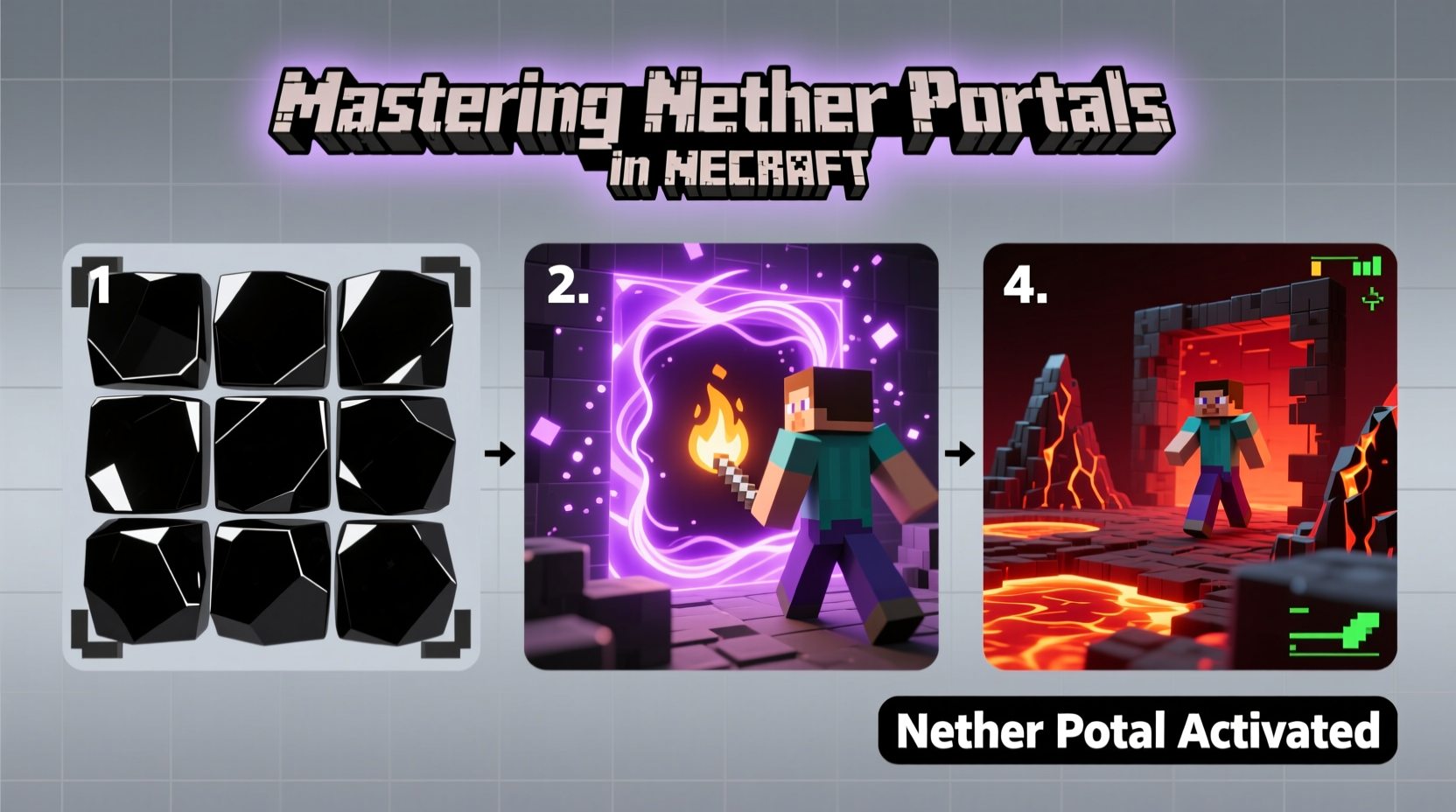
Building a portal is straightforward, but doing it correctly ensures reliability and safety. Follow these steps precisely:
- Gather at least 10 obsidian blocks. You’ll need 14 for a standard 4x5 frame, but extra ensures backups.
- Construct a rectangular frame measuring 4 blocks wide and 5 blocks tall. The corners do not require obsidian—only the edges.
- Leave the bottom row open (no block needed on the ground between side columns).
- Use flint and steel to ignite the inside base of the frame. A purple swirling portal will form.
- Step through only after confirming the exit location is safe.
Once activated, the portal persists even if broken, so long as it remains powered. If destroyed, simply relight it with flint and steel.
Optimizing Portal Placement for Efficient Travel Networks
For single-use exploration, a basic portal suffices. But for advanced gameplay—especially on servers or survival worlds with multiple bases—a networked portal system is invaluable. The key is intentional placement based on Overworld goals.
To build a linked network:
- Determine your primary destinations in the Overworld (e.g., village, mountain base, ocean monument).
- Calculate the equivalent Nether coordinates by dividing Overworld X and Z by 8.
- Build Nether-side portals exactly at those calculated positions.
- If the game cannot place a portal at the exact spot due to lack of space or terrain, it will generate one nearby—potentially breaking the link.
To avoid mismatched linking, construct both Overworld and Nether portals manually at precise locations. Seal each Nether portal in an obsidian bunker with lighting to prevent mob spawns.
| Overworld Goal | Distance (Blocks) | Nether Equivalent | Travel Time Saved |
|---|---|---|---|
| Spawn to Jungle Temple (2,400) | 2,400 | 300 | ~75% faster |
| Village to Stronghold (1,600) | 1,600 | 200 | ~70% faster |
| Coast to Mesa Biome (3,200) | 3,200 | 400 | ~80% faster |
Real Example: The Cross-World Supply Route
A player built a home base at Overworld coordinates (800, 64, 1600). They later established a netherite mining outpost near Y=-58 at (824, 64, 1616)—just 24 blocks east and 16 north. Walking would take minutes; flying longer due to caverns. Instead, they created a second Overworld portal at (824, 64, 1616), calculated the Nether equivalent: (103, 64, 202), and built a matching portal there. Now, switching between bases takes under 15 seconds. The same method was used to link a distant wheat farm at (3200, 64, 0), whose Nether counterpart sits at (400, 64, 0), enabling instant crop retrieval.
Avoiding Common Portal Pitfalls
Even experienced players fall into predictable traps. Recognizing these issues early prevents wasted time and lost items.
- Mislinked portals: The game may create a new exit instead of reusing an existing one if the target area lacks space.
- Lava interference: Lava flows near portal frames can extinguish the portal effect.
- Biome hazards: Exiting into soul sand valleys or basalt deltas exposes you to hordes of piglins and magma cubes.
- Vertical misalignment: Differences in elevation between Overworld and Nether can cause exits high in the air or buried underground.
Do’s and Don’ts of Nether Portal Management
| Action | Recommended? | Reason |
|---|---|---|
| Build portals in multiples of 8 apart | ✅ Yes | Ensures clean linkage between dimensions |
| Use water to cool down netherrack fires | ✅ Yes | Prevents accidental blazes and griefing |
| Place portals directly above lava lakes | ❌ No | Risk of falling in upon entry |
| Light up surrounding Nether areas | ✅ Yes | Reduces hostile mob spawns near your hub |
| Break your return portal behind you | ❌ No | Strands you unless you have resources to rebuild |
Advanced Techniques: Creating a Personalized Nether Highway System
With multiple linked portals, you can construct a centralized transportation hub in the Nether. This \"highway\" acts as a central station connecting all major Overworld locations.
Start by selecting a neutral Nether zone—ideally warped forests or crimson forests away from fortress noise. Build a main portal here, then extend pathways radially to other manually placed portals. Reinforce walkways with nether bricks, add rail lines with powered rails, and illuminate every 4–5 blocks.
Some players integrate minecart systems or even boat-on-lava tricks (using mods or specific version glitches) for speed. While risky, well-maintained paths reduce travel time between distant biomes from 20 minutes to under 2.
Checklist: Building a Reliable Nether Network
- ✔ Record all Overworld portal coordinates
- ✔ Calculate Nether equivalents (X/8, Z/8)
- ✔ Manually build both entrance and exit portals
- ✔ Enclose portals in safe, lit structures
- ✔ Test each connection bidirectionally
- ✔ Label portals clearly (use signs or colored wool)
- ✔ Keep emergency supplies (blocks, food, armor) in the Nether hub
Frequently Asked Questions
Can I have more than one active portal in the Overworld?
Yes. Multiple Overworld portals are not only allowed but encouraged for complex travel networks. Each will attempt to link to a corresponding Nether location based on the 1:8 scale. Manual control ensures consistency.
Why did my portal take me somewhere unexpected?
The game searches for an existing portal within 128 blocks (in Nether coordinates) of the calculated destination. If none exists, it creates a new one in the nearest viable spot—which might be far off or in hazardous terrain. This is why manual placement beats relying on automatic generation.
Do portals work in the End dimension?
No. Nether portals only function between the Overworld and Nether. The End uses endermen, the dragon fight, and end gateways for travel mechanics.
Final Thoughts: From Survival Tool to Strategic Advantage
Mastering Nether portals transforms how you interact with Minecraft’s world. What begins as a simple fire-lit doorway evolves into a precision instrument for exploration, economy, and efficiency. Whether you're racing to find ancient debris, setting up automated farms, or coordinating with teammates on a server, controlled portal use gives you a decisive edge.
The most successful players don’t just use the Nether—they command it. By applying spatial awareness, careful planning, and disciplined construction, you turn chaos into order and distance into convenience.




 浙公网安备
33010002000092号
浙公网安备
33010002000092号 浙B2-20120091-4
Comments
No comments yet. Why don't you start the discussion?