
Memorizing 100 digits of pi might sound like a feat reserved for mathematical prodigies or memory athletes. But in reality, anyone can achieve this with the right strategies, consistent practice, and an understanding of how human memory works. Pi, the infinite non-repeating decimal beginning with 3.14159..., is more than just a number—it’s a mental challenge that tests focus, recall, and persistence. The good news? You don’t need a photographic memory. What you do need are efficient, structured techniques grounded in cognitive science.
This guide breaks down the most effective methods used by memory champions and educators alike. From chunking numbers into manageable groups to building vivid memory palaces, these approaches transform abstract digits into memorable patterns. Whether you're preparing for a competition, boosting brain fitness, or simply proving to yourself what you’re capable of, mastering 100 digits of pi is within reach.
The Power of Chunking: Breaking Down the Digits
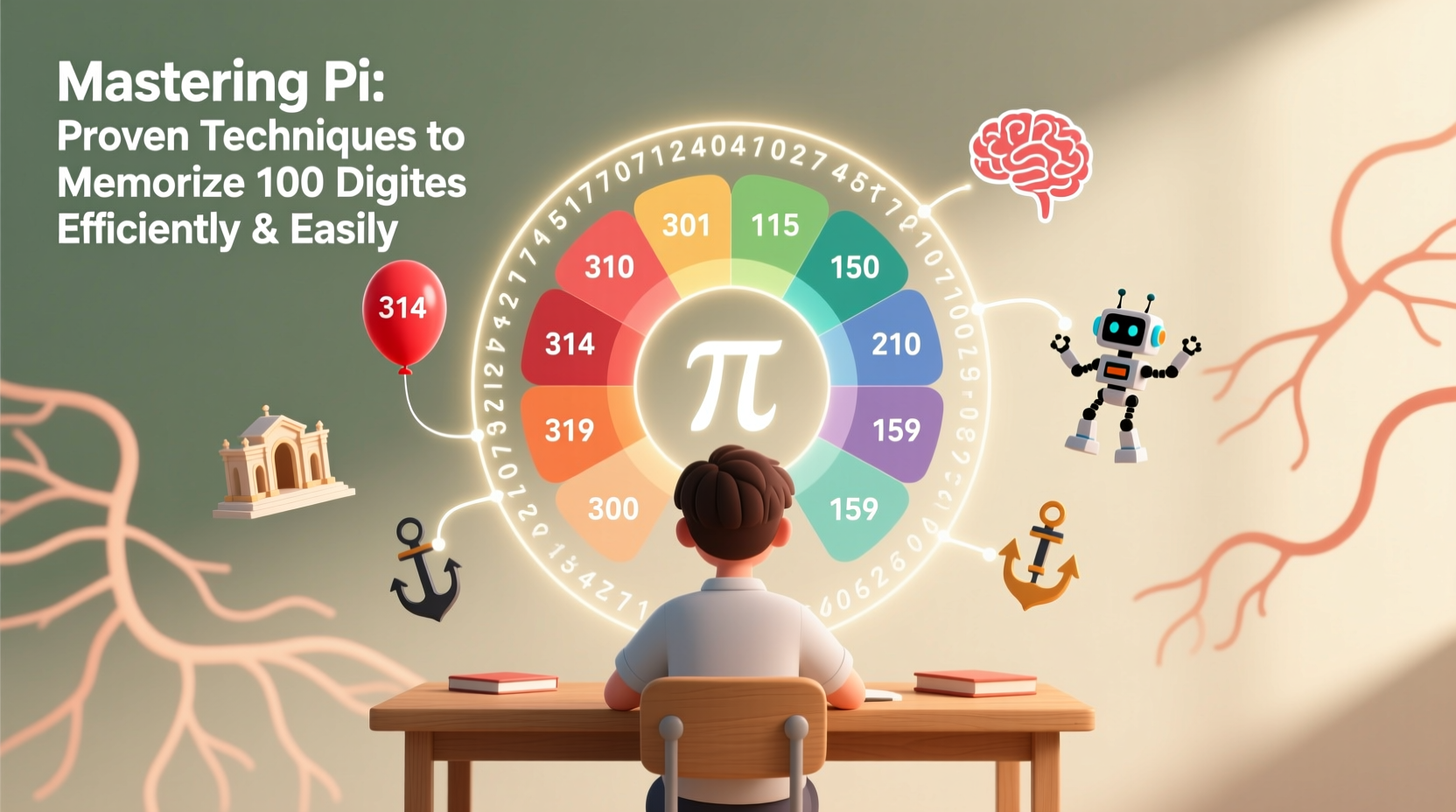
One of the first hurdles in memorizing long sequences is the limitation of short-term memory. Cognitive research shows that most people can hold about 7±2 items in working memory at once. To overcome this, the technique of chunking is essential. Instead of trying to remember 100 individual digits, group them into meaningful clusters—typically sets of 4, 5, or 10 digits.
For example, rather than seeing:
3.1415926535...
You’d break it into:
3.1415 | 9265 | 3589 | 7932 | 3846...
This reduces the total number of units from 100 to around 20–25, making it far easier to manage. Over time, these chunks become familiar, almost like words in a vocabulary list.
Building a Memory Palace: The Ancient Art of Loci
The memory palace technique, also known as the method of loci, dates back to ancient Greece and Rome. Orators like Cicero used it to deliver lengthy speeches without notes. Modern memory champions still rely on it to memorize decks of cards, names, and yes—long strings of numbers like pi.
The idea is simple: associate each chunk of digits with a vivid image, then place those images along a familiar route in your mind—like walking through your home. Each room or object becomes a “hook” for retrieval.
Here’s how to apply it:
- Choose a familiar path (e.g., your front door → hallway → kitchen → bedroom).
- Convert digit groups into images using a number encoding system (see below).
- Place one image per location in sequence.
- Walk through the route mentally to recall the digits.
For instance, if the first chunk is “1415,” you might encode “14” as “door” and “15” as “doll” (using the Major System), then visualize a giant doll slamming a door in your entryway. The more absurd or emotional the image, the better it sticks.
“Top memorizers don’t have better memories—they use better systems.” — Dr. Boris Konrad, Cognitive Neuroscientist and Memory Researcher
Encoding Numbers: The Major System Explained
To convert numbers into memorable images, many use the Major System, a phonetic code that maps digits to consonant sounds. Vowels are used freely to form words. Here's a simplified version:
| Digit | Sound | Example Words |
|---|---|---|
| 0 | s, z | sun, zero, hose |
| 1 | t, d | tie, day, hot |
| 2 | n | noah, knee, hen |
| 3 | m | ma, moon, ham |
| 4 | r | ray, car, arrow |
| 5 | l | law, light, ball |
| 6 | j, sh, ch | shoe, chew, edge |
| 7 | k, g | key, cow, cake |
| 8 | f, v | fee, leaf, cave |
| 9 | p, b | bee, pipe, rope |
Using this system, “31” becomes “m-t” → “mat,” “mitt,” or “moat.” “89” becomes “f-p” → “foam pipe” or “vip.” With practice, you can instantly generate strong visual associations for any two-digit number.
Apply this to pi: take “31415” → “3=m, 1=t, 4=r, 1=t, 5=l” → “meter toll” → picture a taxi meter charging you under a toll bridge. Now that’s memorable.
Step-by-Step Guide to Memorizing 100 Digits in 7 Days
Success comes not from intensity, but consistency. Follow this realistic timeline to internalize 100 digits of pi in under a week:
- Day 1: Learn the first 10 digits using chunking. Practice recalling them aloud every hour.
- Day 2: Add the next 10 digits. Begin linking them to locations in a memory palace (e.g., front yard, porch, door).
- Day 3: Introduce the Major System. Encode digits 21–40 and place them in your mental journey.
- Day 4: Review digits 1–40. Walk through your memory palace twice daily.
- Day 5: Tackle digits 41–70. Focus on creating vivid, exaggerated scenes.
- Day 6: Add digits 71–100. Run full recall three times with eyes closed.
- Day 7: Full review. Write all 100 digits from memory. Repeat after 12 hours to test retention.
After Day 7, continue weekly reviews to move the information into long-term memory. Spaced repetition is key—recall at increasing intervals to strengthen neural pathways.
Real Example: How Sarah Memorized 100 Digits in 6 Days
Sarah, a high school math teacher, wanted to inspire her students by demonstrating that “math isn’t just logic—it’s creativity.” She had no prior memory training but committed to 25 minutes a day using the memory palace and Major System.
She started by mapping her apartment: front door = 3.1415, couch = 9265, coffee table = 3589, and so on. For “7932,” she imagined a giant comb (79) brushing a lion (32) on her kitchen counter. The absurdity made it unforgettable.
By Day 6, she could recite all 100 digits flawlessly in front of her class. Her students were amazed—and more engaged in learning. “It wasn’t magic,” she said later. “It was just a system I followed every day.”
Common Pitfalls and How to Avoid Them
Even with great techniques, progress can stall. Here are frequent mistakes and solutions:
| Pitfall | Solution |
|---|---|
| Relying solely on rote repetition | Use imagery and spatial association instead |
| Skipping review sessions | Schedule daily 10-minute recalls |
| Creating weak or generic images | Make them bizarre, emotional, or humorous |
| Trying to memorize too fast | Limit new digits to 10–20 per session |
| Neglecting sleep and hydration | Memory consolidation happens during rest |
“The brain remembers stories, not spreadsheets.” — Dr. Lynne Kelly, author of *The Memory Code*
Frequently Asked Questions
Can anyone memorize 100 digits of pi?
Absolutely. While natural aptitude varies, the techniques used by memory experts are learnable skills, not innate gifts. With structured practice, most people can achieve this within a week or two.
What if I forget a chunk mid-sequence?
If you blank, return to the last solid anchor point—usually a major location in your memory palace. Don’t panic; pause, visualize the scene, and let the image trigger the number. Over time, gaps will shrink.
Is there a benefit beyond the challenge itself?
Yes. Training your memory improves focus, concentration, and confidence. It strengthens neural plasticity and can enhance performance in academics, public speaking, and problem-solving.
Final Checklist: Your Path to 100 Digits
- ✅ Break pi into 5-digit chunks
- ✅ Choose a memory palace (your home, commute, etc.)
- ✅ Learn the Major System for number-to-image conversion
- ✅ Create vivid, unusual images for each chunk
- ✅ Place images along your mental journey
- ✅ Practice daily recall (morning and night)
- ✅ Review after 24 hours, then weekly
- ✅ Stay patient and trust the process
Conclusion
Memorizing 100 digits of pi is not about raw intelligence—it’s about strategy, discipline, and imagination. By leveraging chunking, the memory palace, and the Major System, you turn a daunting task into a series of creative, engaging steps. The journey itself trains your brain in ways that extend far beyond numbers.
Start today. Pick your first five digits. Build your first image. Walk through your memory palace. Small steps compound into extraordinary results. Once you’ve mastered 100 digits, you’ll realize something deeper: your mind is capable of far more than you thought.




 浙公网安备
33010002000092号
浙公网安备
33010002000092号 浙B2-20120091-4
Comments
No comments yet. Why don't you start the discussion?