
Quartz watches are celebrated for their accuracy, durability, and low maintenance. Unlike mechanical timepieces, they rely on a battery-powered quartz crystal oscillator to keep precise time. Yet even the most reliable quartz watch requires correct setup to function optimally. Misaligned time or date settings not only affect usability but can also lead to long-term complications, especially in watches with calendar mechanisms. This guide walks you through the process of setting your quartz watch with confidence, ensuring both short-term accuracy and long-term performance.
Understanding Your Quartz Watch Mechanism
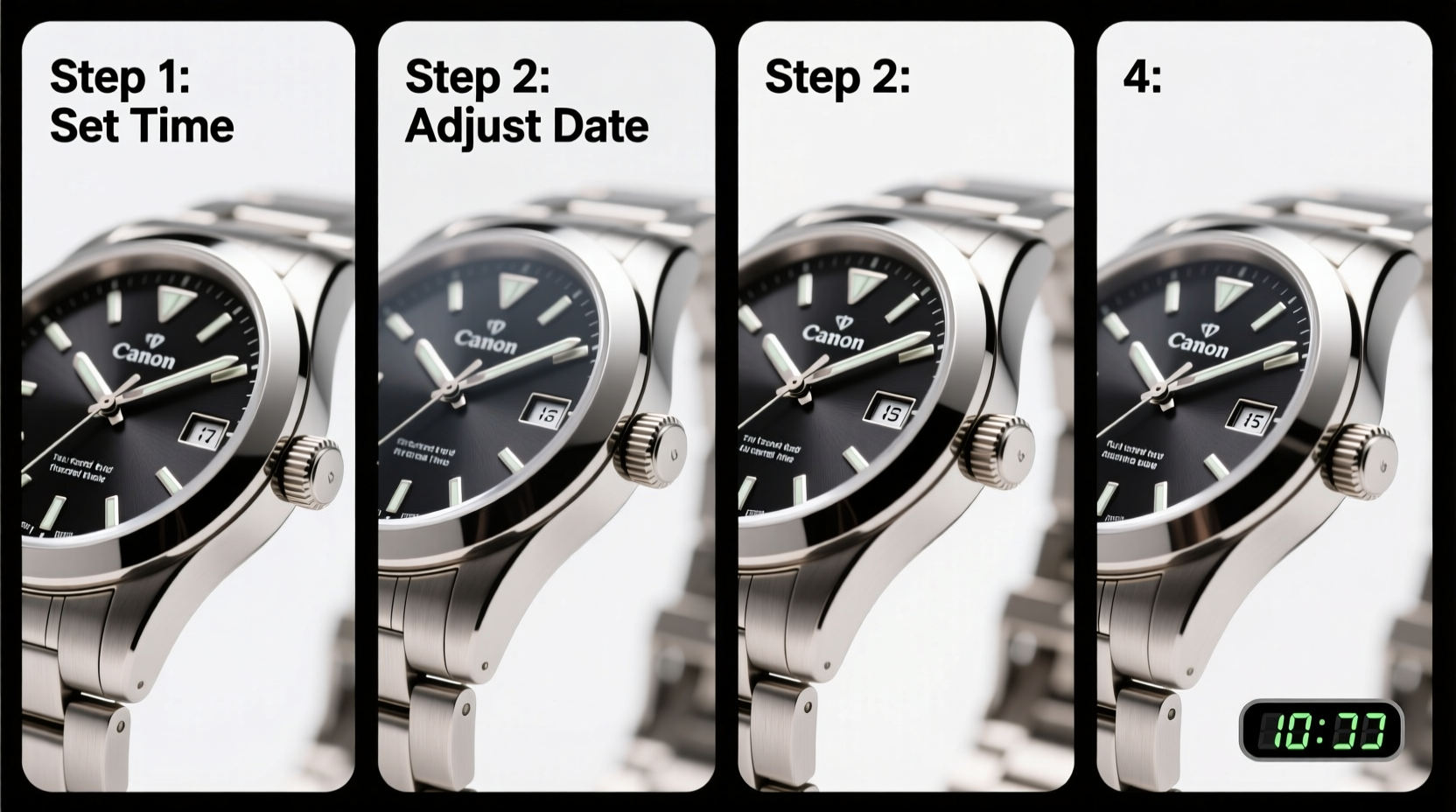
Before adjusting your watch, it's essential to understand how it works. A quartz movement uses a small electric current from the battery to vibrate a tiny quartz crystal at 32,768 times per second. These vibrations are counted and converted into one-second pulses, driving the motor that moves the hands. The date wheel, if present, advances once every 24 hours—typically around midnight.
Most quartz watches feature a crown (the small knob on the side) with two or three positions:
- Position 0 (Pushed In): Normal operation — the watch runs as usual.
- Position 1 (First Pull): Often used to adjust the date (if applicable).
- Position 2 (Second Pull): Used to set the time, which may also advance the date depending on direction.
Some models have additional features like day-of-the-week adjustment or 24-hour subdials, so always refer to your user manual when possible.
Step-by-Step Guide to Setting Time and Date
Follow this sequence to set your quartz watch correctly without risking mechanical strain.
- Check the Current Time: Use a trusted source like an atomic clock website or smartphone to verify the exact time.
- Pull the Crown to Position 2: Gently pull the crown out to its furthest position to access the time-setting mode.
- Adjust the Hour and Minute Hands: Rotate the crown clockwise until the hands reach the correct time. Note that each full rotation typically moves the minute hand 60 minutes.
- Set the Date (If Needed): Once the time is close, push the crown back to Position 1 to adjust the date. Turn the crown counterclockwise or clockwise, depending on your model, to advance or retreat the date display.
- Finalize the Time: Return to Position 2 and fine-tune the time so the seconds align precisely with a reference signal. When the external clock hits the next minute, push the crown back in.
This method ensures that the date mechanism isn’t stressed during transition periods and allows for millisecond-level accuracy.
Common Mistakes and How to Avoid Them
Even experienced users make errors when setting quartz watches. Awareness of these pitfalls can prevent unnecessary wear or misalignment.
| Mistake | Why It’s Problematic | Solution |
|---|---|---|
| Changing date at night | Internal gears are engaged; forcing change causes damage | Wait until morning or set time past noon first |
| Over-rotating the crown | Can strip threading or misalign components | Turn smoothly and stop when resistance increases |
| Ignoring AM/PM when setting | Date may flip at noon instead of midnight | Ensure 24-hour cycle alignment by checking day/night context |
| Using wet hands or tools | Moisture compromises water resistance | Always use dry fingers; avoid pliers or sharp objects |
“Many service issues we see stem from incorrect date adjustments. Waiting just a few hours to avoid the 9 PM–3 AM window saves years of wear.” — Daniel Reyes, Master Watch Technician, SwissTime Repairs
Mini Case Study: Recovering from a Misaligned Calendar
Sarah, a teacher from Portland, noticed her quartz watch was showing the wrong date every evening. She had been changing the date late at night after grading papers, often around 10:30 PM. After three months, the date stopped advancing altogether.
She brought it to a local jeweler, who diagnosed a jammed date jumper—a small spring-loaded part responsible for advancing the date disc. The technician explained that repeated adjustment during the transition phase had worn down the gear teeth. After a minor repair and cleaning, the watch worked again—but Sarah now sets her time earlier in the day and avoids touching the date function after 7 PM.
This real-world example underscores why timing matters as much as technique.
Pro Tips for Long-Term Accuracy
Beyond daily setting, maintaining your quartz watch ensures lasting reliability. Consider these expert-backed practices:
- Reset after battery replacement: Always recheck time and date after a new battery is installed, as power loss resets the system.
- Sync with atomic time: Use radio-controlled or GPS-synced clocks to calibrate your watch monthly for maximum precision.
- Avoid magnetic fields: Keep your watch away from speakers, phones, and laptops, as magnetism can disrupt the stepper motor.
- Wind gently: Even though it’s quartz, rough handling of the crown can damage internal linkages.
FAQ: Frequently Asked Questions
Why does my date change at noon instead of midnight?
This usually means the watch thinks it’s 12 hours off. To fix it, advance the time by exactly 12 hours—either forward or backward—so the internal 24-hour wheel realigns. For example, if it’s 3 PM and the date flips at noon, move the hands to 3 AM, then back to 3 PM.
Can I set the time backwards on a quartz watch?
While many modern quartz watches allow bidirectional setting, older or simpler models may only support forward adjustment. Consult your manual. If unsure, advance the time all the way around rather than turning backward to avoid gear stress.
How often should I replace the battery?
Most quartz batteries last 1–3 years. Signs of a dying battery include the seconds hand jumping in two-second intervals or complete stoppage. Replace it promptly to prevent leakage, which can corrode internal parts.
Essential Checklist for Setting Your Quartz Watch
Use this checklist each time you adjust your timepiece:
- ✅ Confirm the correct current time using a reliable source
- ✅ Ensure the watch has sufficient battery power
- ✅ Avoid adjusting between 9 PM and 3 AM unless absolutely necessary
- ✅ Pull crown gently to correct position (1 for date, 2 for time)
- ✅ Set time first, then adjust date if needed
- ✅ Align seconds with a reference clock before pushing crown back in
- ✅ If applicable, screw crown back down tightly to maintain water resistance
Conclusion: Precision Is Within Reach
Setting a quartz watch properly is more than a routine task—it’s a practice in precision and care. With the right knowledge, you protect not just the accuracy of your timekeeping but also the longevity of a finely engineered instrument. Whether you're wearing a classic Seiko, a modern Casio, or a designer Citizen, taking a few deliberate steps ensures your watch remains a reliable companion for years.




 浙公网安备
33010002000092号
浙公网安备
33010002000092号 浙B2-20120091-4
Comments
No comments yet. Why don't you start the discussion?