
In a world where knowledge evolves at breakneck speed, the ability to learn rapidly isn’t just an advantage—it’s a necessity. Whether you're preparing for exams, upskilling for a new job, or simply expanding your intellectual horizons, mastering the art of rapid learning can dramatically improve your efficiency and long-term retention. The good news? Speed and depth of learning aren’t fixed traits. With the right strategies—rooted in cognitive science and real-world application—anyone can accelerate their learning curve and remember more.
The Science Behind Rapid Learning
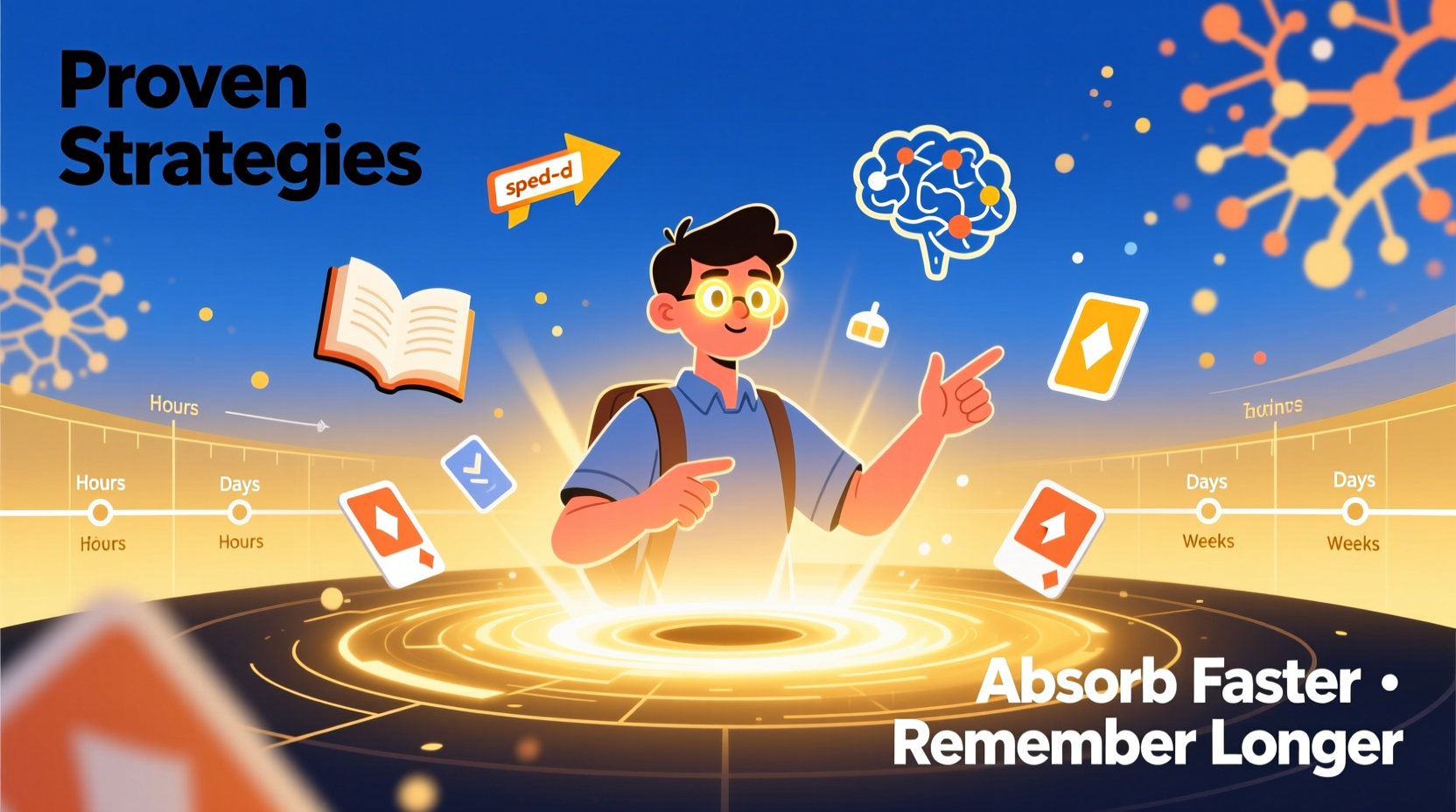
Rapid learning doesn’t mean skimming or memorizing superficially. It means optimizing how your brain processes, stores, and retrieves information. Cognitive psychology reveals that effective learning hinges on three key phases: encoding (how information is absorbed), consolidation (how it’s stabilized in memory), and retrieval (how it’s recalled when needed).
Neuroplasticity—the brain's ability to reorganize itself by forming new neural connections—plays a central role. When you engage in deliberate, structured learning, you strengthen synaptic pathways, making future recall faster and more accurate. Techniques like spaced repetition and active recall directly leverage these mechanisms, turning fleeting exposure into lasting knowledge.
“Learning is not about how much you cover in a day. It’s about how well you understand and remember what you’ve learned.” — Dr. Barbara Oakley, Professor of Engineering and Author of *A Mind for Numbers*
Proven Strategies for Faster Absorption
To absorb information quickly, you must shift from passive reading to active engagement. Here are the most effective methods:
1. Use the Feynman Technique
Named after physicist Richard Feynman, this method involves explaining a concept in simple terms as if teaching it to a child. If you can’t simplify it, you don’t truly understand it. This process forces clarity and exposes gaps in knowledge.
2. Chunk Information
The human working memory holds about 4–7 items at once. “Chunking” breaks complex information into meaningful groups. For example, remembering a phone number as three chunks (e.g., 555-867-5309) instead of ten digits makes it easier to process and store.
3. Leverage Dual Coding
Combine verbal and visual information. When you pair words with diagrams, sketches, or mental imagery, you create multiple memory pathways. A study published in the *Journal of Educational Psychology* found that students who used dual coding recalled 50% more information than those who relied on text alone.
Retention That Lasts: How to Remember More
Fast learning is pointless without retention. These evidence-based strategies ensure knowledge sticks:
Spaced Repetition
Instead of cramming, review material at increasing intervals. Tools like Anki or Quizlet automate this process, showing you flashcards just before you’re likely to forget them. Research shows spaced repetition improves long-term retention by up to 200% compared to massed practice.
Active Recall
Test yourself regularly. Rather than re-reading notes, close the book and ask: What were the key points? Can I explain this process step-by-step? Active recall strengthens memory retrieval and identifies weak areas.
Sleep and Consolidation
Sleep isn’t downtime—it’s when your brain consolidates memories. A 2020 study in *Nature Neuroscience* found that participants who slept after learning retained 40% more information than those who stayed awake. Prioritize 7–9 hours of quality sleep, especially after intensive learning sessions.
Step-by-Step Guide to Building a Rapid Learning Routine
Follow this daily framework to integrate rapid learning into your life:
- Set a clear goal: Define exactly what you want to learn and why. Specific goals increase motivation and focus.
- Preview the material: Skim headings, summaries, and questions first. This primes your brain for deeper processing.
- Engage actively: Read in short bursts (25–30 minutes), pausing to summarize aloud or write key ideas in your own words.
- Apply immediately: Solve a problem, teach someone else, or write a short explanation. Application deepens understanding.
- Schedule reviews: Use a calendar to plan reviews at 1 day, 3 days, 1 week, and 1 month after initial learning.
Common Pitfalls and How to Avoid Them
Even motivated learners fall into traps that sabotage progress. Recognize and avoid these mistakes:
| Pitfall | Why It Hurts Learning | Better Alternative |
|---|---|---|
| Cramming | Overloads working memory; leads to fast forgetting | Use spaced repetition over several days |
| Passive highlighting | Gives illusion of mastery without deep processing | Replace with self-quizzing and summarization |
| Multitasking | Divides attention, reducing comprehension by up to 40% | Practice single-tasking in distraction-free zones |
| Skipping reflection | Misses opportunity to connect new knowledge to existing schema | Spend 5 minutes journaling key takeaways after each session |
Real-World Example: From Overwhelmed to Mastery in 3 Weeks
Consider Sarah, a marketing professional transitioning into data analytics. Faced with learning SQL, Python, and statistics in a short timeframe, she initially tried watching endless tutorial videos—only to feel overwhelmed and forgetful.
She shifted tactics: she began using the Feynman Technique to explain concepts to herself, created flashcards for syntax rules with Anki, and practiced coding challenges daily. She scheduled 25-minute focused blocks followed by 5-minute breaks (Pomodoro technique) and reviewed material every other day.
Within three weeks, she completed a certification and applied her skills to real company datasets. Her retention improved so significantly that she could write queries from memory without referencing guides.
Essential Checklist for Rapid Learners
- ☑ Define a specific learning objective for each session
- ☑ Break content into manageable chunks
- ☑ Use active recall through self-testing or flashcards
- ☑ Apply new knowledge immediately through exercises or teaching
- ☑ Schedule spaced review sessions (1 day, 3 days, 1 week)
- ☑ Get 7+ hours of sleep after intensive learning
- ☑ Eliminate distractions during study periods
- ☑ Reflect daily: What did I learn? How does it connect?
Frequently Asked Questions
Can anyone become a rapid learner, or is it a natural talent?
Rapid learning is a skill, not an innate gift. While some people have advantages, research consistently shows that strategy matters far more than raw intelligence. With deliberate practice and the right techniques, anyone can significantly improve their learning speed and retention.
How long does it take to see results from these strategies?
Many learners report noticeable improvements within 1–2 weeks. You’ll likely find that you grasp concepts faster, need fewer repetitions, and recall information more confidently. Long-term gains compound over months of consistent application.
Is multitasking ever helpful when learning?
No. Cognitive load theory confirms that the brain cannot effectively focus on multiple complex tasks simultaneously. Multitasking reduces comprehension, increases errors, and slows overall progress. Single-tasking with full attention yields superior results.
Take Control of Your Learning Journey
Mastering rapid learning isn’t about pushing harder—it’s about working smarter. By aligning your methods with how the brain naturally learns, you transform effort into results. The strategies outlined here—spaced repetition, active recall, chunking, dual coding, and deliberate reflection—are not shortcuts, but proven pathways to deeper, faster, and longer-lasting understanding.
You don’t need more time. You need better techniques. Start small: pick one strategy, apply it consistently for a week, and observe the difference. Then build from there. Knowledge is power—but only if you can access it when it matters. Begin today, and make every minute of learning count.




 浙公网安备
33010002000092号
浙公网安备
33010002000092号 浙B2-20120091-4
Comments
No comments yet. Why don't you start the discussion?