
Drawing a realistic human eye is often considered one of the most challenging yet rewarding skills in figurative art. The eye conveys emotion, focus, and identity—making it a focal point in portraits. For beginners, the complexity of its structure, subtle gradients, and reflective highlights can be intimidating. However, with structured practice and an understanding of key anatomical and artistic principles, anyone can learn to draw convincing, lifelike eyes. This guide breaks down the process into manageable steps, offering practical techniques, common pitfalls to avoid, and expert-backed insights to accelerate your progress.
Anatomy of the Eye: Understanding the Foundation
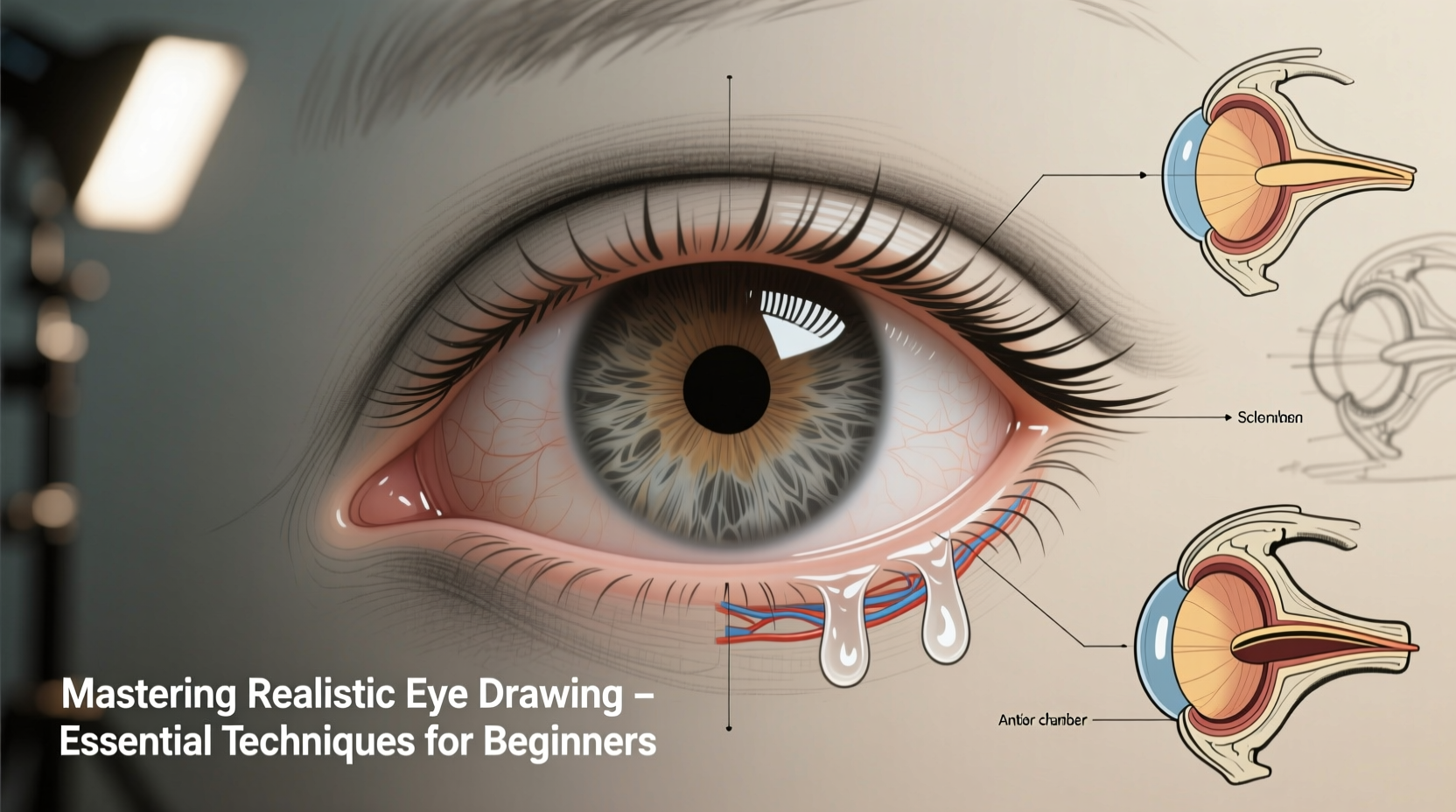
Before putting pencil to paper, it's crucial to understand the basic anatomy of the eye. While artistic stylization allows for interpretation, realism depends on accurate proportions and structural awareness. The eye isn't just a circle—it’s embedded in the skull, surrounded by muscles, eyelids, lashes, and brows that all influence its appearance.
The visible portion includes the cornea (the clear front surface), the iris (colored part), the pupil (central black opening), and the sclera (white of the eye). Above and below, the upper and lower eyelids form protective folds with slight thickness. Eyelashes grow from both lids, curving outward, and the tear duct occupies the inner corner. The outer corner, or lateral canthus, tapers slightly upward.
Understanding how these elements sit within the orbital cavity helps prevent flat, floating eyes. The eyeball itself is spherical and sits behind the orbital rim, meaning only about half of it is visible. The upper eyelid typically covers more of the iris than the lower lid, especially when the eye is open naturally.
Step-by-Step Guide to Drawing a Realistic Eye
Follow this structured approach to build a realistic eye from scratch. Each stage builds upon the last, allowing you to refine details progressively.
- Sketch the Basic Shape: Begin with a horizontal almond shape. Avoid perfect symmetry; real eyes have subtle irregularities. Lightly mark the centerline to align the iris and pupil later.
- Define the Eyelids: Draw the upper and lower lid curves. The upper lid has a more pronounced arch, especially near the center. Indicate where the lid touches the iris—usually at the top third.
- Add the Iris and Pupil: Place a circle within the eye shape, ensuring it aligns with the gaze direction. The pupil should sit perfectly centered in the iris. Leave a small white highlight to suggest reflection.
- Outline Eyelashes: Draw individual lashes starting from the lid edges. Upper lashes are longer, thicker, and curve upward; lower lashes are shorter and sparser. Avoid drawing them as a solid line.
- Shade the Iris: Use circular strokes to create texture. Add radial lines or speckles depending on the eye color. Keep the area near the pupil darker and gradually lighten toward the edge.
- Model the Sclera: Shade gently around the iris to show curvature. The sclera isn’t pure white—add faint shadows beneath the lids and near the corners.
- Render Depth with Shadows: Add cast shadows from the upper lid onto the iris and sclera. Include subtle creases above the lid and soft shading along the orbital rim.
- Finalize Highlights: Preserve or erase small areas for reflections—one primary highlight on the cornea and possibly a secondary one. These bring life and wetness to the eye.
“Observation is the artist’s most powerful tool. Spend time studying real eyes—their asymmetry, moisture, and micro-shadows make all the difference.” — Daniel Park, Portrait Artist and Instructor
Essential Shading Techniques for Depth and Realism
Shading transforms a flat sketch into a dimensional, living eye. Mastery lies not in heavy contrast but in controlled gradation and precision.
Start with a light touch using an HB or 2B pencil. Build up values slowly, focusing on transitions rather than abrupt changes. The cornea is convex, so light wraps around it, creating a smooth gradient from highlight to shadow. Use blending stumps or tissue to soften edges, but avoid over-blending, which can flatten the form.
Key shadow areas include:
- The fold of the upper eyelid casting a soft shadow over the iris
- The space between the eyeball and lower lid, often slightly darker
- The inner corner (lacrimal caruncle), which tends to be warm-toned and shadowed
- The brow ridge, which adds overhead context and framing
For the iris, use a combination of circular hatching and stippling to mimic natural texture. Vary pressure to suggest depth—darker near the pupil, lighter at the periphery. A well-rendered iris appears to sit within the eye, not float on the surface.
Common Mistakes and How to Avoid Them
Even experienced artists fall into traps when drawing eyes. Recognizing these early prevents bad habits.
| Mistake | Why It’s Problematic | Solution |
|---|---|---|
| Symmetrical eyes | Real eyes vary slightly in size, shape, and openness | Use references; allow natural asymmetry in your sketches |
| Over-darkened irises | Can make the eye look dead or sunken | Preserve mid-tones and highlights; eyes are moist and reflective |
| Flat eyelids | Lack of volume makes the eye appear two-dimensional | Add subtle creases and soft shading to suggest skin folds |
| Uniform eyelash lines | Looks unnatural and cartoonish | Draw individual lashes with varying lengths and directions |
| Ignoring the orbital context | Eye appears disconnected from the face | Include brow, cheekbone, and nose bridge in your composition |
Checklist for Beginners: Mastering Eye Drawing
Use this checklist during each practice session to ensure comprehensive development:
- ✅ Studied reference images from multiple angles
- ✅ Sketched the almond shape with natural asymmetry
- ✅ Aligned the iris and pupil correctly with the gaze
- ✅ Added a reflection highlight on the cornea
- ✅ Used circular strokes for textured irises
- ✅ Applied soft shading under the upper lid and inner corner
- ✅ Drew individual eyelashes, not solid lines
- ✅ Preserved the white of the paper for brightest highlights
- ✅ Compared proportions to facial guidelines (e.g., eye halfway down head)
- ✅ Evaluated the drawing in a mirror to catch distortions
Frequently Asked Questions
How do I make the eye look wet and alive?
A wet, lifelike eye relies on strategic highlights and subtle gradients. Leave two small unshaded spots on the cornea—one primary highlight facing the light source, and a smaller secondary one. Avoid over-sharpening; the shine should blend softly into the surrounding tone.
What pencil grades should I use for realistic eyes?
Begin with HB or 2B for light sketching and outlines. Use 2B–4B for mid-tones and iris shading, and 6B for deep shadows like the pupil or upper lid crease. Softer pencils (6B+) allow rich blacks without scratching the paper.
How long does it take to master drawing realistic eyes?
With consistent practice—drawing at least 3–5 eyes per week—most beginners see significant improvement within 4–6 weeks. Mastery, however, evolves over months or years as observational skills deepen. Focus on progress, not perfection.
Conclusion: Start Seeing Like an Artist
Drawing realistic eyes isn’t about replicating a photograph—it’s about learning to see like an artist. Every wrinkle, glint of light, and subtle shift in tone tells a story. By breaking down the eye into manageable components, practicing deliberate shading, and learning from mistakes, you develop not just technical skill but visual intelligence. The eye is more than anatomy; it’s expression, presence, and connection. With patience and persistence, your drawings will begin to capture not just likeness, but life.




 浙公网安备
33010002000092号
浙公网安备
33010002000092号 浙B2-20120091-4
Comments
No comments yet. Why don't you start the discussion?