
Reports are among the most critical tools for communication in business, academia, and government. Whether you're summarizing project outcomes, analyzing data, or recommending strategies, a well-written report can influence decisions, secure funding, or drive change. Yet, many professionals struggle with structure, clarity, and tone—leading to documents that confuse rather than convince. Mastering report writing isn’t about complex jargon; it’s about precision, purpose, and reader-focused delivery. This guide walks through every stage of creating a powerful report, from planning to final polish.
Understand the Purpose and Audience
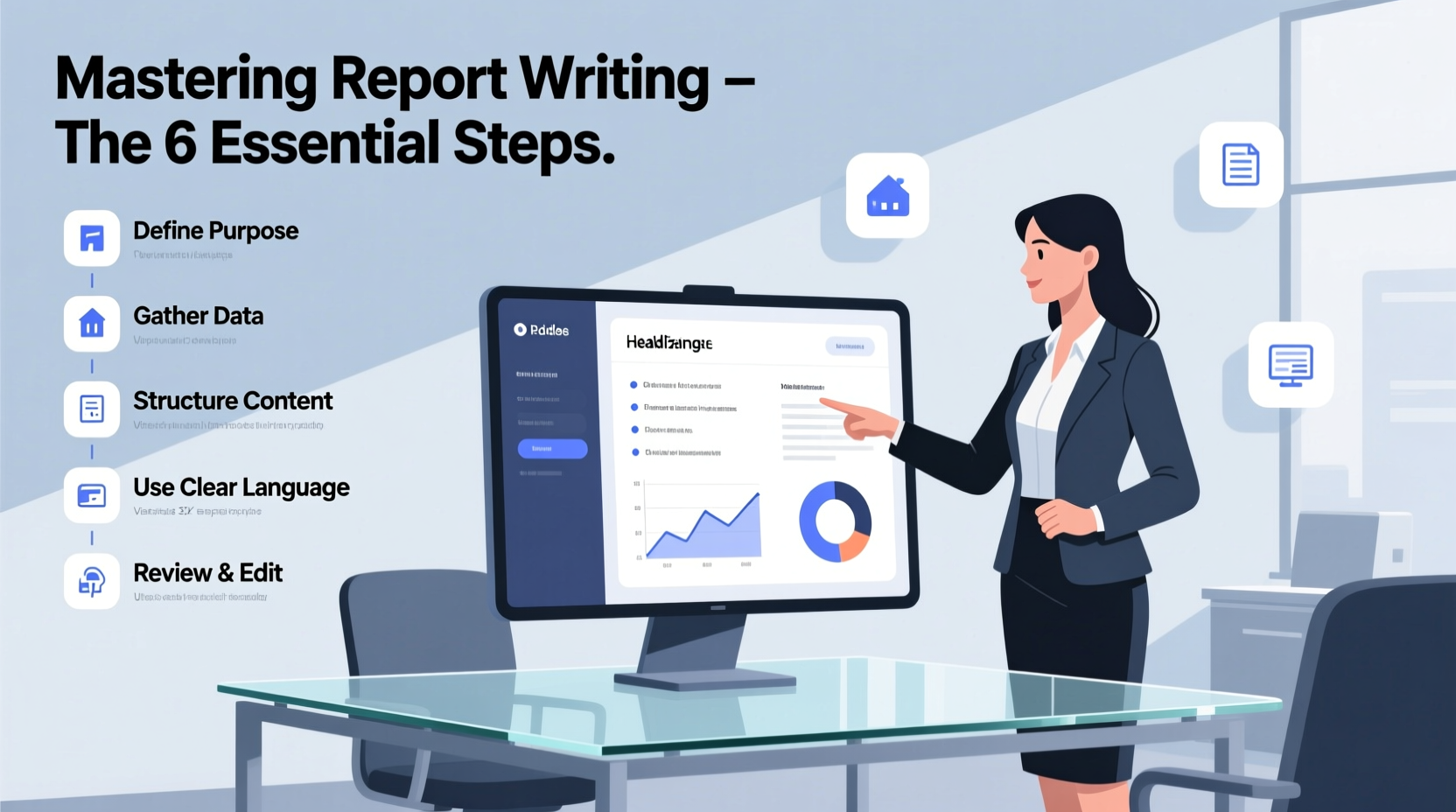
Before writing a single sentence, clarify two essentials: why the report exists and who will read it. A technical audit for engineers demands different language than a summary for executives. Misalignment here leads to information overload—or worse, irrelevance.
Ask yourself:
- What decision will this report support?
- Is the reader looking for detail, or just key takeaways?
- Do they need recommendations, or only facts?
A marketing team reviewing campaign performance may require charts and conversion metrics. A board of directors, however, might prefer an executive summary highlighting ROI and strategic implications. Tailoring content ensures impact.
Follow a Logical Structure
A strong report follows a predictable flow. Readers should never wonder where to find conclusions or data. The standard framework includes:
- Executive Summary
- Introduction
- Methodology (if applicable)
- Findings/Analysis
- Conclusion
- Recommendations
- Appendices (optional)
The executive summary is not an introduction—it's a standalone overview. Busy readers often read only this section. It must capture the problem, method, key findings, and recommended actions in 150–250 words.
The body should follow a \"pyramid principle\": lead with conclusions, then support them with evidence. Avoid burying the main point in paragraphs of background. Each section should answer a specific question: What did we do? What did we find? What should we do next?
Common Structural Pitfalls
| Pitfall | Why It Hurts Clarity | Better Approach |
|---|---|---|
| No clear headings | Readers lose orientation | Use descriptive subheadings (e.g., “Customer Satisfaction Declined 12%”) |
| Data without interpretation | Leaves reader guessing meaning | Pair each chart with a one-sentence insight |
| Recommendations disconnected from findings | Seems arbitrary or unsupported | Link each suggestion directly to evidence |
Write with Clarity and Precision
Professional writing favors simplicity. Avoid passive voice, vague terms like “several” or “a lot,” and redundant phrases such as “in order to.” Instead, use active verbs and concrete language.
Compare:
- Passive: “It was observed that sales were declining.”
- Active: “Sales declined by 8% over six weeks.”
Specific numbers, defined timeframes, and direct statements build credibility. Use technical terms only when necessary—and define them on first use.
“Clarity is kindness in professional writing. If your reader has to guess what you mean, you’ve failed.” — Dr. Lena Patel, Technical Communication Professor, University of Toronto
Step-by-Step Guide to Drafting Your Report
Follow this sequence to maintain focus and efficiency:
- Define the objective: Write down the core question the report answers.
- Gather and organize data: Collect sources, statistics, interviews, or survey results.
- Create an outline: Map sections using the standard structure. Allocate space based on importance.
- Write the findings first: Detail observations before shaping narrative.
- Draft the conclusion and recommendations: Ensure alignment with data.
- Write the executive summary: Summarize everything concisely.
- Revise for logic and flow: Read aloud to catch awkward phrasing.
- Edit for brevity: Cut filler words and repetitive points.
- Proofread: Check spelling, grammar, and formatting consistency.
Real-World Example: Improving Employee Retention
A mid-sized tech company noticed rising turnover. HR compiled exit interviews, engagement surveys, and manager feedback into a report titled “Understanding Voluntary Turnover in 2023.”
Instead of listing raw data, the report opened with: “Voluntary turnover increased from 14% to 23% year-over-year, primarily due to limited career advancement opportunities (cited by 68% of departing employees).”
The analysis linked high attrition in junior developer roles to a lack of mentorship programs. The recommendation proposed launching a formal mentorship initiative within 90 days, projected to reduce turnover by 10–15%.
Leaders approved the program within a week. The clarity of the problem, supported by targeted data and actionable steps, made the case undeniable.
Essential Checklist Before Submission
Use this checklist to ensure your report meets professional standards:
- ✅ Does the title clearly reflect the report’s purpose?
- ✅ Is the executive summary self-contained and under 250 words?
- ✅ Are all sections logically ordered and properly headed?
- ✅ Is every claim supported by data or citation?
- ✅ Do recommendations follow directly from findings?
- ✅ Have all acronyms been defined on first use?
- ✅ Is the tone consistent and free of slang or emotional language?
- ✅ Has the document been spell-checked and formatted uniformly?
- ✅ Are charts labeled and easy to interpret?
- ✅ Is there a contact name or point of follow-up?
Frequently Asked Questions
How long should a report be?
There’s no fixed length—only the right length. Most effective reports range from 3 to 10 pages. Focus on completeness, not volume. If you can convey the message in five pages, don’t stretch it to ten. Executive summaries should never exceed one page.
When should I use visuals?
Use visuals when they clarify or simplify information. A line graph showing quarterly revenue trends is faster to interpret than a paragraph of percentages. Always label axes, include units, and add a brief caption explaining the takeaway. Avoid decorative graphics—they distract.
Can I include personal opinions in a report?
Only if framed as informed judgment backed by evidence. Reports should remain objective. Instead of saying “I believe training is ineffective,” say “Survey results indicate 74% of staff feel current training does not meet their needs, suggesting a redesign is warranted.”
Final Thoughts: Make Every Word Count
A great report doesn’t just transmit information—it drives action. From the precision of its data to the strength of its recommendations, every element must serve the reader’s needs. By understanding your audience, structuring logically, writing clearly, and revising ruthlessly, you turn routine documentation into a tool for influence.
Start small: apply these principles to your next memo or project update. Notice how responses improve when clarity replaces confusion. Over time, your reputation as a thoughtful, effective communicator will grow—not because you write more, but because you write better.




 浙公网安备
33010002000092号
浙公网安备
33010002000092号 浙B2-20120091-4
Comments
No comments yet. Why don't you start the discussion?